
JD1,一种破坏细胞膜的小分子,可破坏葡萄球菌细菌持留细胞、生物膜和细胞内感染。
Staphylococcal Bacterial Persister Cells, Biofilms, and Intracellular Infection Are Disrupted by JD1, a Membrane-Damaging Small Molecule.
机构信息
Department of Molecular, Cellular, and Developmental Biology, University of Colorado Boulder, Boulder, Colorado, USA.
出版信息
mBio. 2021 Oct 26;12(5):e0180121. doi: 10.1128/mBio.01801-21. Epub 2021 Oct 12.
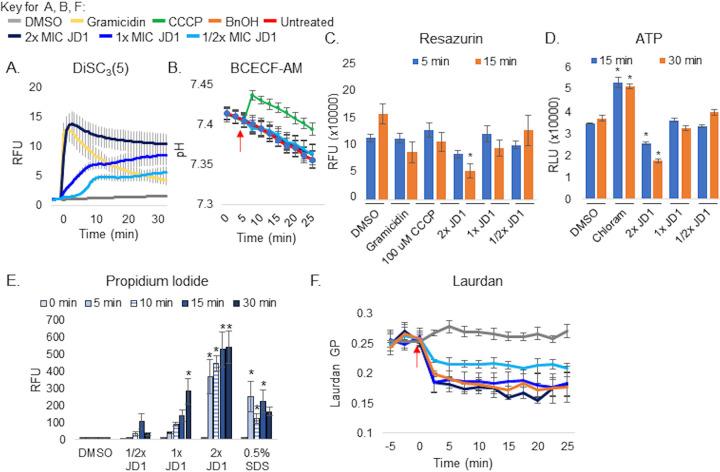
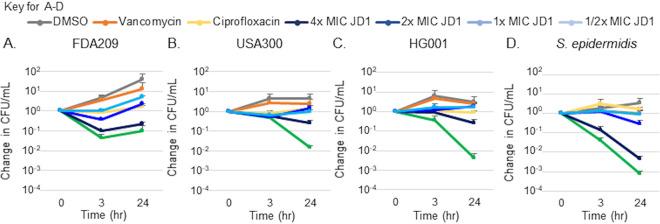
Rates of antibiotic and multidrug resistance are rapidly rising, leaving fewer options for successful treatment of bacterial infections. In addition to acquiring genetic resistance, many pathogens form persister cells, form biofilms, and/or cause intracellular infections that enable bacteria to withstand antibiotic treatment and serve as a source of recurring infections. JD1 is a small molecule previously shown to kill Gram-negative bacteria under conditions where the outer membrane and/or efflux pumps are disrupted. We show here that JD1 rapidly disrupts membrane potential and kills Gram-positive bacteria. Further investigation revealed that treatment with JD1 disrupts membrane barrier function and causes aberrant membranous structures to form. Additionally, exposure to JD1 reduced the number of Staphylococcus aureus and Staphylococcus epidermidis viable persister cells within broth culture by up to 1,000-fold and reduced the matrix and cell volume of biofilms that had been established for 24 h. Finally, we show that JD1 reduced the number of recoverable methicillin-resistant S. aureus organisms from infected cells. These observations indicate that JD1 inhibits staphylococcal cells in difficult-to-treat growth stages as well as, or better than, current clinical antibiotics. Thus, JD1 shows the importance of testing compounds under conditions that are relevant to infection, demonstrates the utility that membrane-targeting compounds have against multidrug-resistant bacteria, and indicates that small molecules that target bacterial cell membranes may serve as potent broad-spectrum antibacterials. Untreatable bacterial infections are a critical public health care issue. In addition to increasing antibiotic resistance, bacteria that are in slow-growing or nongrowing states, or that live inside mammalian cells, are typically insensitive to clinical antibiotics and therefore difficult to eradicate. Bacterial cell membranes have been proposed as potential novel antibiotic targets that may be vulnerable in these difficult to treat cell types because cell membranes are always present and performing essential functions. The small molecule JD1 was previously shown to disrupt Gram-negative bacterial cell membranes. Here, we show that it also disrupts the cell membrane of Gram-positive bacteria and reduces viable bacteria within persister populations, biofilms, and mammalian cells. These observations demonstrate the importance of testing novel compounds under infection-relevant conditions, because their potency against rapidly growing cells may not reveal their full potential.
抗生素和多药耐药率正在迅速上升,这使得成功治疗细菌感染的选择越来越少。除了获得遗传耐药性外,许多病原体还形成了持久性细胞、生物膜和/或引起细胞内感染,使细菌能够耐受抗生素治疗,并成为反复感染的来源。JD1 是一种以前被证明在破坏外膜和/或外排泵的情况下能够杀死革兰氏阴性菌的小分子。我们在这里表明,JD1 能够迅速破坏革兰氏阳性菌的膜电位并杀死它们。进一步的研究表明,用 JD1 处理会破坏膜屏障功能,并导致异常的膜结构形成。此外,暴露于 JD1 可使肉汤培养物中的金黄色葡萄球菌和表皮葡萄球菌的存活持久性细胞数量减少多达 1000 倍,并减少已经建立了 24 小时的生物膜的基质和细胞体积。最后,我们表明,JD1 减少了从感染细胞中回收的耐甲氧西林金黄色葡萄球菌的数量。这些观察结果表明,JD1 抑制了难以治疗的生长阶段的葡萄球菌细胞,并且与当前的临床抗生素一样有效,或者更好。因此,JD1 表明在与感染相关的条件下测试化合物的重要性,证明了靶向膜的化合物对多药耐药菌的有效性,并表明靶向细菌细胞膜的小分子可能成为有效的广谱抗菌药物。无法治疗的细菌感染是一个严重的公共卫生保健问题。除了增加抗生素耐药性外,处于缓慢生长或非生长状态的细菌或生活在哺乳动物细胞内的细菌通常对临床抗生素不敏感,因此难以根除。细菌细胞膜已被提议作为潜在的新型抗生素靶标,因为它们在这些难以治疗的细胞类型中可能容易受到影响,因为细胞膜始终存在并发挥着重要功能。小分子 JD1 以前被证明可以破坏革兰氏阴性菌的细胞膜。在这里,我们表明它也破坏了革兰氏阳性菌的细胞膜,并减少了持久性细胞、生物膜和哺乳动物细胞中存活的细菌数量。这些观察结果表明,在感染相关条件下测试新型化合物的重要性,因为它们对快速生长细胞的效力可能无法揭示其全部潜力。




 Zotero 插件