
右美托咪定联合罗哌卡因用于超声引导竖脊肌平面阻滞延长剖胸术后镇痛时间并减少围术期阿片类药物消耗:一项随机对照临床研究。
Dexmedetomidine Added to Ropivacaine for Ultrasound-guided Erector Spinae Plane Block Prolongs Analgesia Duration and Reduces Perioperative Opioid Consumption After Thoracotomy: A Randomized, Controlled Clinical Study.
机构信息
Department of Anesthesiology, National Cancer Center/National Clinical Research Center for Cancer/Cancer Hospital, Chinese Academy of Medical Sciences and Peking Union Medical College, Beijing.
Department of Anesthesiology, National Cancer Center/National Clinical Research Center for Cancer/Cancer Hospital & Shenzhen Hospital, Chinese Academy of Medical Sciences and Peking Union Medical College, Shenzhen, China.
出版信息
Clin J Pain. 2021 Oct 12;38(1):8-14. doi: 10.1097/AJP.0000000000000992.
OBJECTIVES
Single-injection erector spinae plane block (ESPB) provides good control of pain relief after open thoracotomy surgeries. However, the duration of pain relief does not last long. For this purpose, we hypothesized that adding α2-adrenoceptor agonist, dexmedetomidine, for interfascial nerve blockade may increase the duration of analgesia. There are only few studies using dexmedetomidine for interfasical nerve blocks in humans. In this study, our aim is to investigate whether addition of dexmedetomidine to ropivacaine for ESPB could effectively prolong the duration of postoperative analgesia and reduce opioid consumption after open thoracotomy.
MATERIALS AND METHODS
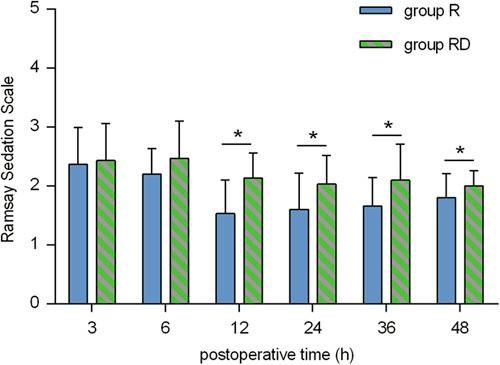
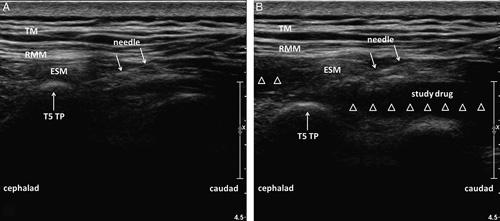
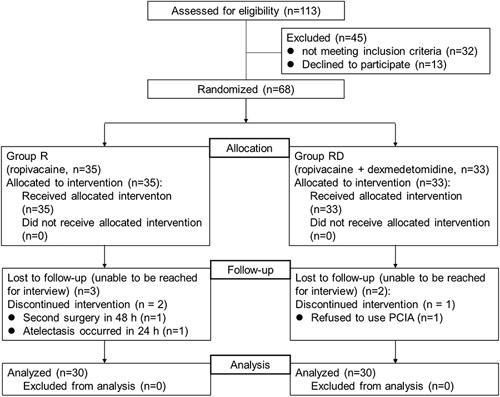
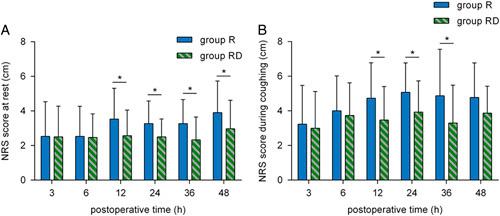
Sixty patients with esophageal cancer were randomized to receive ESPB using 28 mL of 0.5% ropivacaine, with 2 mL of normal saline (group R) or 0.5 µg/kg dexmedetomidine in 2 mL (group RD) administered interfascially. ESPB was performed at the fifth thoracic level under ultrasound guidance. The primary outcome was the duration of analgesia. The secondary outcomes were total postoperative sufentanil consumption, Numeric Rating Scale pain scores, Ramsay Sedation Scale scores and adverse effects.
RESULTS
The duration of analgesia in group RD (505.1±113.9) was longer than that in group R (323.2±75.4) (P<0.001). The total postoperative sufentanil consumption was lower in group RD (23.3±10.0) than in group R (33.8±13.8) (P=0.001). There was no significant difference in the incidence of adverse effects between the 2 groups.
CONCLUSION
After open thoracotomy, addition of dexmedetomidine to ropivacaine for ESPB effectively prolonged the duration of postoperative analgesia and reduced opioid consumption without increasing additional incidence of adverse effects.
目的
单次注射竖脊肌平面阻滞(ESPB)可有效缓解开胸手术后的疼痛,但疼痛缓解时间并不持久。为此,我们假设在筋膜间神经阻滞中加入α2-肾上腺素能受体激动剂右美托咪定可延长镇痛时间。目前仅有少数研究将右美托咪定用于人体筋膜间神经阻滞。本研究旨在探讨在 ESPB 中加入右美托咪定能否有效延长开胸手术后的镇痛时间,并减少阿片类药物的消耗。
材料和方法
60 例食管癌患者随机分为两组,每组 30 例。在超声引导下,于第 5 胸椎水平行 ESPB,分别注入 0.5%罗哌卡因 28ml(组 R)或 0.5%罗哌卡因 2ml 加 0.5μg/kg 右美托咪定(组 RD)。主要观察指标为镇痛时间。次要观察指标为术后舒芬太尼总用量、数字评分量表(NRS)疼痛评分、 Ramsay 镇静评分和不良反应。
结果
组 RD 的镇痛时间(505.1±113.9)明显长于组 R(323.2±75.4)(P<0.001)。组 RD 的术后舒芬太尼总用量(23.3±10.0)明显少于组 R(33.8±13.8)(P=0.001)。两组不良反应发生率无显著差异。
结论
开胸手术后,在 ESPB 中加入右美托咪定可有效延长术后镇痛时间,减少阿片类药物消耗,且不增加不良反应发生率。


 Zotero 插件