
英国医院环境中社区获得性和医院获得性 SARS-CoV-2 的传播:一项队列研究。
Transmission of community- and hospital-acquired SARS-CoV-2 in hospital settings in the UK: A cohort study.
机构信息
Oxford Centre for Global Health Research, Nuffield Department of Medicine, University of Oxford, Oxford, United Kingdom.
Mahidol-Oxford Tropical Medicine Research Unit, Faculty of Tropical Medicine, Mahidol University, Bangkok, Thailand.
出版信息
PLoS Med. 2021 Oct 12;18(10):e1003816. doi: 10.1371/journal.pmed.1003816. eCollection 2021 Oct.
BACKGROUND
Nosocomial spread of Severe Acute Respiratory Syndrome Coronavirus 2 (SARS-CoV-2) has been widely reported, but the transmission pathways among patients and healthcare workers (HCWs) are unclear. Identifying the risk factors and drivers for these nosocomial transmissions is critical for infection prevention and control interventions. The main aim of our study was to quantify the relative importance of different transmission pathways of SARS-CoV-2 in the hospital setting.
METHODS AND FINDINGS
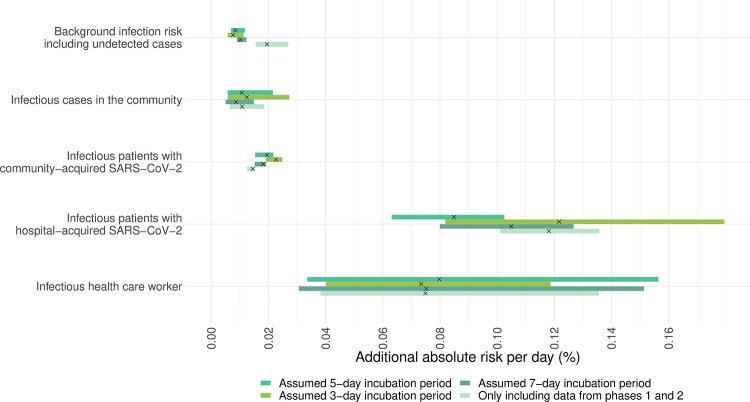
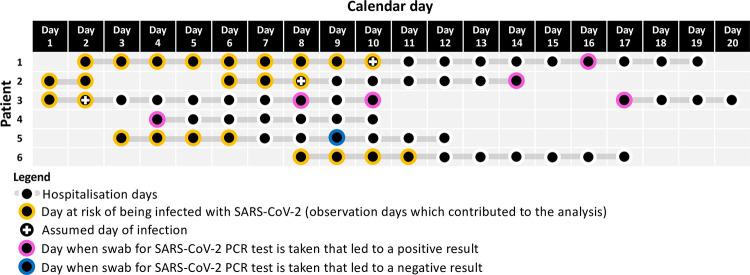
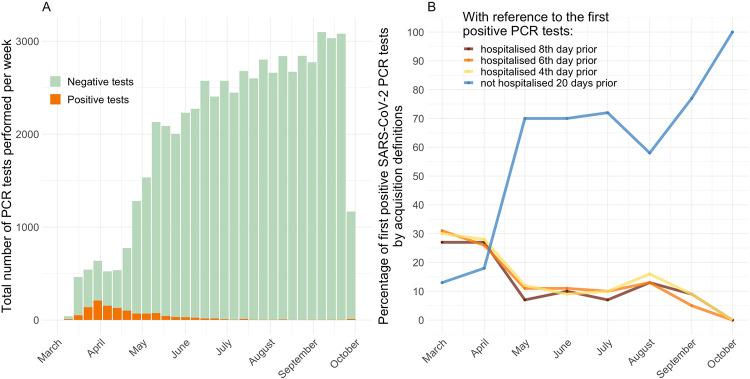
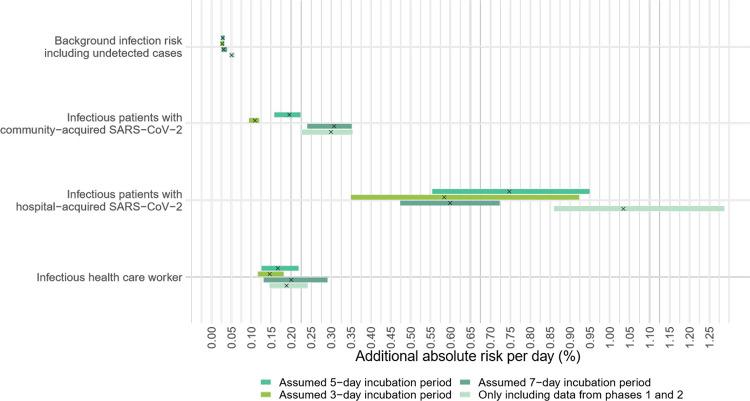
This is an observational cohort study using data from 4 teaching hospitals in Oxfordshire, United Kingdom, from January to October 2020. Associations between infectious SARS-CoV-2 individuals and infection risk were quantified using logistic, generalised additive and linear mixed models. Cases were classified as community- or hospital-acquired using likely incubation periods of 3 to 7 days. Of 66,184 patients who were hospitalised during the study period, 920 had a positive SARS-CoV-2 PCR test within the same period (1.4%). The mean age was 67.9 (±20.7) years, 49.2% were females, and 68.5% were from the white ethnic group. Out of these, 571 patients had their first positive PCR tests while hospitalised (62.1%), and 97 of these occurred at least 7 days after admission (10.5%). Among the 5,596 HCWs, 615 (11.0%) tested positive during the study period using PCR or serological tests. The mean age was 39.5 (±11.1) years, 78.9% were females, and 49.8% were nurses. For susceptible patients, 1 day in the same ward with another patient with hospital-acquired SARS-CoV-2 was associated with an additional 7.5 infections per 1,000 susceptible patients (95% credible interval (CrI) 5.5 to 9.5/1,000 susceptible patients/day) per day. Exposure to an infectious patient with community-acquired Coronavirus Disease 2019 (COVID-19) or to an infectious HCW was associated with substantially lower infection risks (2.0/1,000 susceptible patients/day, 95% CrI 1.6 to 2.2). As for HCW infections, exposure to an infectious patient with hospital-acquired SARS-CoV-2 or to an infectious HCW were both associated with an additional 0.8 infection per 1,000 susceptible HCWs per day (95% CrI 0.3 to 1.6 and 0.6 to 1.0, respectively). Exposure to an infectious patient with community-acquired SARS-CoV-2 was associated with less than half this risk (0.2/1,000 susceptible HCWs/day, 95% CrI 0.2 to 0.2). These assumptions were tested in sensitivity analysis, which showed broadly similar results. The main limitations were that the symptom onset dates and HCW absence days were not available.
CONCLUSIONS
In this study, we observed that exposure to patients with hospital-acquired SARS-CoV-2 is associated with a substantial infection risk to both HCWs and other hospitalised patients. Infection control measures to limit nosocomial transmission must be optimised to protect both staff and patients from SARS-CoV-2 infection.
背景
严重急性呼吸综合征冠状病毒 2 (SARS-CoV-2)的医院内传播已被广泛报道,但患者和医护人员(HCWs)之间的传播途径仍不清楚。确定这些医院内传播的危险因素和驱动因素对于感染预防和控制干预至关重要。我们的主要目的是量化 SARS-CoV-2 在医院环境中的不同传播途径的相对重要性。
方法和发现
这是一项在英国牛津郡 4 所教学医院进行的观察性队列研究,时间为 2020 年 1 月至 10 月。使用逻辑、广义加性和线性混合模型,量化传染性 SARS-CoV-2 个体与感染风险之间的关联。使用可能的潜伏期 3 至 7 天,将病例分类为社区或医院获得性。在研究期间,66184 名住院患者中有 920 名在同期内 SARS-CoV-2 PCR 检测呈阳性(1.4%)。平均年龄为 67.9(±20.7)岁,49.2%为女性,68.5%为白人。在这些患者中,571 名患者在住院期间首次 PCR 检测呈阳性(62.1%),其中 97 例至少在入院后 7 天发生(10.5%)。在 5596 名 HCWs 中,615 名(11.0%)在研究期间使用 PCR 或血清学检测呈阳性。平均年龄为 39.5(±11.1)岁,78.9%为女性,49.8%为护士。对于易感患者,与住院获得性 SARS-CoV-2 的另一位患者在同一病房中接触一天,与每 1000 名易感患者每天额外增加 7.5 例感染有关(95%可信区间(CrI)为 5.5 至 9.5/1000 名易感患者/天)。接触具有社区获得性 2019 年冠状病毒病(COVID-19)的传染性患者或具有传染性的 HCW 与感染风险显著降低有关(2.0/1000 名易感患者/天,95%CrI 为 1.6 至 2.2)。对于 HCW 感染,与具有医院获得性 SARS-CoV-2 的传染性患者或具有传染性的 HCW 接触,与每天每 1000 名易感 HCW 额外增加 0.8 例感染有关(95%CrI 分别为 0.3 至 1.6 和 0.6 至 1.0)。接触具有社区获得性 SARS-CoV-2 的传染性患者的风险低于此风险的一半(0.2/1000 名易感 HCW/天,95%CrI 为 0.2 至 0.2)。敏感性分析检验了这些假设,结果大致相似。主要限制是症状发作日期和 HCW 缺勤日期不可用。
结论
在这项研究中,我们观察到与医院获得性 SARS-CoV-2 接触会对 HCWs 和其他住院患者造成严重的感染风险。必须优化感染控制措施,以保护工作人员和患者免受 SARS-CoV-2 感染。

 Zotero 插件