
智利男女孩童的营养改善之路:19 世纪末至 20 世纪身高年龄 Z 分数的变化。
The Escape from Malnutrition of Chilean Boys and Girls: Height-for-Age Z Scores in Late XIX and XX Centuries.
机构信息
Economics Department, Faculty of Economics and Business, University of Chile, Santiago 832000, Chile.
Inter-American Development Bank, Washington, DC 20577, USA.
出版信息
Int J Environ Res Public Health. 2021 Oct 4;18(19):10436. doi: 10.3390/ijerph181910436.
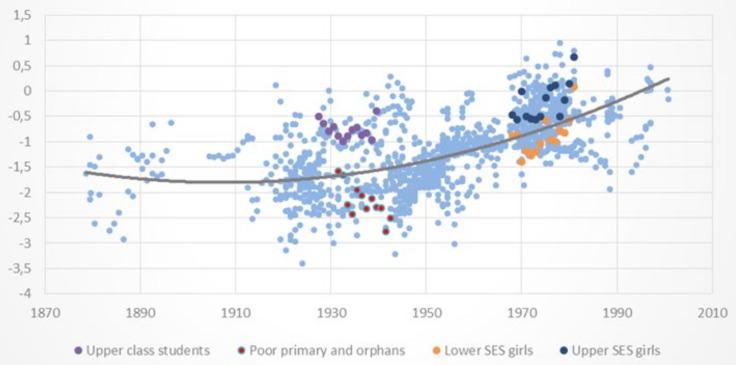
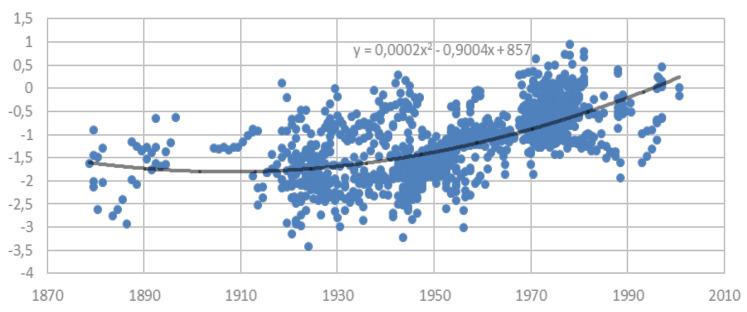
We studied the trends of height-for-age (HAZ) Z scores by socioeconomic status (SES) groups of Chilean boys and girls aged 5-18 born between 1877 and 2001, by performing a meta-analysis of 53 studies reporting height-for-age sample data from which 1258 HAZ score datapoints were calculated using the 2000 reference growth charts for the US of the Centers for Disease Control and Prevention (CDC). We found stagnant mean and median HAZ scores of about -1.55 to -1.75 for the general population, and -2.2 to -2.55 for lower SES groups up to cohorts born in the 1940s. However, we found an upwards structural change in cohorts born after the 1940s, a period in which HAZ scores grew at a pace of about 0.25 to 0.30 HAZ per decade. Since this change happened in a context of moderate Gross Domestic Product (GDP) growth, high and persistent income inequality, and stagnant wages of the working class, we discuss the extent to which our findings are associated with the increase in public social spending and the implementation and expansion of a variety of social policies since the 1940s and early 1950s.
我们研究了智利男女童按社会经济地位(SES)分组的身高年龄(HAZ)Z 分数趋势,这些儿童出生于 1877 年至 2001 年之间,年龄在 5 至 18 岁之间。我们对 53 项研究进行了荟萃分析,这些研究报告了身高年龄的样本数据,从中计算了 1258 个 HAZ 评分数据点,使用的是美国疾病控制与预防中心(CDC)的 2000 年参考生长图表。我们发现,一般人群的平均和中位数 HAZ 评分约为-1.55 至-1.75,SES 较低的群体的 HAZ 评分约为-2.2 至-2.55,直至 20 世纪 40 年代出生的队列。然而,我们发现,20 世纪 40 年代以后出生的队列出现了向上的结构性变化,这一时期 HAZ 评分以每十年 0.25 至 0.30 的速度增长。由于这种变化发生在国内生产总值(GDP)适度增长、高且持续的收入不平等以及工人阶级工资停滞的背景下,我们讨论了我们的发现与自 20 世纪 40 年代和 50 年代初以来公共社会支出的增加以及各种社会政策的实施和扩大之间的关联程度。

 Zotero 插件