
基于循环肿瘤 DNA 测序的生物标志物用于小细胞肺癌患者预测分类器的可行性。
The Feasibility of Using Biomarkers Derived from Circulating Tumor DNA Sequencing as Predictive Classifiers in Patients with Small-Cell Lung Cancer.
机构信息
Department of Medical Oncology, National Cancer Center/National Clinical Research Center for Cancer/Cancer Hospital, Chinese Academy of Medical Sciences & Peking Union Medical College, Beijing, China.
Medical Center, Geneplus-Beijing, Beijing, China.
出版信息
Cancer Res Treat. 2022 Jul;54(3):753-766. doi: 10.4143/crt.2021.905. Epub 2021 Oct 5.
PURPOSE
To investigate the feasibility of biomarkers based on dynamic circulating tumor DNA (ctDNA) to classify small cell lung cancer (SCLC) into different subtypes.
MATERIALS AND METHODS
Tumor and longitudinal plasma ctDNA samples were analyzed by next-generation sequencing of 1,021 genes. PyClone was used to infer the molecular tumor burden index (mTBI). Pre-treatment tumor tissues [T1] and serial plasma samples were collected (pre-treatment [B1], after two [B2], six [B3] cycles of chemotherapy and at progression [B4]).
RESULTS
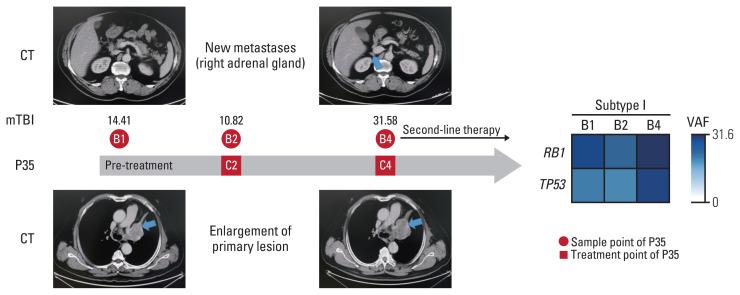
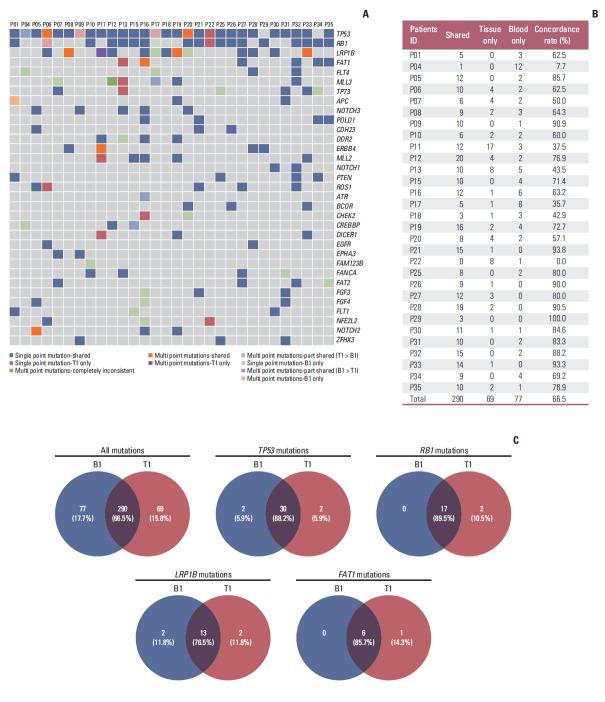
Overall concordance between T1 and B1 sequencing (n=30) was 66.5%, and 89.5% in the gene of RB1. A classification method was designed according to the changes of RB1 mutation, named as subtype Ⅰ (both positive at B1 and B2), subtype Ⅱ (positive at B1 but negative at B2), and subtype Ⅲ (both negative at B1 and B2). The median progressive-free survival for subtype Ⅰ patients (4.5 months [95%CI: 2.6-5.8]) was inferior to subtype Ⅱ (not reached, p<0.0001) and subtype Ⅲ (10.8 months [95%CI: 6.0-14.4], p=0.002). The median overall survival for subtype Ⅰ patients (16.3 months [95%CI: 5.3-22.9]) was inferior to subtype Ⅱ (not reached, p=0.01) and subtype Ⅲ (not reached, p=0.02). Patients with a mTBI dropped to zero at B2 had longer median overall survival (not reached vs. 19.5 months, p=0.01). The changes of mTBI from B4 to B1 were sensitive to predict new metastases, with a sensitivity of 100% and a specificity of 85.7%.
CONCLUSION
Monitoring ctDNA based RB1 mutation and mTBI provided a feasible tool to predict the prognosis of SCLC.
目的
研究基于动态循环肿瘤 DNA(ctDNA)的生物标志物能否将小细胞肺癌(SCLC)分为不同亚型。
材料和方法
对 1021 个基因进行下一代测序,分析肿瘤和纵向血浆 ctDNA 样本。使用 PyClone 推断分子肿瘤负担指数(mTBI)。采集预处理肿瘤组织[T1]和连续血浆样本(预处理[B1],化疗后两个[B2]、六个[B3]周期及进展时[B4])。
结果
T1 和 B1 测序(n=30)的总体一致性为 66.5%,RB1 基因的一致性为 89.5%。根据 RB1 突变的变化设计了一种分类方法,命名为亚型Ⅰ(B1 和 B2 均为阳性)、亚型Ⅱ(B1 阳性而 B2 阴性)和亚型Ⅲ(B1 和 B2 均为阴性)。亚型Ⅰ患者(4.5 个月[95%CI:2.6-5.8])的中位无进展生存期短于亚型Ⅱ(未达到,p<0.0001)和亚型Ⅲ(10.8 个月[95%CI:6.0-14.4],p=0.002)。亚型Ⅰ患者(5.3-22.9)的中位总生存期短于亚型Ⅱ(未达到,p=0.01)和亚型Ⅲ(未达到,p=0.02)。B2 时 mTBI 降至零的患者中位总生存期更长(未达到 vs. 19.5 个月,p=0.01)。从 B4 到 B1 的 mTBI 变化对预测新转移具有敏感性,敏感性为 100%,特异性为 85.7%。
结论
基于 ctDNA 的 RB1 突变和 mTBI 监测为预测 SCLC 预后提供了一种可行的工具。


 Zotero 插件