
遗传性癌症检测后改善照护(IMPACT)研究:一项随机试验的方案,评估两种干预措施在改善癌症风险管理和遗传检测结果的家族沟通方面的效果。
IMProving care After inherited Cancer Testing (IMPACT) study: protocol of a randomized trial evaluating the efficacy of two interventions designed to improve cancer risk management and family communication of genetic test results.
机构信息
College of Public Health, University of South Florida, 13201 Bruce B Downs Boulevard, IDRB 304, Tampa, FL, 33612, USA.
My Gene Counsel, PO Box 612, Branford, CT, 06405, USA.
出版信息
BMC Cancer. 2021 Oct 13;21(1):1099. doi: 10.1186/s12885-021-08822-4.
BACKGROUND
Implementing genetic testing for inherited cancer predisposition into routine clinical care offers a tremendous opportunity for cancer prevention and early detection. However, genetic testing itself does not improve outcomes; rather, outcomes depend on implemented follow-up care. The IMPACT study is a hybrid type I randomized effectiveness-implementation trial to simultaneously evaluate the effectiveness of two interventions for individuals with inherited cancer predisposition focused on: 1) increasing family communication (FC) of genetic test results; and 2) improving engagement with guideline-based cancer risk management (CRM).
METHODS
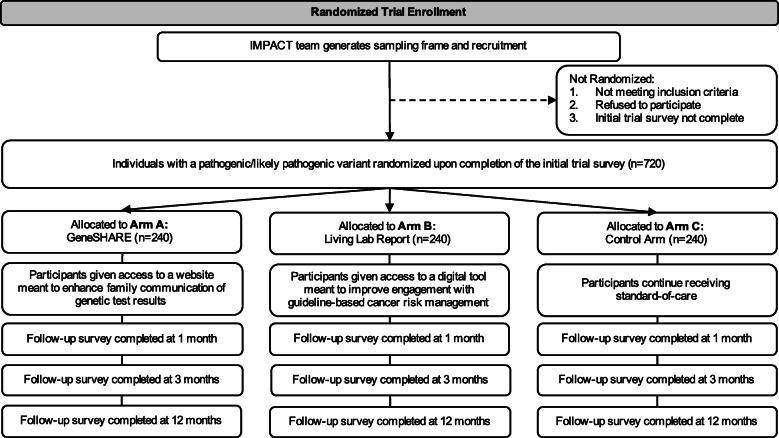
This prospective study will recruit a racially, geographically, and socioeconomically diverse population of individuals with a documented pathogenic/likely pathogenic (P/LP) variant in an inherited cancer gene. Eligible participants will be asked to complete an initial trial survey and randomly assigned to one of three arms: A) GeneSHARE, a website designed to increase FC of genetic test results; B) My Gene Counsel's Living Lab Report, a digital tool designed to improve understanding of genetic test results and next steps, including CRM guidelines; or C) a control arm in which participants continue receiving standard care. Follow-up surveys will be conducted at 1, 3, and 12 months following randomization. These surveys include single-item measures, scales, and indices related to: 1) FC and CRM behaviors and behavioral factors following the COM-B theoretical framework (i.e., capability, opportunity, and motivation); 2) implementation outcomes (i.e., acceptability, appropriateness, exposure, and reach); and 3) other contextual factors (i.e., sociodemographic and clinical factors, and uncertainty, distress, and positive aspects of genetic test results). The primary outcomes are an increase in FC of genetic test results (Arm A) and improved engagement with guideline-based CRM without overtreatment or undertreatment (Arm B) by the 12-month follow-up survey.
DISCUSSION
Our interventions are designed to shift the paradigm by which individuals with P/LP variants in inherited cancer genes are provided with information to enhance FC of genetic test results and engagement with guideline-based CRM. The information gathered through evaluating the effectiveness and implementation of these real-world approaches is needed to modify and scale up adaptive, stepped interventions that have the potential to maximize FC and CRM.
TRIAL REGISTRATION
This study is registered at Clinicaltrials.gov (NCT04763915, date registered: February 21, 2021).
PROTOCOL VERSION
September 17th, 2021 Amendment Number 04.
背景
将遗传性癌症易感性基因检测纳入常规临床护理提供了巨大的癌症预防和早期发现机会。然而,基因检测本身并不能改善结果;相反,结果取决于实施的后续护理。IMPACT 研究是一项混合 I 型随机有效性-实施试验,旨在同时评估两种干预措施对遗传性癌症易感性个体的有效性,重点是:1)增加遗传检测结果的家庭沟通(FC);2)提高基于指南的癌症风险管理(CRM)的参与度。
方法
本前瞻性研究将招募一群具有遗传性癌症基因中已记录的致病性/可能致病性(P/LP)变异的个体,他们具有种族、地理和社会经济多样性。合格的参与者将被要求完成一项初始试验调查,并被随机分配到以下三个组之一:A)GeneSHARE,一个旨在增加遗传检测结果 FC 的网站;B)My Gene Counsel's Living Lab Report,一个旨在提高对遗传检测结果及其后续步骤(包括 CRM 指南)的理解的数字工具;或 C)参与者继续接受标准护理的对照组。随机分组后,将在 1、3 和 12 个月进行随访调查。这些调查包括与以下内容相关的单项措施、量表和指标:1)基于 COM-B 理论框架(即能力、机会和动机)的 FC 和 CRM 行为和行为因素;2)实施结果(即可接受性、适当性、暴露度和可达性);3)其他背景因素(即社会人口学和临床因素以及遗传检测结果的不确定性、痛苦和积极方面)。主要结果是在 12 个月随访调查时增加遗传检测结果的 FC(A 组)和改善基于指南的 CRM 的参与度,而不会出现过度治疗或治疗不足(B 组)。
讨论
我们的干预措施旨在通过提供信息来改变提供遗传性癌症基因中 P/LP 变异个体信息的模式,以增强遗传检测结果的 FC 和基于指南的 CRM 的参与度。通过评估这些真实世界方法的有效性和实施情况收集的信息,对于修改和扩大具有最大 FC 和 CRM 潜力的适应性、阶梯式干预措施是必要的。
试验注册
本研究在 Clinicaltrials.gov 注册(NCT04763915,注册日期:2021 年 2 月 21 日)。
方案版本
2021 年 9 月 17 日第 04 次修订
 Zotero 插件