
微塑料作为印度环境中的污染物:综述。
Microplastics as contaminants in Indian environment: a review.
机构信息
University School of Environment Management, Guru Gobind Singh Indraprastha University, Dwarka Sector 16C, New Delhi, 110078, India.
出版信息
Environ Sci Pollut Res Int. 2021 Dec;28(48):68025-68052. doi: 10.1007/s11356-021-16827-6. Epub 2021 Oct 14.
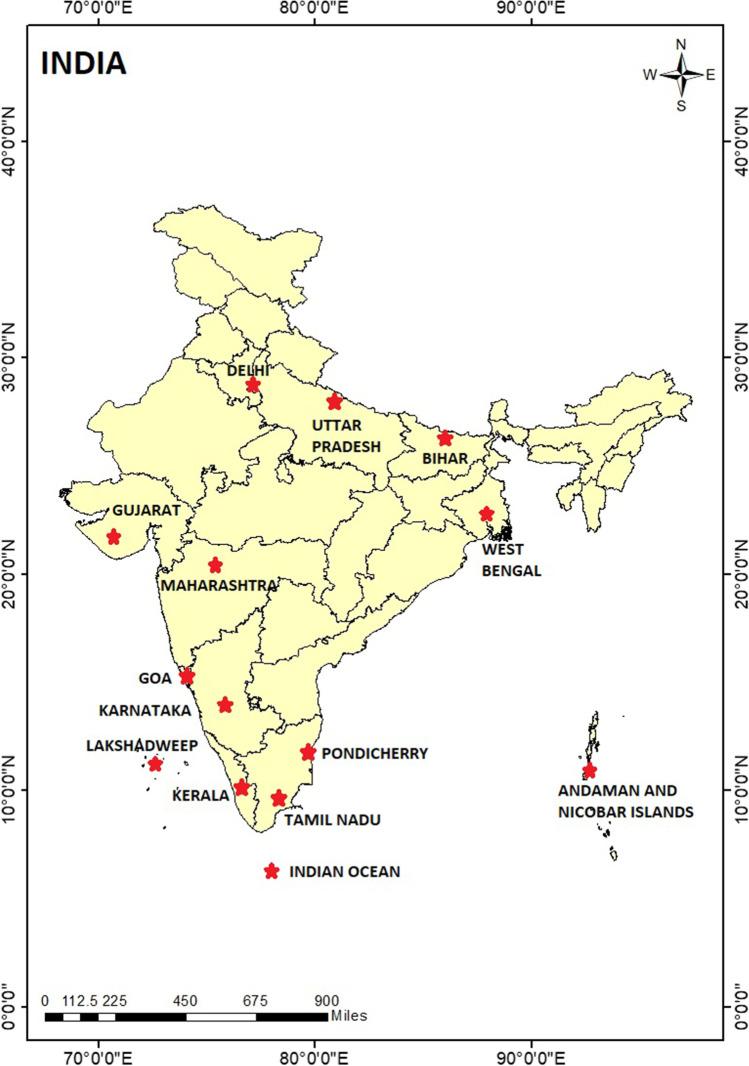
The increased production and consumption scale of plastic items has led to the generation of microplastics (MPs), an emerging class of contaminants, in our environment. MPs are plastic particles less than 5 mm in size and could originate due to primary and secondary sources. The primary ones are generated as such in the MP size range while the secondary MPs are a result of fragmentation of larger plastic particles which eventually enters the aquatic, terrestrial and atmospheric environments. The increasing concern of MP pollution in every compartment of our environment is being globally explored, with relatively fewer studies in India. Among the total studies published on MP prevalence in the Indian environments, marine systems have received significantly higher attention compared to the other compartments like freshwater, atmosphere, terrestrial and human consumables. This review article is an effort to present current understanding of MP pollution in aquatic systems, terrestrial systems, atmosphere and human consumables of India by reviewing available scientific literature. Along with this, the review also focuses on identification of the gap areas in current knowledge and highlights way forward for future research. This would further help in meeting the goals of this emergent pollutant management.
塑料物品的生产和消费规模不断扩大,导致微塑料(MPs)在我们的环境中大量产生,成为一种新兴的污染物。MPs 是指尺寸小于 5 毫米的塑料颗粒,可能来自于原生和次生来源。原生 MPs 是在 MP 尺寸范围内直接生成的,而次生 MPs 则是较大塑料颗粒碎裂的结果,最终进入水、陆、气环境。全球范围内都在关注 MP 污染在环境各个部分的不断增加,而印度的相关研究相对较少。在印度环境中关于 MP 流行情况的所有研究中,海洋系统受到的关注明显高于其他部分,如淡水、大气、陆地和人类消费用品。这篇综述文章通过回顾现有科学文献,努力展示印度在水生系统、陆地系统、大气和人类消费用品中 MP 污染的最新理解。此外,该综述还侧重于确定当前知识中的差距领域,并强调未来研究的前进方向。这将有助于实现对这种新兴污染物的管理目标。


 Zotero 插件