
治疗性肝素与预防性肝素对中症 COVID-19 住院患者的死亡、机械通气或入住重症监护病房的影响:RAPID 随机临床试验。
Effectiveness of therapeutic heparin versus prophylactic heparin on death, mechanical ventilation, or intensive care unit admission in moderately ill patients with covid-19 admitted to hospital: RAPID randomised clinical trial.
机构信息
Departments of Medicine, and Laboratory Medicine and Pathobiology, St Michael's Hospital, Li Ka Shing Knowledge Institute, University of Toronto, Toronto, ON, Canada.
Haematology-Oncology Clinical Research Group, St Michael's Hospital, University of Toronto, Toronto, ON, Canada.
出版信息
BMJ. 2021 Oct 14;375:n2400. doi: 10.1136/bmj.n2400.
OBJECTIVE
To evaluate the effects of therapeutic heparin compared with prophylactic heparin among moderately ill patients with covid-19 admitted to hospital wards.
DESIGN
Randomised controlled, adaptive, open label clinical trial.
SETTING
28 hospitals in Brazil, Canada, Ireland, Saudi Arabia, United Arab Emirates, and US.
PARTICIPANTS
465 adults admitted to hospital wards with covid-19 and increased D-dimer levels were recruited between 29 May 2020 and 12 April 2021 and were randomly assigned to therapeutic dose heparin (n=228) or prophylactic dose heparin (n=237).
INTERVENTIONS
Therapeutic dose or prophylactic dose heparin (low molecular weight or unfractionated heparin), to be continued until hospital discharge, day 28, or death.
MAIN OUTCOME MEASURES
The primary outcome was a composite of death, invasive mechanical ventilation, non-invasive mechanical ventilation, or admission to an intensive care unit, assessed up to 28 days. The secondary outcomes included all cause death, the composite of all cause death or any mechanical ventilation, and venous thromboembolism. Safety outcomes included major bleeding. Outcomes were blindly adjudicated.
RESULTS
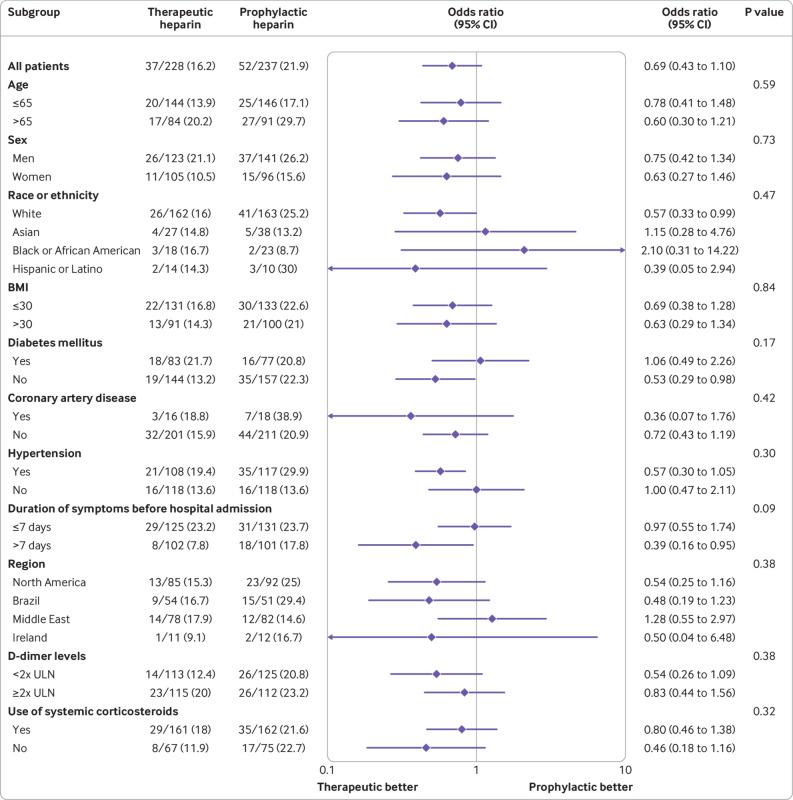
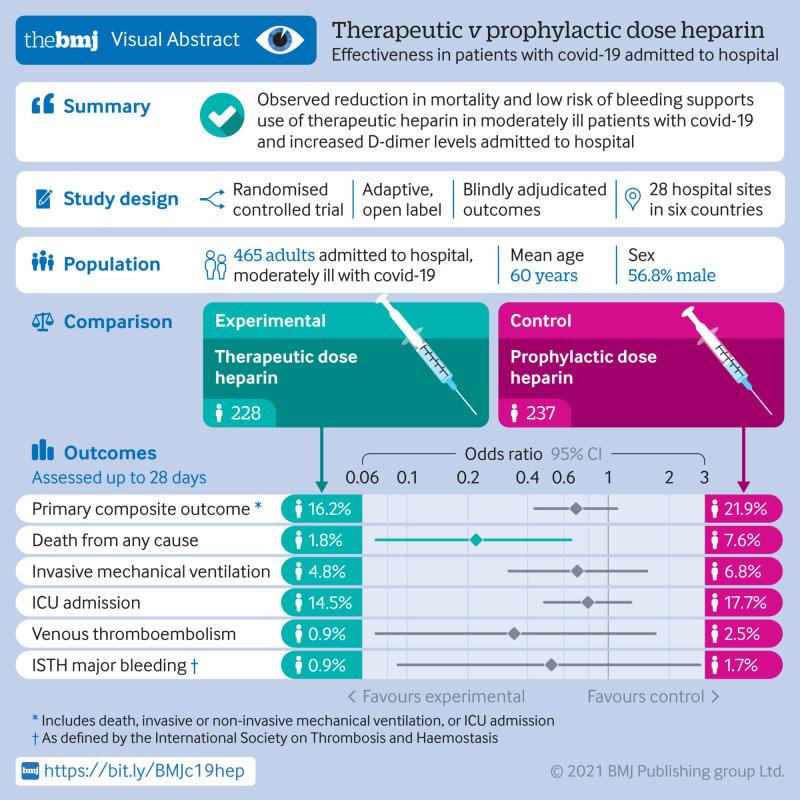
The mean age of participants was 60 years; 264 (56.8%) were men and the mean body mass index was 30.3 kg/m. At 28 days, the primary composite outcome had occurred in 37/228 patients (16.2%) assigned to therapeutic heparin and 52/237 (21.9%) assigned to prophylactic heparin (odds ratio 0.69, 95% confidence interval 0.43 to 1.10; P=0.12). Deaths occurred in four patients (1.8%) assigned to therapeutic heparin and 18 patients (7.6%) assigned to prophylactic heparin (0.22, 0.07 to 0.65; P=0.006). The composite of all cause death or any mechanical ventilation occurred in 23 patients (10.1%) assigned to therapeutic heparin and 38 (16.0%) assigned to prophylactic heparin (0.59, 0.34 to 1.02; P=0.06). Venous thromboembolism occurred in two patients (0.9%) assigned to therapeutic heparin and six (2.5%) assigned to prophylactic heparin (0.34, 0.07 to 1.71; P=0.19). Major bleeding occurred in two patients (0.9%) assigned to therapeutic heparin and four (1.7%) assigned to prophylactic heparin (0.52, 0.09 to 2.85; P=0.69).
CONCLUSIONS
In moderately ill patients with covid-19 and increased D-dimer levels admitted to hospital wards, therapeutic heparin was not significantly associated with a reduction in the primary outcome but the odds of death at 28 days was decreased. The risk of major bleeding appeared low in this trial.
TRIAL REGISTRATION
ClinicalTrials.gov NCT04362085.
目的
评估治疗剂量肝素与预防剂量肝素在中度 COVID-19 住院患者中的疗效。
设计
随机对照、适应性、开放标签临床试验。
地点
巴西、加拿大、爱尔兰、沙特阿拉伯、阿拉伯联合酋长国和美国的 28 家医院。
参与者
2020 年 5 月 29 日至 2021 年 4 月 12 日期间,招募了 465 名因 COVID-19 入院且 D-二聚体水平升高的成年患者,并将其随机分配至治疗剂量肝素组(n=228)或预防剂量肝素组(n=237)。
干预措施
治疗剂量或预防剂量肝素(低分子量肝素或未分馏肝素),持续使用至出院、第 28 天或死亡。
主要结局指标
主要结局为死亡、有创机械通气、无创机械通气或入住重症监护病房的复合结局,评估时间为 28 天。次要结局指标包括全因死亡、全因死亡或任何机械通气的复合结局以及静脉血栓栓塞症。安全性结局指标包括大出血。结局由盲法裁判裁定。
结果
参与者的平均年龄为 60 岁;264 名(56.8%)为男性,平均体重指数为 30.3kg/m。在 28 天,治疗性肝素组 37/228 例(16.2%)和预防性肝素组 52/237 例(21.9%)患者发生主要复合结局(比值比 0.69,95%置信区间 0.43 至 1.10;P=0.12)。治疗性肝素组有 4 例(1.8%)和预防性肝素组有 18 例(7.6%)患者死亡(0.22,0.07 至 0.65;P=0.006)。治疗性肝素组有 23 例(10.1%)和预防性肝素组有 38 例(16.0%)患者发生全因死亡或任何机械通气的复合结局(0.59,0.34 至 1.02;P=0.06)。治疗性肝素组有 2 例(0.9%)和预防性肝素组有 6 例(2.5%)患者发生静脉血栓栓塞症(0.34,0.07 至 1.71;P=0.19)。治疗性肝素组有 2 例(0.9%)和预防性肝素组有 4 例(1.7%)患者发生大出血(0.52,0.09 至 2.85;P=0.69)。
结论
在因 COVID-19 住院且 D-二聚体水平升高的中度患者中,治疗性肝素并未显著降低主要结局,但 28 天死亡的几率降低。该试验中,大出血的风险似乎较低。
试验注册
ClinicalTrials.gov NCT04362085。

 Zotero 插件