
政府政策对全球 COVID-19 传播的影响。
Effects of government policies on the spread of COVID-19 worldwide.
机构信息
Department of Chemistry, Seoul National University, Seoul, 08826, Republic of Korea.
Interdisciplinary Program in Bioinformatics, Seoul National University, Seoul, 08826, Republic of Korea.
出版信息
Sci Rep. 2021 Oct 14;11(1):20495. doi: 10.1038/s41598-021-99368-9.
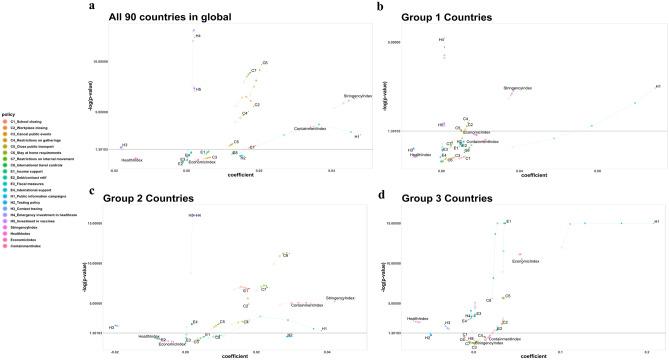
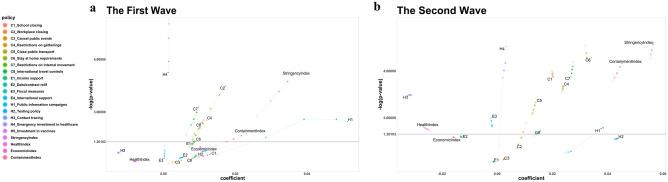
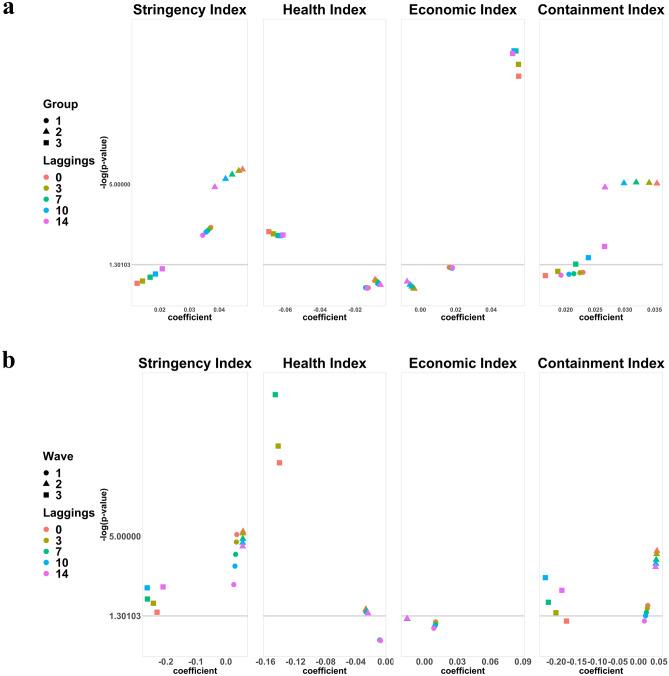
The outbreak of novel COVID-19 disease elicited a wide range of anti-contagion and economic policies like school closure, income support, contact tracing, and so forth, in the mitigation and suppression of the spread of the SARS-CoV-2 virus. However, a systematic evaluation of these policies has not been made. Here, 17 implemented policies from the Oxford COVID-19 Government Response Tracker dataset employed in 90 countries from December 31, 2019, to August 31, 2020, were analyzed. A Poisson regression model was applied to analyze the relationship between policies and daily confirmed cases using a generalized estimating equations approach. A lag is a fixed time displacement in time series data. With that, lagging (0, 3, 7, 10, and 14 days) was also considered during the analysis since the effects of policies implemented on a given day may affect the number of confirmed cases several days after implementation. The countries were divided into three groups depending on the number of waves of the pandemic observed in each country. Through subgroup analysis, we showed that with and without lagging, contact tracing and containment policies were significant for countries with two waves, while closing, economic, and health policies were significant for countries with three waves. Wave-specific analysis for each wave showed that significant health, economic, and containment policies varied across waves of the pandemic. Emergency investment in healthcare was consistently significant among the three groups of countries, while the Stringency index was significant among all waves of the pandemic. These findings may help in making informed decisions regarding whether, which, or when these policies should be intensified or lifted.
新型 COVID-19 疾病的爆发引发了广泛的抗传染病和经济政策,如学校关闭、收入支持、接触者追踪等,以减轻和抑制 SARS-CoV-2 病毒的传播。然而,这些政策尚未进行系统评估。在这里,分析了来自牛津 COVID-19 政府反应追踪器数据集的 17 项政策,这些政策于 2019 年 12 月 31 日至 2020 年 8 月 31 日在 90 个国家实施。采用泊松回归模型,通过广义估计方程方法分析政策与每日确诊病例之间的关系。滞后是时间序列数据中的固定时间位移。因此,在分析中还考虑了滞后(0、3、7、10 和 14 天),因为在给定日期实施的政策的影响可能会在实施后几天影响确诊病例的数量。根据每个国家观察到的大流行波数,将这些国家分为三组。通过亚组分析,我们表明,无论是否滞后,接触者追踪和遏制政策对有两波大流行的国家是显著的,而关闭、经济和卫生政策对有三波大流行的国家是显著的。针对每一波的波特定分析表明,重大的卫生、经济和遏制政策在大流行的各个波中都有所不同。紧急投资于医疗保健在这三个国家组中始终是显著的,而严格指数在所有大流行波中都是显著的。这些发现可能有助于就这些政策是否应该加强或取消做出明智的决策,以及在何时加强或取消。

 Zotero 插件