
家禽肠道黏膜层的发育和功能特性。
Development and Functional Properties of Intestinal Mucus Layer in Poultry.
机构信息
Institute of Animal Nutrition, Department of Veterinary Medicine, Freie Universität Berlin, Berlin, Germany.
Faculty of Veterinary Science, Prince of Songkla University, Hatyai, Songkhla, Thailand.
出版信息
Front Immunol. 2021 Oct 4;12:745849. doi: 10.3389/fimmu.2021.745849. eCollection 2021.
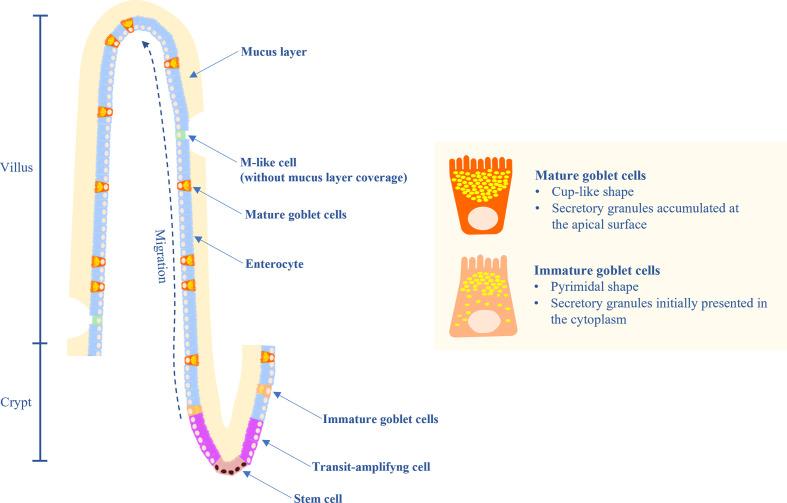
Intestinal mucus plays important roles in protecting the epithelial surfaces against pathogens, supporting the colonization with commensal bacteria, maintaining an appropriate environment for digestion, as well as facilitating nutrient transport from the lumen to the underlying epithelium. The mucus layer in the poultry gut is produced and preserved by mucin-secreting goblet cells that rapidly develop and mature after hatch as a response to external stimuli including environmental factors, intestinal microbiota as well as dietary factors. The ontogenetic development of goblet cells affects the mucin composition and secretion, causing an alteration in the physicochemical properties of the mucus layer. The intestinal mucus prevents the invasion of pathogens to the epithelium by its antibacterial properties (e.g. β-defensin, lysozyme, avidin and IgA) and creates a physical barrier with the ability to protect the epithelium from pathogens. Mucosal barrier is the first line of innate defense in the gastrointestinal tract. This barrier has a selective permeability that allows small particles and nutrients passing through. The structural components and functional properties of mucins have been reviewed extensively in humans and rodents, but it seems to be neglected in poultry. This review discusses the impact of age on development of goblet cells and their mucus production with relevance for the functional characteristics of mucus layer and its protective mechanism in the chicken's intestine. Dietary factors directly and indirectly (through modification of the gut bacteria and their metabolic activities) affect goblet cell proliferation and differentiation and can be used to manipulate mucosal integrity and dynamic. However, the mode of action and mechanisms behind these effects need to be studied further. As mucins resist to digestion processes, the sloughed mucins can be utilized by bacteria in the lower part of the gut and are considered as endogenous loss of protein and energy to animal. Hydrothermal processing of poultry feed may reduce this loss by reduction in mucus shedding into the lumen. Given the significance of this loss and the lack of precise data, this matter needs to be carefully investigated in the future and the nutritional strategies reducing this loss have to be defined better.
肠黏液在保护上皮表面免受病原体侵害、支持共生菌定植、维持适宜的消化环境以及促进营养物质从腔内向上皮下层运输方面发挥着重要作用。禽类肠道中的黏液层是由分泌黏蛋白的杯状细胞产生和维持的,这些细胞在孵化后会迅速发育和成熟,以响应包括环境因素、肠道微生物群和饮食因素在内的外部刺激。杯状细胞的个体发生发育会影响黏蛋白的组成和分泌,从而改变黏液层的理化性质。肠黏液通过其抗菌特性(如β-防御素、溶菌酶、亲和素和 IgA)阻止病原体侵入上皮细胞,并形成具有保护上皮细胞免受病原体侵害的物理屏障。黏膜屏障是胃肠道固有防御的第一道防线。该屏障具有选择性通透性,允许小分子和营养物质通过。黏蛋白的结构成分和功能特性在人类和啮齿动物中得到了广泛的研究,但在禽类中似乎被忽视了。本综述讨论了年龄对杯状细胞发育及其黏液产生的影响,以及这对鸡肠道中黏液层功能特性及其保护机制的相关性。饮食因素直接和间接(通过改变肠道细菌及其代谢活性)影响杯状细胞的增殖和分化,可以用于操纵黏膜完整性和动态。然而,需要进一步研究这些影响的作用方式和机制。由于黏蛋白能抵抗消化过程,脱落的黏蛋白可以被肠道下部的细菌利用,被认为是动物体内蛋白质和能量的内源性损失。家禽饲料的湿热加工可以通过减少黏液脱落到腔中来减少这种损失。鉴于这种损失的重要性和缺乏精确的数据,未来需要对此进行仔细研究,并更好地定义减少这种损失的营养策略。


 Zotero 插件