
前列腺特异性抗原密度在PI-RADS v2.1分类中对避免血清前列腺特异性抗原水平为4-20 ng/mL患者进行不必要的移行带活检的作用。
The Role of PSA Density among PI-RADS v2.1 Categories to Avoid an Unnecessary Transition Zone Biopsy in Patients with PSA 4-20 ng/mL.
作者信息
Wang Zhi-Bing, Wei Chao-Gang, Zhang Yue-Yue, Pan Peng, Dai Guang-Cheng, Tu Jian, Shen Jun-Kang
机构信息
Department of Radiology, The Second Affiliated Hospital of Soochow University, Suzhou 215004, China.
Department of Radiology, Huai'an Hospital of Huai'an City, Huai'an 223200, China.
出版信息
Biomed Res Int. 2021 Oct 11;2021:3995789. doi: 10.1155/2021/3995789. eCollection 2021.
OBJECTIVE
To evaluate the role of prostate-specific antigen density (PSAD) in different Prostate Imaging Reporting and Data System version 2.1 (PI-RADS v2.1) categories to avoid an unnecessary biopsy in transition zone (TZ) patients with PSA ranging from 4 to 20 ng/mL.
MATERIALS AND METHODS
In this retrospective and single-center study, 333 biopsy-naïve patients with TZ lesions who underwent biparametric magnetic resonance imaging (bp-MRI) were analyzed from January 2016 to March 2020. Multivariate logistic regression analyses were performed to determine independent predictors of clinically significant prostate cancer (cs-PCa). The receiver operating characteristic (ROC) curve was used to compare diagnostic performance.
RESULTS
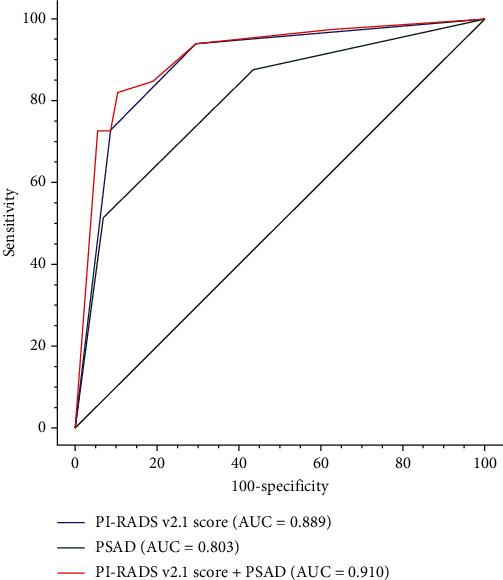
PI-RADS v2.1 and PSAD were the independent predictors for TZ cs-PCa in patients with PSA 4-20 ng/mL. 0.9% (2/213), 10.0% (7/70), and 48.0% (24/50) of PI-RADS v2.1 score 1-2, 3, and 4-5 had TZ cs-PCa. However, for patients with PI-RADS v2.1 score 1-2, there were no obvious changes in the detection of TZ cs-PCa (0.8% (1/129), 1.3% (1/75), and 0.0% (0/9)) combining with different PSAD stratification (PSAD < 0.15, 0.15-0.29, and ≥0.30 ng/mL/mL). For patients with PI-RADS v2.1 score ≥ 3, the TZ cs-PCa detection rate significantly varied according to different PSAD stratification. A PI-RADS v2.1 score 3 and PSAD < 0.15 and 0.15-0.29 ng/mL/mL had 8.6% (3/35) and 3.7% (1/27) of TZ cs-PCa, while a PI-RADS v2.1 score 3 and PSAD ≥ 0.30 ng/mL/mL had a higher TZ cs-PCa detection rate (37.5% (3/8)). A PI-RADS v2.1 score 4-5 and PSAD <0.15 ng/mL/mL had no cs-PCa (0.0% (0/9)). In contrast, a PI-RADS v2.1 score 4-5 and PSAD 0.15-0.29 and ≥0.30 ng/mL/mL had the highest cs-PCa detection rate (50.0% (10/20), 66.7% (14/21)). It showed the highest AUC in the combination of PI-RADS v2.1 and PSAD (0.910), which was significantly higher than PI-RADS v2.1 (0.889, = 0.039) or PSAD (0.803, < 0.001).
CONCLUSIONS
For TZ patients with PSA 4-20 ng/mL, PI-RADS v2.1 score ≤ 2 can avoid an unnecessary biopsy regardless of PSAD. PI-RADS v2.1 score ≥ 3 may avoid an unnecessary biopsy after combining with PSAD. PI-RADS v2.1 combined with PSAD could significantly improve diagnostic performance.
目的
评估前列腺特异性抗原密度(PSAD)在不同前列腺影像报告和数据系统第2.1版(PI-RADS v2.1)分类中的作用,以避免对前列腺特异抗原(PSA)水平在4至20 ng/mL之间的移行带(TZ)患者进行不必要的活检。
材料与方法
在这项回顾性单中心研究中,分析了2016年1月至2020年3月期间333例未接受过活检的TZ病变患者,这些患者均接受了双参数磁共振成像(bp-MRI)检查。进行多因素逻辑回归分析以确定临床显著前列腺癌(cs-PCa)的独立预测因素。采用受试者操作特征(ROC)曲线比较诊断性能。
结果
PI-RADS v2.1和PSAD是PSA水平在4至20 ng/mL之间的TZ患者发生cs-PCa的独立预测因素。PI-RADS v2.1评分为1-2、3和4-5的患者中,分别有0.9%(2/213)、10.0%(7/70)和48.0%(24/50)发生TZ cs-PCa。然而,对于PI-RADS v2.1评分为1-2的患者,结合不同的PSAD分层(PSAD < 0.15、0.15-0.29和≥0.30 ng/mL/mL),TZ cs-PCa的检出率无明显变化(分别为0.8%(1/129)、1.3%(1/75)和0.0%(0/9))。对于PI-RADS v2.1评分≥3的患者,TZ cs-PCa的检出率根据不同的PSAD分层有显著差异。PI-RADS v2.1评分为3且PSAD < 0.15和0.15-0.29 ng/mL/mL的患者中,TZ cs-PCa的发生率分别为8.6%(3/35)和3.7%(1/27),而PI-RADS v2.1评分为3且PSAD≥0.30 ng/mL/mL的患者中,TZ cs-PCa的检出率更高(37.5%(3/8))。PI-RADS v2.1评分为4-5且PSAD <0.15 ng/mL/mL的患者未发生cs-PCa(0.0%(0/9))。相比之下,PI-RADS v2.1评分为4-5且PSAD为0.15-0.29和≥0.30 ng/mL/mL的患者中,cs-PCa的检出率最高(分别为50.0%(10/20)、66.7%(14/21))。PI-RADS v2.1和PSAD联合使用时显示出最高的曲线下面积(AUC)(0.910),显著高于PI-RADS v2.1(0.889,P = 0.039)或PSAD(0.803,P < 0.001)。
结论
对于PSA水平在4至20 ng/mL之间的TZ患者,无论PSAD如何,PI-RADS v2.1评分≤2均可避免不必要的活检。PI-RADS v2.1评分≥3结合PSAD后可能避免不必要的活检。PI-RADS v2.1与PSAD联合使用可显著提高诊断性能。


 Zotero 插件