
试验观察:肿瘤内免疫疗法。
Trial watch: intratumoral immunotherapy.
机构信息
Canada Department of Medicine, Institute for Research in Immunology and Cancer (Iric), Université de Montréal, Montreal, QC, Canada.
Université de Montréal, Montreal, QC, Canada.
出版信息
Oncoimmunology. 2021 Oct 15;10(1):1984677. doi: 10.1080/2162402X.2021.1984677. eCollection 2021.
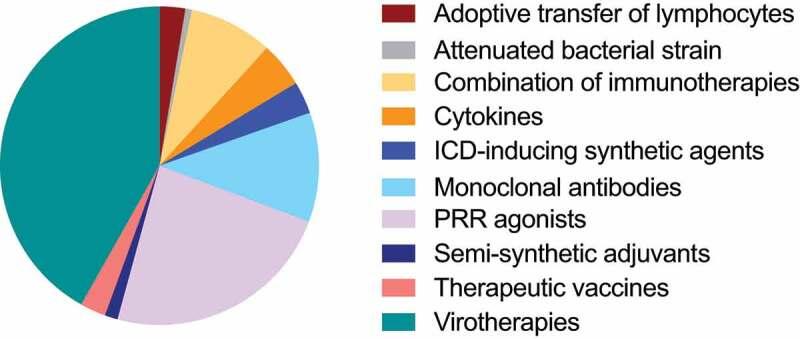
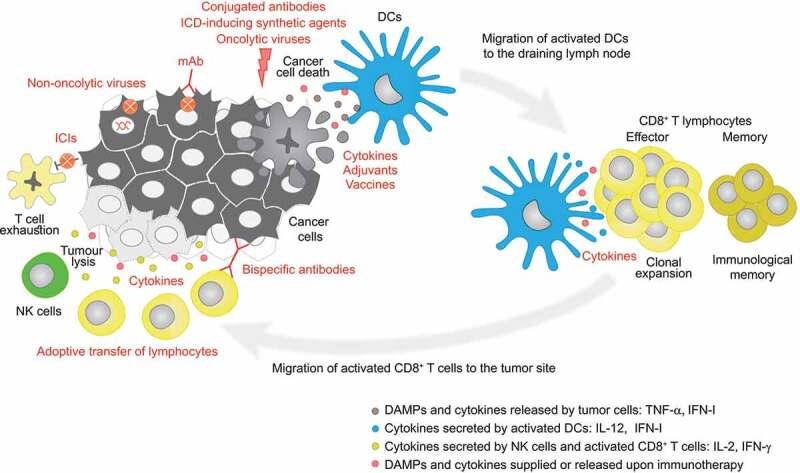
While chemotherapy and radiotherapy remain the first-line approaches for the management of most unresectable tumors, immunotherapy has emerged in the past two decades as a game-changing treatment, notably with the clinical success of immune checkpoint inhibitors. Immunotherapies aim at (re)activating anticancer immune responses which occur in two main steps: (1) the activation and expansion of tumor-specific T cells following cross-presentation of tumor antigens by specialized myeloid cells (priming phase); and (2) the immunological clearance of malignant cells by these antitumor T lymphocytes (effector phase). Therapeutic vaccines, adjuvants, monoclonal antibodies, cytokines, immunogenic cell death-inducing agents including oncolytic viruses, anthracycline-based chemotherapy and radiotherapy, as well as adoptive cell transfer, all act at different levels of this cascade to (re)instate cancer immunosurveillance. Intratumoral delivery of these immunotherapeutics is being tested in clinical trials to promote superior antitumor immune activity in the context of limited systemic toxicity.
虽然化疗和放疗仍然是大多数不可切除肿瘤的一线治疗方法,但免疫疗法在过去二十年中作为一种改变游戏规则的治疗方法出现,特别是免疫检查点抑制剂的临床成功。免疫疗法旨在(重新)激活抗癌免疫反应,这发生在两个主要步骤中:(1)在专门的髓样细胞交叉呈递肿瘤抗原后,肿瘤特异性 T 细胞的激活和扩增(启动阶段);和(2)这些抗肿瘤 T 淋巴细胞对恶性细胞的免疫清除(效应阶段)。治疗性疫苗、佐剂、单克隆抗体、细胞因子、诱导免疫原性细胞死亡的药物,包括溶瘤病毒、蒽环类化疗和放疗,以及过继细胞转移,都在这个级联的不同水平上作用,以(重新)建立癌症免疫监视。这些免疫疗法的瘤内给药正在临床试验中进行测试,以在有限的全身毒性情况下促进更优的抗肿瘤免疫活性。
 Zotero 插件