
在巴西玛瑙斯市第二波疫情之前,高抗严重急性呼吸综合征冠状病毒 2 抗体血清转化率,以及社会行为措施的保护作用:前瞻性 DETECTCoV-19 队列研究结果。
High anti-SARS-CoV-2 antibody seroconversion rates before the second wave in Manaus, Brazil, and the protective effect of social behaviour measures: results from the prospective DETECTCoV-19 cohort.
机构信息
Instituto Leoônidas e Maria Deane, Fiocruz Amazoônia, Manaus, Brazil.
Facultad de Ciencias de la Salud, Universidad Peruana de Ciencias Aplicadas, Lima, Peru.
出版信息
Lancet Glob Health. 2021 Nov;9(11):e1508-e1516. doi: 10.1016/S2214-109X(21)00355-7.
BACKGROUND
The city of Manaus, Brazil, has seen two collapses of the health system due to the COVID-19 pandemic. We report anti-SARS-CoV-2 nucleocapsid IgG antibody seroconversion rates and associated risk factors in Manaus residents before the second wave of the epidemic in Brazil.
METHODS
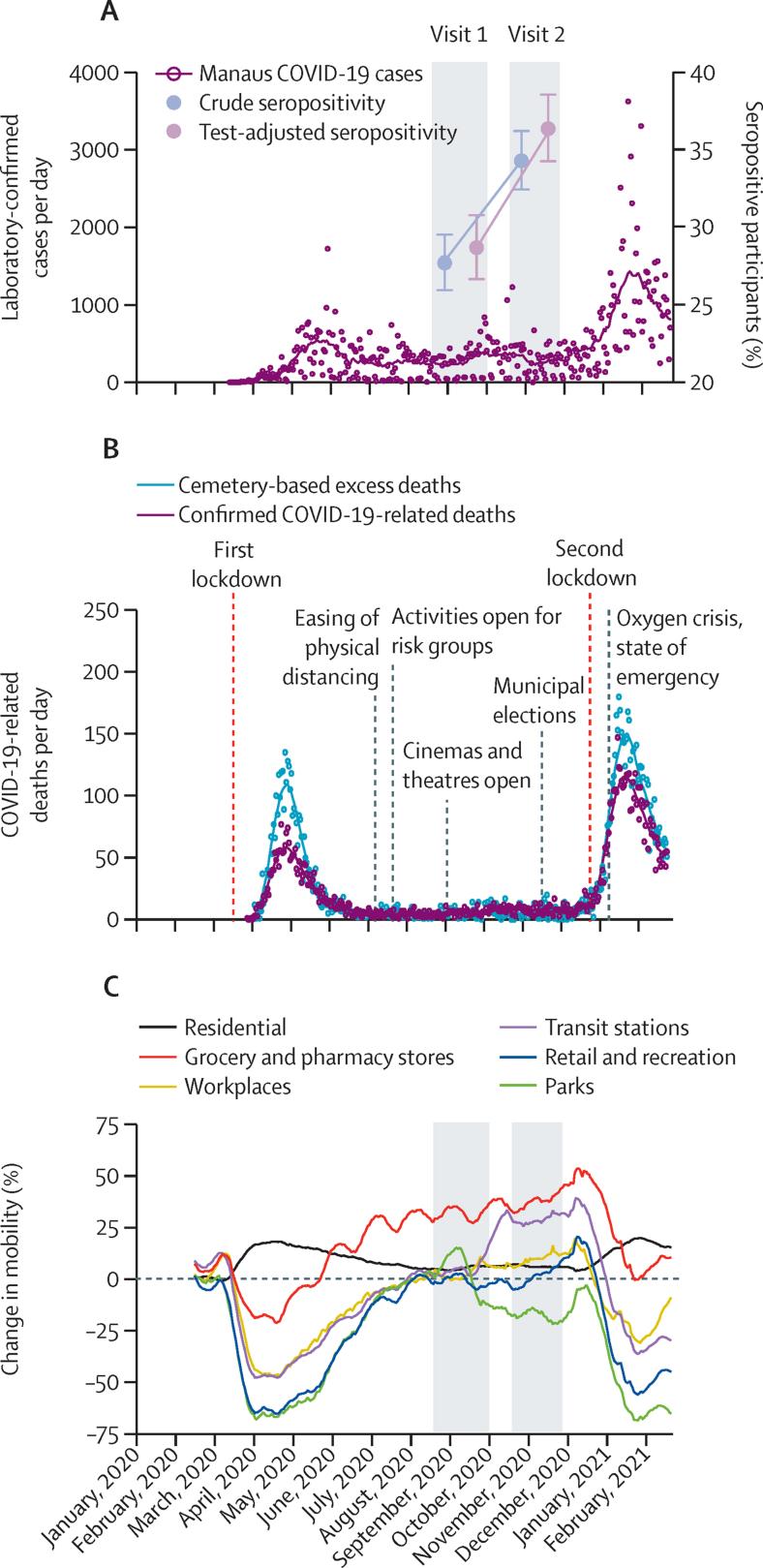
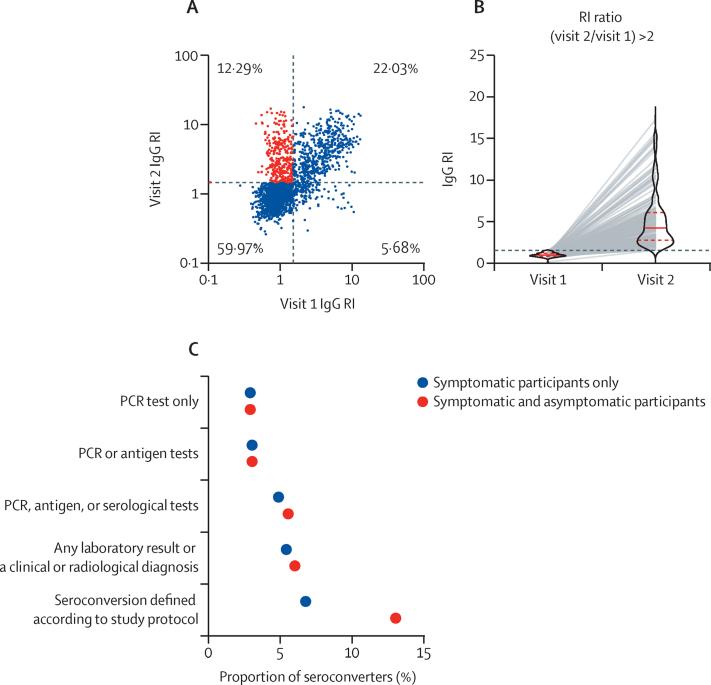
A convenience sample of adult (aged ≥18 years) residents of Manaus was recruited through online and university website advertising into the DETECTCoV-19 study cohort. The current analysis of seroconversion included a subgroup of DETECTCoV-19 participants who had at least two serum sample collections separated by at least 4 weeks between Aug 19 and Oct 2, 2020 (visit 1), and Oct 19 and Nov 27, 2020 (visit 2). Those who reported (or had no data on) having a COVID-19 diagnosis before visit 1, and who were positive for anti-SARS-CoV-2 nucleocapsid IgG antibodies at visit 1 were excluded. Using an in-house ELISA, the reactivity index (RI; calculated as the optical density ratio of the sample to the negative control) for serum anti-SARS-CoV-2 nucleocapsid IgG antibodies was measured at both visits. We calculated the incidence of seroconversion (defined as RI values ≤1·5 at visit 1 and ≥1·5 at visit 2, and a ratio >2 between the visit 2 and visit 1 RI values) during the study period, as well as incidence rate ratios (IRRs) through cluster-corrected and adjusted Poisson regression models to analyse associations between seroconversion and variables related to sociodemographic characteristics, health access, comorbidities, COVID-19 exposure, protective behaviours, and symptoms.
FINDINGS
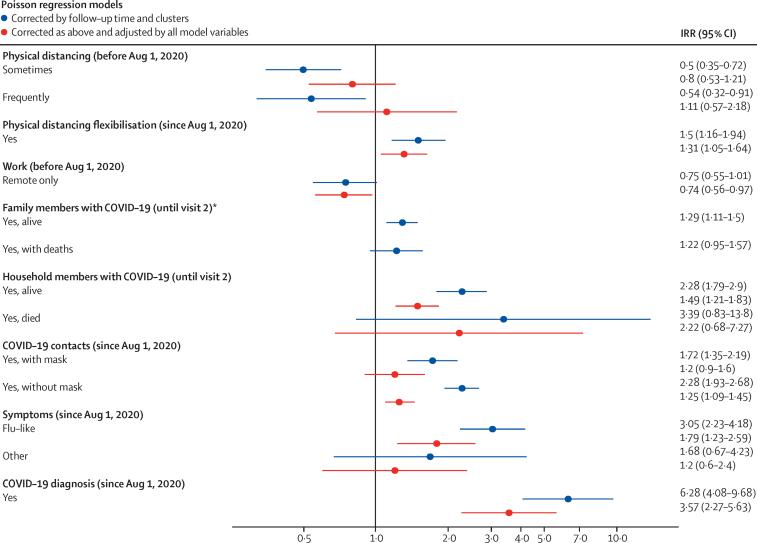
2496 DETECTCoV-19 cohort participants returned for a follow-up visit between Oct 19 and Nov 27, 2020, of whom 204 reported having COVID-19 before the first visit and 24 had no data regarding previous disease status. 559 participants were seropositive for anti-SARS-CoV-2 nucleocapsid IgG antibodies at baseline. Of the remaining 1709 participants who were seronegative at baseline, 71 did not meet the criteria for seroconversion and were excluded from the analyses. Among the remaining 1638 participants who were seronegative at baseline, 214 showed seroconversion at visit 2. The seroconversion incidence was 13·06% (95% CI 11·52-14·79) overall and 6·78% (5·61-8·10) for symptomatic seroconversion, over a median follow-up period of 57 days (IQR 54-61). 48·1% of seroconversion events were estimated to be asymptomatic. The sample had higher proportions of affluent and higher-educated people than those reported for the Manaus city population. In the fully adjusted and corrected model, risk factors for seroconversion before visit 2 were having a COVID-19 case in the household (IRR 1·49 [95% CI 1·21-1·83]), not wearing a mask during contact with a person with COVID-19 (1·25 [1·09-1·45]), relaxation of physical distancing (1·31 [1·05-1·64]), and having flu-like symptoms (1·79 [1·23-2·59]) or a COVID-19 diagnosis (3·57 [2·27-5·63]) between the first and second visits, whereas working remotely was associated with lower incidence (0·74 [0·56-0·97]).
INTERPRETATION
An intense infection transmission period preceded the second wave of COVID-19 in Manaus. Several modifiable behaviours increased the risk of seroconversion, including non-compliance with non-pharmaceutical interventions measures such as not wearing a mask during contact, relaxation of protective measures, and non-remote working. Increased testing in high-transmission areas is needed to provide timely information about ongoing transmission and aid appropriate implementation of transmission mitigation measures.
FUNDING
Ministry of Education, Brazil; Fundação de Amparo à Pesquisa do Estado do Amazonas; Pan American Health Organization (PAHO)/WHO.
背景
巴西玛瑙斯市由于 COVID-19 大流行,其卫生系统已经崩溃了两次。我们报告了巴西第二波疫情之前玛瑙斯居民抗 SARS-CoV-2 核衣壳 IgG 抗体血清转化率和相关风险因素。
方法
通过在线和大学网站广告招募了便利样本的成年(年龄≥18 岁)玛瑙斯居民,纳入 DETECTCoV-19 研究队列。目前的血清转化分析包括 DETECTCoV-19 参与者的一个亚组,他们在 2020 年 8 月 19 日至 10 月 2 日(访问 1)和 10 月 19 日至 11 月 27 日(访问 2)之间至少有两次血清样本采集,且两次采集之间至少间隔 4 周。那些报告(或没有 COVID-19 诊断数据)在访问 1 之前有 COVID-19 诊断,且在访问 1 时抗 SARS-CoV-2 核衣壳 IgG 抗体阳性的参与者被排除在外。使用内部 ELISA,在两次访问时均测量血清抗 SARS-CoV-2 核衣壳 IgG 抗体的反应性指数(RI;通过样品与阴性对照的光密度比计算)。我们计算了研究期间血清转化的发生率(定义为访问 1 时 RI 值≤1.5,访问 2 时 RI 值≥1.5,访问 2 时 RI 值与访问 1 时 RI 值的比值>2),以及通过聚类校正和调整后的泊松回归模型分析血清转化与社会人口特征、卫生服务获取、合并症、COVID-19 暴露、保护行为和症状相关变量之间的关联。
结果
2020 年 10 月 19 日至 11 月 27 日期间,共有 2496 名 DETECTCoV-19 队列参与者进行了随访,其中 204 名报告在第一次就诊前患有 COVID-19,24 名参与者没有关于既往疾病状态的数据。559 名参与者在基线时抗 SARS-CoV-2 核衣壳 IgG 抗体呈阳性。在基线时血清阴性的 1709 名参与者中,有 71 名不符合血清转化标准,被排除在分析之外。在基线时血清阴性的其余 1638 名参与者中,有 214 名在访问 2 时出现血清转化。总的血清转化发生率为 13.06%(95%CI 11.52-14.79),症状性血清转化发生率为 6.78%(5.61-8.10),中位随访时间为 57 天(IQR 54-61)。估计有 48.1%的血清转化事件为无症状。该样本中,富裕和受教育程度较高的人群比例高于玛瑙斯市人群报告的比例。在完全调整和校正模型中,访问 2 前发生血清转化的危险因素包括家中有 COVID-19 病例(IRR 1.49[95%CI 1.21-1.83])、与 COVID-19 患者接触时不戴口罩(1.25[1.09-1.45])、放松身体距离(1.31[1.05-1.64])、在第一次和第二次就诊之间出现流感样症状(1.79[1.23-2.59])或 COVID-19 诊断(3.57[2.27-5.63]),而远程工作与发病率降低相关(0.74[0.56-0.97])。
解释
在玛瑙斯市第二波 COVID-19 疫情之前,出现了一次强烈的感染传播期。包括不遵守非药物干预措施(如与 COVID-19 患者接触时不戴口罩)、放松保护措施和不远程工作在内的一些可改变的行为增加了血清转化的风险。需要在高传播地区增加检测,以便及时了解正在进行的传播情况,并有助于适当实施传播缓解措施。
资金
巴西教育部、亚马逊州研究支持基金会、泛美卫生组织(PAHO/WHO)。
 Zotero 插件