
体脂分布与乳腺癌、子宫内膜癌和卵巢癌风险:一项两样本孟德尔随机化研究。
Body Fat Distribution and Risk of Breast, Endometrial, and Ovarian Cancer: A Two-Sample Mendelian Randomization Study.
作者信息
Freuer Dennis, Linseisen Jakob, O'Mara Tracy A, Leitzmann Michael, Baurecht Hansjörg, Baumeister Sebastian-Edgar, Meisinger Christa
机构信息
Chair of Epidemiology, University of Augsburg, University Hospital Augsburg, 86156 Augsburg, Germany.
Institute for Medical Information Processing, Biometry, and Epidemiology, Ludwig-Maximilians-Universität München, 81377 Munich, Germany.
出版信息
Cancers (Basel). 2021 Oct 9;13(20):5053. doi: 10.3390/cancers13205053.
BACKGROUND
Mounting evidence shows that adiposity increases female-specific cancer risk, but the role of body fat distribution is less clear. We used a two-sample Mendelian randomization (MR) approach to elucidate causal relations of body fat distribution to the risks of breast, endometrial and ovarian cancers and their subtypes.
METHODS
Body composition was assessed using segmental bioelectrical impedance analysis, yielding trunk, arm, and leg fat ratios (TFR, AFR, LFR) and BMI including 195,043 and 434,794 European women, respectively. The sample sizes for the outcomes ranged between 58,396 and 228,951. Causal effects were estimated per one standard deviation increment in the respective exposure within the radial regression framework. Robust sensitivity analyses were performed to verify MR assumptions. In a multivariable MR setting, the proportion of risk attributable to overall and abdominal fat content was assessed.
RESULTS
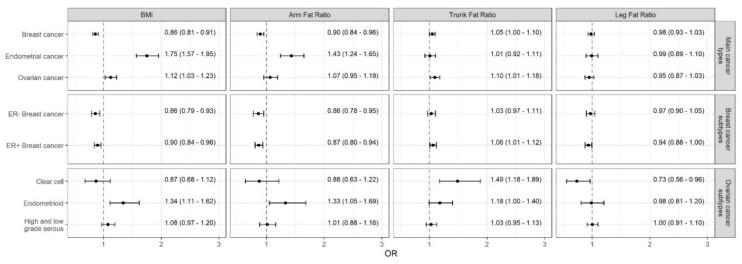
TFR, which represents abdominal fat content, was associated with ovarian cancer and its clear cell and endometrioid histotypes independent of overall fat content. BMI was inversely associated with breast cancer and its ER- and ER+ subtypes, but positively with endometrial cancer and ovarian cancer, including its endometrioid histotype. These estimates were confirmed using AFR as proxy for overall body fat.
CONCLUSIONS
Visceral adiposity seems to be a driver of elevated ovarian cancer risk, particularly of the endometrioid and clear cell ovarian cancer histotypes. General adiposity decreases the risk of breast cancer but increases the risk of endometrial and ovarian cancer.
背景
越来越多的证据表明,肥胖会增加女性特有的癌症风险,但体脂分布的作用尚不清楚。我们采用双样本孟德尔随机化(MR)方法来阐明体脂分布与乳腺癌、子宫内膜癌和卵巢癌及其亚型风险之间的因果关系。
方法
使用分段生物电阻抗分析评估身体成分,分别得出195,043名和434,794名欧洲女性的躯干、手臂和腿部脂肪比率(TFR、AFR、LFR)以及BMI。各结局的样本量在58,396至228,951之间。在径向回归框架内,针对各暴露因素每增加一个标准差来估计因果效应。进行了稳健的敏感性分析以验证MR假设。在多变量MR设置中,评估了总体和腹部脂肪含量所致风险的比例。
结果
代表腹部脂肪含量的TFR与卵巢癌及其透明细胞和子宫内膜样组织学类型相关,且独立于总体脂肪含量。BMI与乳腺癌及其ER-和ER+亚型呈负相关,但与子宫内膜癌和卵巢癌(包括其子宫内膜样组织学类型)呈正相关。使用AFR作为总体身体脂肪的替代指标时,这些估计结果得到了证实。
结论
内脏肥胖似乎是卵巢癌风险升高的驱动因素,尤其是子宫内膜样和透明细胞卵巢癌组织学类型。总体肥胖会降低乳腺癌风险,但会增加子宫内膜癌和卵巢癌的风险。

 Zotero 插件