
瘦人和非肥胖个体中的非酒精性脂肪性肝病:当前及未来挑战
Non-Alcoholic Fatty Liver Disease in Lean and Non-Obese Individuals: Current and Future Challenges.
作者信息
Kuchay Mohammad Shafi, Martínez-Montoro José Ignacio, Choudhary Narendra Singh, Fernández-García José Carlos, Ramos-Molina Bruno
机构信息
Division of Endocrinology and Diabetes, Medanta The Medicity Hospital, Gurugram 122001, Haryana, India.
Department of Endocrinology and Nutrition, Virgen de la Victoria University Hospital, Institute of Biomedical Research in Malaga (IBIMA), Faculty of Medicine, University of Malaga, 29010 Malaga, Spain.
出版信息
Biomedicines. 2021 Sep 28;9(10):1346. doi: 10.3390/biomedicines9101346.
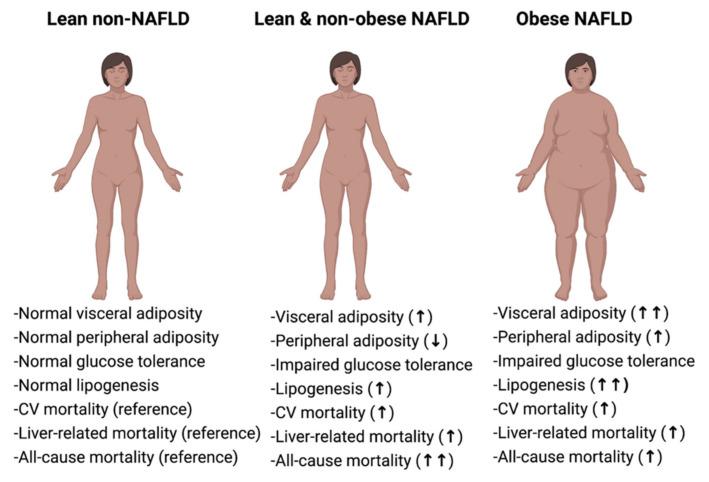
Non-alcoholic fatty liver disease (NAFLD), which approximately affects a quarter of the world's population, has become a major public health concern. Although usually associated with excess body weight, it may also affect normal-weight individuals, a condition termed as lean/non-obese NAFLD. The prevalence of lean/non-obese NAFLD is around 20% within the NAFLD population, and 5% within the general population. Recent data suggest that individuals with lean NAFLD, despite the absence of obesity, exhibit similar cardiovascular- and cancer-related mortality compared to obese NAFLD individuals and increased all-cause mortality risk. Lean and obese NAFLD individuals share several metabolic abnormalities, but present dissimilarities in genetic predisposition, body composition, gut microbiota, and susceptibility to environmental factors. Current treatment of lean NAFLD is aimed at improving overall fitness and decreasing visceral adiposity, with weight loss strategies being the cornerstone of treatment. Moreover, several drugs including PPAR agonists, SGLT2 inhibitors, or GLP-1 receptor agonists could also be useful in the management of lean NAFLD. Although there has been an increase in research regarding lean NAFLD, there are still more questions than answers. There are several potential drugs for NAFLD therapy, but clinical trials are needed to evaluate their efficacy in lean individuals.
非酒精性脂肪性肝病(NAFLD)影响着全球约四分之一的人口,已成为一个主要的公共卫生问题。尽管它通常与体重超标有关,但也可能影响体重正常的个体,这种情况被称为瘦型/非肥胖型NAFLD。在NAFLD人群中,瘦型/非肥胖型NAFLD的患病率约为20%,在普通人群中为5%。最近的数据表明,瘦型NAFLD患者尽管没有肥胖,但与肥胖型NAFLD患者相比,心血管疾病和癌症相关死亡率相似,全因死亡风险增加。瘦型和肥胖型NAFLD患者有一些共同的代谢异常,但在遗传易感性、身体组成、肠道微生物群以及对环境因素的易感性方面存在差异。目前对瘦型NAFLD的治疗旨在提高整体健康水平和减少内脏脂肪,减肥策略是治疗的基石。此外,包括PPAR激动剂、SGLT2抑制剂或GLP-1受体激动剂在内的几种药物也可能有助于瘦型NAFLD的管理。尽管关于瘦型NAFLD的研究有所增加,但问题仍然多于答案。有几种潜在的NAFLD治疗药物,但需要进行临床试验来评估它们对瘦型个体的疗效。
 Zotero 插件