
外泌体环状RNA:消化系统肿瘤转移的新前沿。
Exosomal circular RNAs: A new frontier in the metastasis of digestive system tumors.
作者信息
Shen Baile, Sun Keke
机构信息
Department of Gastroenterology, Yinzhou Hospital Affiliated to Medical School of Ningbo University, Ningbo, Zhejiang 315040, P.R. China.
出版信息
Oncol Lett. 2021 Dec;22(6):826. doi: 10.3892/ol.2021.13087. Epub 2021 Oct 12.
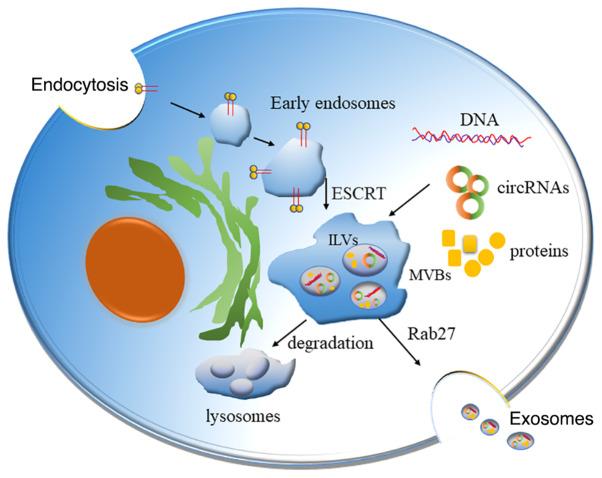
Exosomes are membrane vesicles with a diameter of 30-150 nm. Exosomes are secreted by various types of tumor cell and contain a variety of proteins, circular RNAs (circRNAs), microRNAs and DNA, depending on the host cells. Among them, circRNAs, which are long non-coding endogenous RNAs, form covalently closed and continuous loops that link the 3' and 5' terminals generated by back-splicing. circRNAs have become a hotspot of research. Exosomal circRNAs are in volved in the pathogenesis of cancer, especially metastasis, which is mainly ascribed to the frequently abnormal expression levels within neoplasms. Nonetheless, the functions and regulatory mechanisms of exosomal circRNAs in the progression of digestive system tumors (DSTs) remain unclear. More knowledge on the regulation and network interactions of exosomal circRNAs will help identify superior treatment strategies for the metastasis of DSTs. The present review aims to summarize the existing studies on the functions and mechanisms of exosomal circRNAs in tumorigenesis, and evaluate the associations between the dysregulation of exosomal circRNAs and tumor metastasis.
外泌体是直径为30 - 150纳米的膜性囊泡。外泌体由各种类型的肿瘤细胞分泌,根据宿主细胞的不同,其包含多种蛋白质、环状RNA(circRNA)、微小RNA和DNA。其中,circRNA作为长链非编码内源性RNA,形成共价闭合的连续环,连接由反向剪接产生的3'和5'末端。circRNA已成为研究热点。外泌体circRNA参与癌症发病机制,尤其是转移过程,这主要归因于肿瘤内其表达水平经常异常。尽管如此,外泌体circRNA在消化系统肿瘤(DST)进展中的功能和调控机制仍不清楚。更多关于外泌体circRNA调控和网络相互作用的知识将有助于确定DST转移的更优治疗策略。本综述旨在总结外泌体circRNA在肿瘤发生中的功能和机制的现有研究,并评估外泌体circRNA失调与肿瘤转移之间的关联。


 Zotero 插件