
中国中老年人群的不良童年经历与随后的慢性疾病及与人口统计学和社会经济特征的关联。
Adverse Childhood Experiences and Subsequent Chronic Diseases Among Middle-aged or Older Adults in China and Associations With Demographic and Socioeconomic Characteristics.
机构信息
School of Public Health, Sun Yat-sen University, Guangzhou, China.
出版信息
JAMA Netw Open. 2021 Oct 1;4(10):e2130143. doi: 10.1001/jamanetworkopen.2021.30143.
IMPORTANCE
Associations between adverse childhood experiences (ACEs) and chronic diseases among middle-aged or older Chinese individuals have not been well documented. In addition, whether demographic and socioeconomic characteristics modify any such associations has been underexplored.
OBJECTIVES
To examine associations between ACEs and subsequent chronic diseases and to assess whether age, sex, educational level, annual per capita household expenditure level, and childhood economic hardship modify these associations.
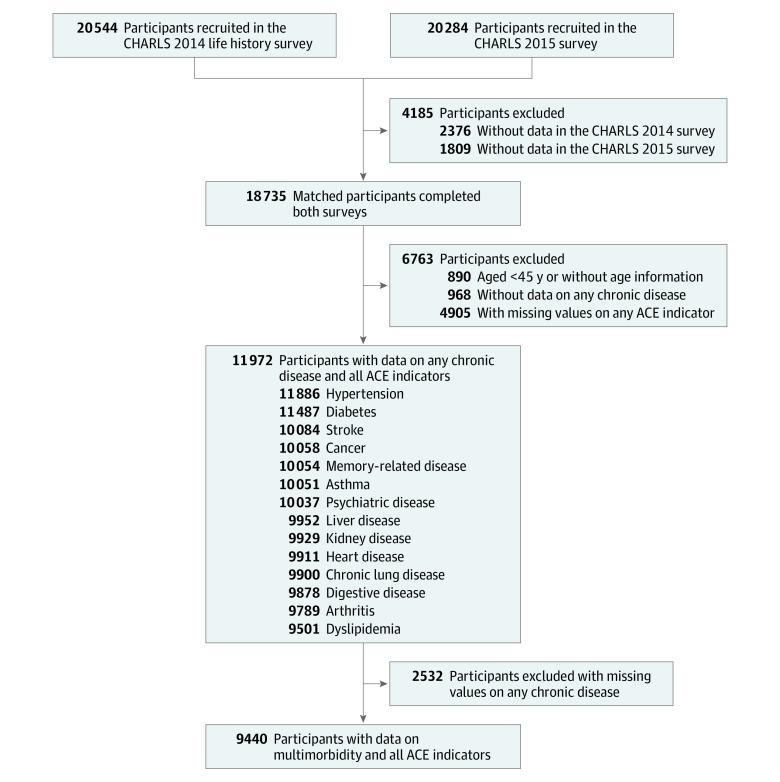
DESIGN, SETTING, AND PARTICIPANTS: This population-based cross-sectional study used data from the China Health and Retirement Longitudinal Study (CHARLS), a survey of residents aged 45 years or older in 28 provinces across China; specifically, the study used data from the CHARLS life history survey conducted from June 1 to December 31, 2014, and a CHARLS follow-up health survey conducted from July 1 to September 30, 2015. The study population included 11 972 respondents aged 45 years or older who had data on at least 1 of 14 specified chronic diseases and information on all 12 of the ACE indicators included in this study. Data analysis was performed from December 1 to 30, 2020.
EXPOSURES
Any of 12 ACEs (physical abuse, emotional neglect, household substance abuse, household mental illness, domestic violence, incarcerated household member, parental separation or divorce, unsafe neighborhood, bullying, parental death, sibling death, and parental disability), measured by indicators on a questionnaire. The number of ACEs per participant was summed and categorized into 1 of 5 cumulative-score groups: 0, 1, 2, 3, and 4 or more.
MAIN OUTCOMES AND MEASURES
Hypertension, dyslipidemia, diabetes, heart disease, stroke, chronic lung disease, asthma, liver disease, cancer, digestive disease, kidney disease, arthritis, psychiatric disease, and memory-related disease were defined by self-reported physician diagnoses or in combination with health assessment and medication data. Multimorbidity was defined as the presence of 2 or more of these 14 chronic diseases. Logistic regression models were used to assess associations of the 12 ACEs with the 14 chronic diseases and with multimorbidity. Modification of the associations by demographic and socioeconomic characteristics was assessed by stratified analyses and tests for interaction.
RESULTS
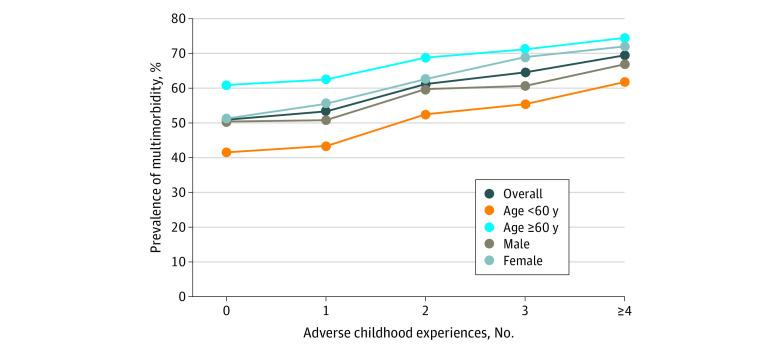
Of the 11 972 individuals included (mean [SD] age, 59.85 [9.56] years; 6181 [51.6%] were females), 80.9% had been exposed to at least 1 ACE and 18.0% reported exposure to 4 or more ACEs. Compared with those without ACE exposure, participants who experienced 4 or more ACEs had increased risks of dyslipidemia, chronic lung disease, asthma, liver disease, digestive disease, kidney disease, arthritis, psychiatric disease, memory-related disease, and multimorbidity. The estimated odds ratios (ORs) ranged from 1.27 (95% CI, 1.02-1.59) for dyslipidemia to 2.59 (95% CI, 2.16-3.11) for digestive disease. A dose-response association was also observed between the number of ACEs and the risk of most of the chronic diseases (excluding hypertension, diabetes, and cancer) (eg, chronic lung disease for ≥4 ACEs vs none: OR, 2.01; 95% CI, 1.59-2.55; P < .001 for trend) and of multimorbidity (for individuals among the overall study population with ≥4 ACEs vs none: OR, 2.03; 95% CI, 1.70-2.41; P < .001 for trend). The demographic or socioeconomic characteristics of age, sex, educational level, annual per capita household expenditure level, or childhood economic hardship were not shown to significantly modify the associations between ACEs and multimorbidity.
CONCLUSIONS AND RELEVANCE
In this population-based, cross-sectional study of adults in China, exposure to ACEs was associated with higher risks of chronic diseases regardless of demographic and socioeconomic characteristics during childhood or adulthood. These findings suggest a need to prevent ACEs and a need for a universal life-course public health strategy to reduce potential adverse health outcomes later in life among individuals who experience them.
重要性:在中国中年或老年人群中,不良童年经历(ACEs)与慢性疾病之间的关联尚未得到很好的记录。此外,这些关联是否受到人口统计学和社会经济特征的影响,这方面的研究还很少。
目的:本研究旨在探讨 ACEs 与随后发生的慢性疾病之间的关联,并评估年龄、性别、教育水平、人均家庭年度支出水平和童年经济困难是否会改变这些关联。
设计、地点和参与者:本基于人群的横断面研究使用了来自中国 28 个省份的 45 岁及以上居民的中国健康与退休纵向研究(CHARLS)的数据;具体来说,研究使用了 2014 年 6 月 1 日至 12 月 31 日进行的 CHARLS 生活史调查的数据,以及 2015 年 7 月 1 日至 9 月 30 日进行的 CHARLS 后续健康调查的数据。研究人群包括 11972 名年龄在 45 岁及以上的应答者,这些应答者至少有 1 种指定慢性疾病的数据,并且有本研究中包含的 12 个 ACE 指标的信息。数据分析于 2020 年 12 月 1 日至 30 日进行。
暴露:任何 12 种 ACE(身体虐待、情感忽视、家庭物质滥用、家庭精神疾病、家庭暴力、监禁家庭成员、父母离异或分居、不安全的邻里环境、欺凌、父母死亡、兄弟姐妹死亡、父母残疾),通过问卷上的指标进行衡量。每位参与者的 ACE 数量相加,并分为 5 个累积评分组之一:0、1、2、3 和 4 个或更多。
主要结果和措施:高血压、血脂异常、糖尿病、心脏病、中风、慢性肺病、哮喘、肝病、癌症、消化系统疾病、肾病、关节炎、精神疾病和与记忆相关的疾病,是通过医生诊断或结合健康评估和药物数据来定义的。多种慢性疾病定义为存在 2 种或多种上述 14 种慢性疾病。使用 logistic 回归模型评估 12 种 ACE 与 14 种慢性疾病以及多种慢性疾病之间的关联。通过分层分析和交互作用检验评估人口统计学和社会经济特征对关联的修饰作用。
结果:在纳入的 11972 名个体中(平均[标准差]年龄为 59.85[9.56]岁;6181[51.6%]为女性),80.9%的个体至少经历过 1 种 ACE,18.0%的个体报告经历过 4 种或更多 ACE。与没有 ACE 暴露的参与者相比,经历过 4 种或更多 ACE 的参与者患血脂异常、慢性肺病、哮喘、肝病、消化系统疾病、肾病、关节炎、精神疾病、与记忆相关的疾病和多种慢性疾病的风险增加。估计的比值比(ORs)范围从血脂异常的 1.27(95%CI,1.02-1.59)到消化系统疾病的 2.59(95%CI,2.16-3.11)。(除高血压、糖尿病和癌症外)大多数慢性疾病(慢性肺病的 ACE 数≥4 与无 ACE:OR,2.01;95%CI,1.59-2.55;P<.001 趋势)和多种慢性疾病(在总体研究人群中,ACE 数≥4 与无 ACE:OR,2.03;95%CI,1.70-2.41;P<.001 趋势)与 ACE 数量之间也存在剂量-反应关系。年龄、性别、教育水平、人均家庭年度支出水平或童年经济困难等人口统计学或社会经济特征并未显示出显著改变 ACE 与多种慢性疾病之间的关联。
结论:在这项基于人群的横断面研究中,中国成年人经历 ACEs 与慢性疾病风险增加相关,无论儿童期还是成年期的人口统计学和社会经济特征如何。这些发现表明,需要预防 ACEs,并需要采取普遍的生命历程公共卫生策略,以减少经历 ACEs 的个体在以后生活中潜在的不良健康后果。
 Zotero 插件