
SARS-CoV-2 的隐匿传播和第一波 COVID-19 疫情。
Cryptic transmission of SARS-CoV-2 and the first COVID-19 wave.
机构信息
Laboratory for the Modeling of Biological and Socio-technical Systems, Northeastern University, Boston, MA, USA.
Networks and Urban Systems Centre, University of Greenwich, London, UK.
出版信息
Nature. 2021 Dec;600(7887):127-132. doi: 10.1038/s41586-021-04130-w. Epub 2021 Oct 25.
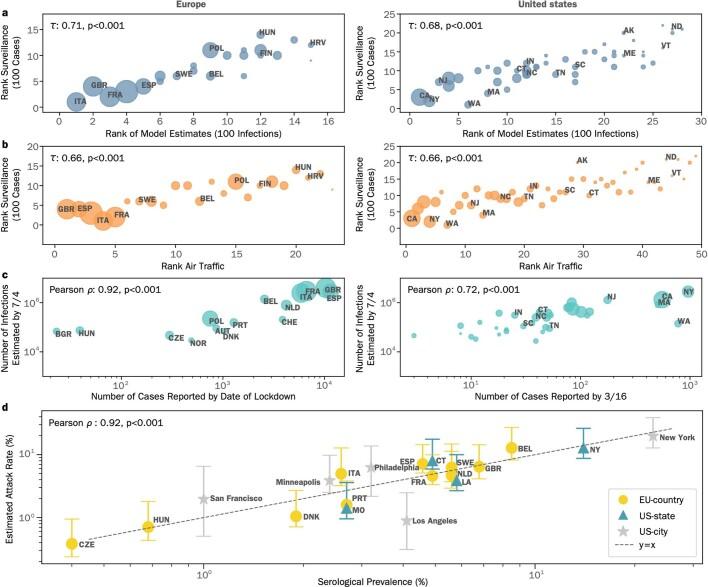
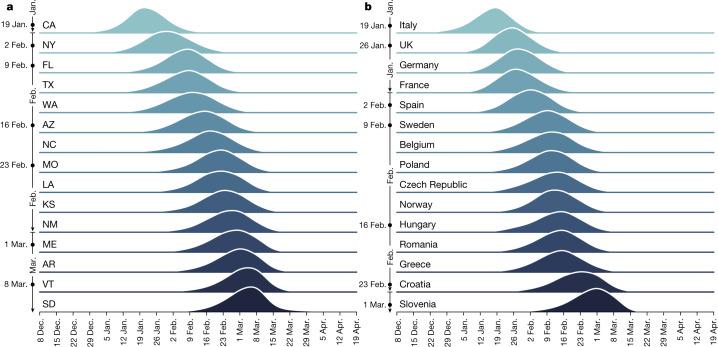
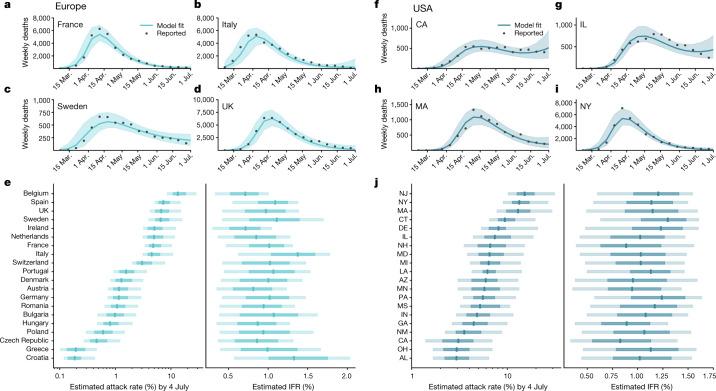
Considerable uncertainty surrounds the timeline of introductions and onsets of local transmission of severe acute respiratory syndrome coronavirus 2 (SARS-CoV-2) globally. Although a limited number of SARS-CoV-2 introductions were reported in January and February 2020 (refs.), the narrowness of the initial testing criteria, combined with a slow growth in testing capacity and porous travel screening, left many countries vulnerable to unmitigated, cryptic transmission. Here we use a global metapopulation epidemic model to provide a mechanistic understanding of the early dispersal of infections and the temporal windows of the introduction of SARS-CoV-2 and onset of local transmission in Europe and the USA. We find that community transmission of SARS-CoV-2 was likely to have been present in several areas of Europe and the USA by January 2020, and estimate that by early March, only 1 to 4 in 100 SARS-CoV-2 infections were detected by surveillance systems. The modelling results highlight international travel as the key driver of the introduction of SARS-CoV-2, with possible introductions and transmission events as early as December 2019 to January 2020. We find a heterogeneous geographic distribution of cumulative infection attack rates by 4 July 2020, ranging from 0.78% to 15.2% across US states and 0.19% to 13.2% in European countries. Our approach complements phylogenetic analyses and other surveillance approaches and provides insights that can be used to design innovative, model-driven surveillance systems that guide enhanced testing and response strategies.
全球范围内严重急性呼吸综合征冠状病毒 2(SARS-CoV-2)的引入和本地传播的时间线存在相当大的不确定性。尽管 2020 年 1 月和 2 月报告了有限数量的 SARS-CoV-2 引入病例(参考文献),但初始检测标准的局限性,加上检测能力的缓慢增长和旅行筛查的漏洞,使许多国家容易受到未经缓解的、隐蔽的传播的影响。在这里,我们使用全球元种群流行模型来提供对 SARS-CoV-2 早期传播和欧洲及美国 SARS-CoV-2 引入和本地传播开始的时间窗口的机制理解。我们发现,到 2020 年 1 月,SARS-CoV-2 的社区传播可能已经在欧洲和美国的几个地区存在,并且估计到 3 月初,只有 1 到 4 例 SARS-CoV-2 感染被监测系统检测到。建模结果强调了国际旅行是 SARS-CoV-2 引入的关键驱动因素,可能早在 2019 年 12 月至 2020 年 1 月就已经发生了引入和传播事件。到 2020 年 7 月 4 日,我们发现累积感染攻击率在地理上存在不均匀分布,美国各州的范围从 0.78%到 15.2%,欧洲国家的范围从 0.19%到 13.2%。我们的方法补充了系统发生分析和其他监测方法,并提供了可以用于设计创新的、基于模型的监测系统的见解,这些系统可以指导增强的测试和响应策略。


 Zotero 插件