
在囊性纤维化中联合使用阿奇霉素和吸入妥布霉素的疗效测试:一项随机对照临床试验。
Testing the effects of combining azithromycin with inhaled tobramycin for in cystic fibrosis: a randomised, controlled clinical trial.
机构信息
Department of Pediatrics, University of Washington School of Medicine, Seattle, Washington, USA
Cystic Fibrosis Foundation Therapeutics Development Network Coordinating Centre, Seattle Children's Research Institute, Seattle, Washington, USA.
出版信息
Thorax. 2022 Jun;77(6):581-588. doi: 10.1136/thoraxjnl-2021-217782. Epub 2021 Oct 27.
RATIONALE
Inhaled tobramycin and oral azithromycin are common chronic therapies in people with cystic fibrosis and airway infection. Some studies have shown that azithromycin can reduce the ability of tobramycin to kill . This trial was done to test the effects of combining azithromycin with inhaled tobramycin on clinical and microbiological outcomes in people already using inhaled tobramycin. We theorised that those randomised to placebo (no azithromycin) would have greater improvement in forced expiratory volume in one second (FEV) and greater reduction in sputum in response to tobramycin.
METHODS
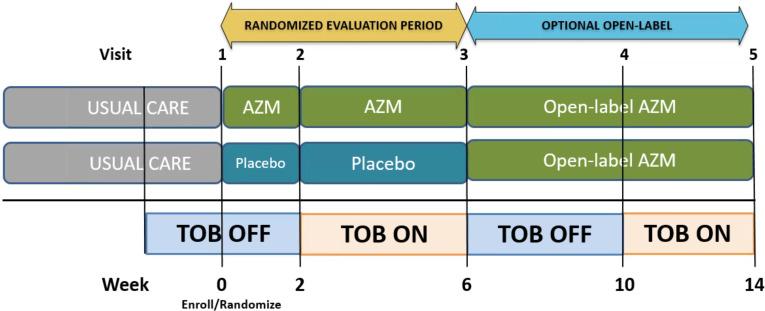
A 6-week prospective, randomised, placebo-controlled, double-blind trial testing oral azithromycin versus placebo combined with clinically prescribed inhaled tobramycin in individuals with cystic fibrosis and airway infection.
RESULTS
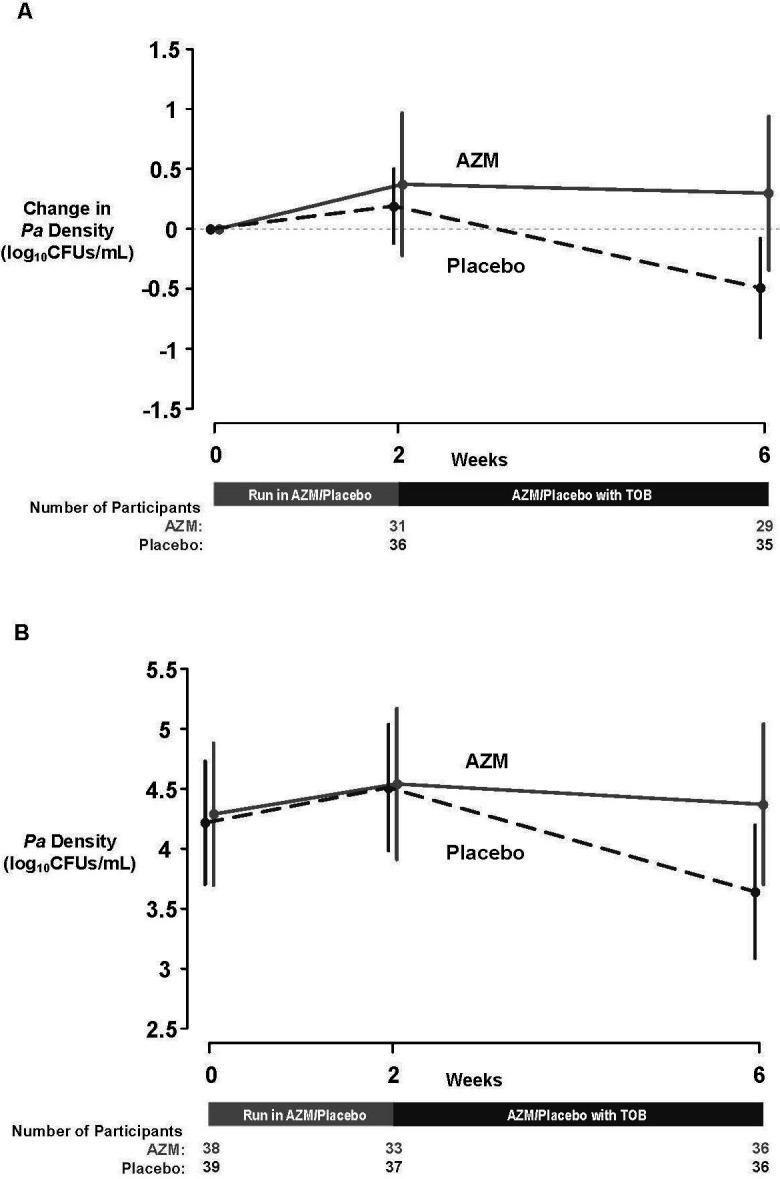
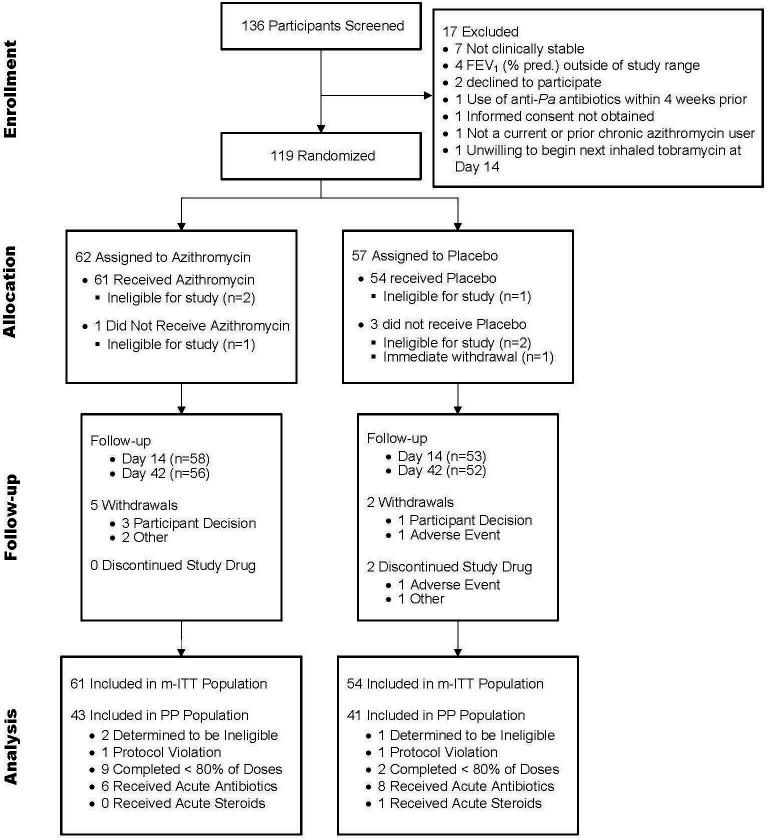
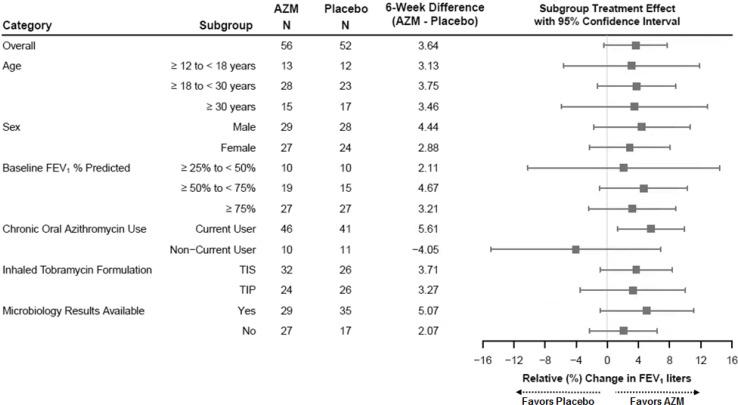
Over a 6-week period, including 4 weeks of inhaled tobramycin, the relative change in FEV did not statistically significantly differ between groups (azithromycin (n=56) minus placebo (n=52) difference: 3.44%; 95% CI: -0.48 to 7.35; p=0.085). Differences in secondary clinical outcomes, including patient-reported symptom scores, weight and need for additional antibiotics, did not significantly differ. Among the 29 azithromycin and 35 placebo participants providing paired sputum samples, the 6-week change in density differed in favour of the placebo group (difference: 0.75 log CFU/mL; 95% CI: 0.03 to 1.47; p=0.043).
CONCLUSIONS
Despite having greater reduction in density in participants able to provide sputum samples, participants randomised to placebo with inhaled tobramycin did not experience significantly greater improvements in lung function or other clinical outcomes compared with those randomised to azithromycin with tobramycin.
背景
妥布霉素吸入剂和阿奇霉素口服剂是囊性纤维化患者气道感染的常见慢性治疗药物。一些研究表明,阿奇霉素可以降低妥布霉素的杀菌能力。本试验旨在测试在已经使用妥布霉素吸入剂的患者中,联合使用阿奇霉素与吸入用妥布霉素对临床和微生物学结果的影响。我们推测,随机分配至安慰剂(无阿奇霉素)组的患者对妥布霉素的反应会使一秒用力呼气容积(FEV)的改善更大,痰液减少更多。
方法
一项为期 6 周的前瞻性、随机、安慰剂对照、双盲试验,在囊性纤维化合并气道感染患者中,测试口服阿奇霉素与安慰剂联合临床处方妥布霉素吸入剂的效果。
结果
在 6 周的治疗期间,包括 4 周的妥布霉素吸入,FEV 的相对变化在两组间无统计学差异(阿奇霉素组(n=56)减去安慰剂组(n=52)差值:3.44%;95%CI:-0.48 至 7.35;p=0.085)。次要临床结局的差异,包括患者报告的症状评分、体重和对额外抗生素的需求,也无显著差异。在提供配对痰液样本的 29 名阿奇霉素组和 35 名安慰剂组患者中,6 周时 密度的变化有利于安慰剂组(差值:0.75 log CFU/mL;95%CI:0.03 至 1.47;p=0.043)。
结论
尽管能够提供痰液样本的患者中 密度降低幅度更大,但与随机分配至妥布霉素+阿奇霉素组的患者相比,随机分配至妥布霉素+安慰剂组的患者在肺功能或其他临床结局方面并未显著改善。

 Zotero 插件