
量化热对人体体力工作能力的影响;第三部分:太阳辐射的影响随空气温度、湿度和衣物覆盖范围而变化。
Quantifying the impact of heat on human physical work capacity; part III: the impact of solar radiation varies with air temperature, humidity, and clothing coverage.
机构信息
Environmental Ergonomics Research Centre, Loughborough University, Loughborough, LE11 3TU, UK.
Thermal Ergonomics Laboratory, University of Sydney, Sydney, NSW, Australia.
出版信息
Int J Biometeorol. 2022 Jan;66(1):175-188. doi: 10.1007/s00484-021-02205-x. Epub 2021 Oct 28.
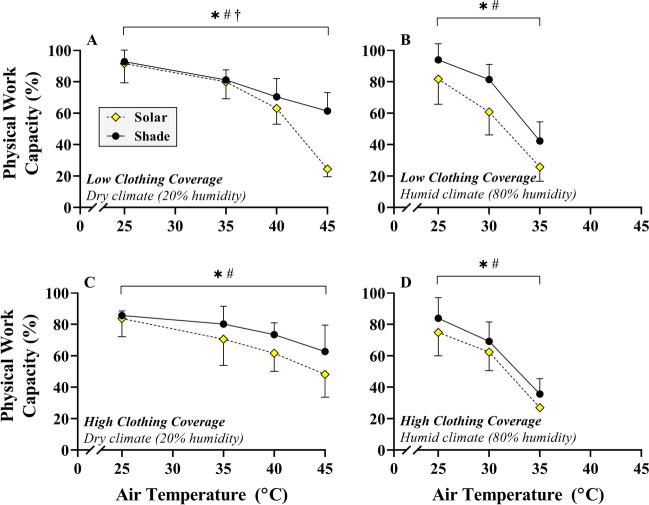
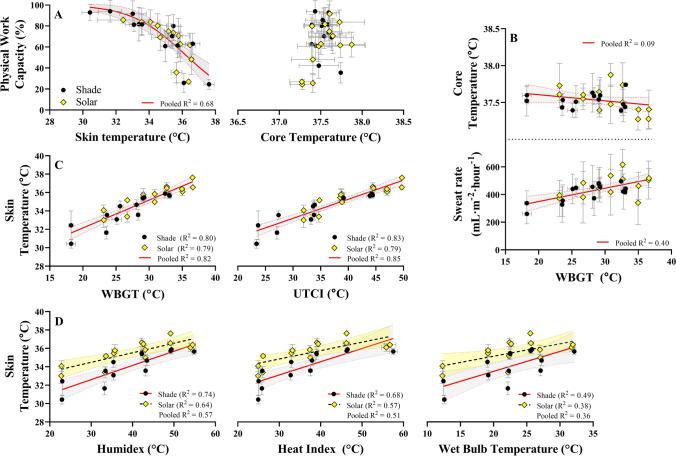
Heat stress decreases human physical work capacity (PWC), but the extent to which solar radiation (SOLAR) compounds this response is not well understood. This study empirically quantified how SOLAR impacts PWC in the heat, considering wide, but controlled, variations in air temperature, humidity, and clothing coverage. We also provide correction equations so PWC can be quantified outdoors using heat stress indices that do not ordinarily account for SOLAR (including the Heat Stress Index, Humidex, and Wet-Bulb Temperature). Fourteen young adult males (7 donning a work coverall, 7 with shorts and trainers) walked for 1 h at a fixed heart rate of 130 beats∙min1, in seven combinations of air temperature (25 to 45°C) and relative humidity (20 or 80%), with and without SOLAR (800 W/m from solar lamps). Cumulative energy expenditure in the heat, relative to the work achieved in a cool reference condition, was used to determine PWC%. Skin temperature was the primary determinant of PWC in the heat. In dry climates with exposed skin (0.3 Clo), SOLAR caused PWC to decrease exponentially with rising air temperature, whereas work coveralls (0.9 Clo) negated this effect. In humid conditions, the SOLAR-induced reduction in PWC was consistent and linear across all levels of air temperature and clothing conditions. Wet-Bulb Globe Temperature and the Universal Thermal Climate Index represented SOLAR correctly and did not require a correction factor. For the Heat Stress Index, Humidex, and Wet-Bulb Temperature, correction factors are provided enabling forecasting of heat effects on work productivity.
热应激会降低人体的体力工作能力(PWC),但太阳辐射(SOLAR)对这种反应的影响程度尚不清楚。本研究通过实证量化了 SOLAR 在热环境中对 PWC 的影响,考虑了空气温度、湿度和服装覆盖范围的广泛但受控的变化。我们还提供了校正方程,以便使用通常不考虑 SOLAR 的热应激指数(包括热应激指数、湿球温度和湿球黑球温度)在户外量化 PWC。14 名年轻男性(7 名穿着工作服,7 名穿着短裤和运动鞋)以 130 次/分钟的固定心率行走 1 小时,在空气温度(25 至 45°C)和相对湿度(20 或 80%)的七种组合下进行,有和没有 SOLAR(来自太阳灯的 800 W/m)。与凉爽参考条件下完成的工作量相比,热环境中的累积能量消耗用于确定 PWC%。皮肤温度是热环境中 PWC 的主要决定因素。在干燥气候下,暴露的皮肤(0.3 Clo),SOLAR 会导致 PWC 随空气温度的升高呈指数下降,而工作服(0.9 Clo)则会消除这种影响。在潮湿条件下,SOLAR 引起的 PWC 降低在所有空气温度和服装条件下都是一致的和线性的。湿球黑球温度和通用热气候指数正确地代表了 SOLAR,不需要校正因子。对于热应激指数、湿球温度和湿球黑球温度,提供了校正因子,以便预测热对工作生产力的影响。

 Zotero 插件