
用于个性化健康维护和疾病预防的数字韧性生物标志物。
Digital Resilience Biomarkers for Personalized Health Maintenance and Disease Prevention.
作者信息
van den Brink Willem, Bloem Robbert, Ananth Adithya, Kanagasabapathi Thiru, Amelink Arjen, Bouwman Jildau, Gelinck Gerwin, van Veen Sjaak, Boorsma Andre, Wopereis Suzan
机构信息
Department of Microbiology and Systems Biology, Netherlands Organization for Applied Scientific Research (TNO), Zeist, Netherlands.
Department of Environmental Modeling Sensing and Analysis, Netherlands Organization for Applied Scientific Research (TNO), Utrecht, Netherlands.
出版信息
Front Digit Health. 2021 Jan 22;2:614670. doi: 10.3389/fdgth.2020.614670. eCollection 2020.
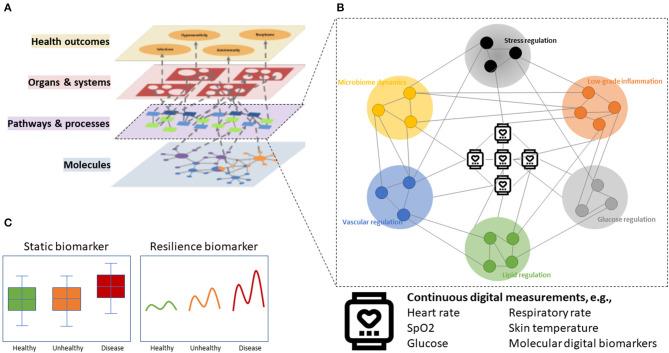
Health maintenance and disease prevention strategies become increasingly prioritized with increasing health and economic burden of chronic, lifestyle-related diseases. A key element in these strategies is the empowerment of individuals to control their health. Self-measurement plays an essential role in achieving such empowerment. Digital measurements have the advantage of being measured non-invasively, passively, continuously, and in a real-world context. An important question is whether such measurement can sensitively measure subtle disbalances in the progression toward disease, as well as the subtle effects of, for example, nutritional improvement. The concept of resilience biomarkers, defined as the dynamic evaluation of the biological response to an external challenge, has been identified as a viable strategy to measure these subtle effects. In this review, we explore the potential of integrating this concept with digital physiological measurements to come to digital resilience biomarkers. Additionally, we discuss the potential of wearable, non-invasive, and continuous measurement of molecular biomarkers. These types of innovative measurements may, in the future, also serve as a digital resilience biomarker to provide even more insight into the personal biological dynamics of an individual. Altogether, digital resilience biomarkers are envisioned to allow for the measurement of subtle effects of health maintenance and disease prevention strategies in a real-world context and thereby give personalized feedback to improve health.
随着慢性、与生活方式相关疾病的健康和经济负担日益加重,健康维护和疾病预防策略的优先级越来越高。这些策略的一个关键要素是增强个人控制自身健康的能力。自我测量在实现这种能力增强方面发挥着至关重要的作用。数字测量具有非侵入性、被动性、连续性以及能在现实环境中进行测量的优势。一个重要问题是,这种测量能否灵敏地检测出疾病进展过程中的细微失衡,以及诸如营养改善等的细微影响。弹性生物标志物的概念被定义为对生物对外界挑战的反应进行动态评估,已被确定为测量这些细微影响的可行策略。在本综述中,我们探讨将这一概念与数字生理测量相结合以形成数字弹性生物标志物的潜力。此外,我们还讨论了可穿戴式、非侵入性和连续测量分子生物标志物的潜力。未来,这些类型的创新测量也可能作为数字弹性生物标志物,以便更深入地了解个体的个人生物动态。总体而言,数字弹性生物标志物有望在现实环境中测量健康维护和疾病预防策略的细微影响,从而提供个性化反馈以改善健康。

 Zotero 插件