
枯草芽孢杆菌 degQ 基因的表达及其对脂肽产量和分泌蛋白酶形成的影响。
Expression of degQ gene and its effect on lipopeptide production as well as formation of secretory proteases in Bacillus subtilis strains.
机构信息
Department of Bioprocess Engineering (150k), Institute of Food Science and Biotechnology (150), University of Hohenheim, Stuttgart, Germany.
出版信息
Microbiologyopen. 2021 Oct;10(5):e1241. doi: 10.1002/mbo3.1241.
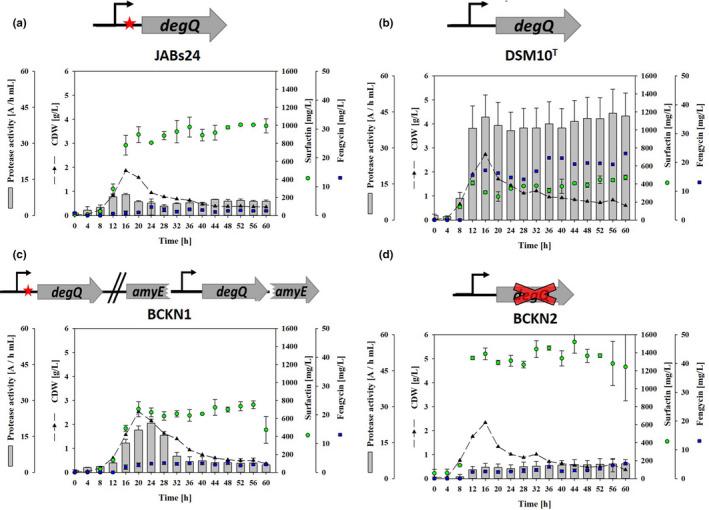
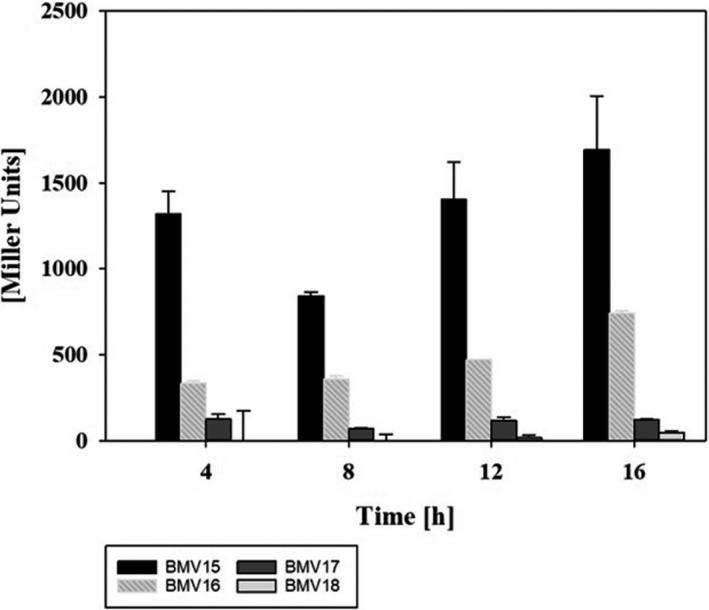
Bacillus subtilis is described as a promising production strain for lipopeptides. In the case of B. subtilis strains JABs24 and DSM10 , surfactin and plipastatin are produced. Lipopeptide formation is controlled, among others, by the DegU response regulator. The activating phospho-transfer by the DegS sensor kinase is stimulated by the pleiotropic regulator DegQ, resulting in enhanced DegU activation. In B. subtilis 168, a point mutation in the degQ promoter region leads to a reduction in gene expression. Corresponding reporter strains showed a 14-fold reduced expression. This effect on degQ expression and the associated impact on lipopeptide formation was examined for B. subtilis JABs24, a lipopeptide-producing derivative of strain 168, and B. subtilis wild-type strain DSM10 , which has a native degQ expression. Based on the stimulatory effects of the DegU regulator on secretory protease formation, the impact of degQ expression on extracellular protease activity was additionally investigated. To follow the impact of degQ, a deletion mutant was constructed for DSM10 , while a natively expressed degQ version was integrated into strain JABs24. This allowed strain-specific quantification of the stimulatory effect of degQ expression on plipastatin and the negative effect on surfactin production in strains JABs24 and DSM10 . While an unaffected degQ expression reduced surfactin production in JABs24 by about 25%, a sixfold increase in plipastatin was observed. In contrast, degQ deletion in DSM10 increased surfactin titer by threefold but decreased plipastatin production by fivefold. In addition, although significant differences in extracellular protease activity were detected, no decrease in plipastatin and surfactin produced during cultivation was observed.
枯草芽孢杆菌被描述为生产脂肽的有前途的生产菌株。在枯草芽孢杆菌菌株 JABs24 和 DSM10 的情况下,产生表面活性剂和普利司他汀。脂肽的形成受到 DegU 反应调节剂的控制。DegS 传感器激酶的激活磷酸转移受到多效调节剂 DegQ 的刺激,从而增强 DegU 的激活。在枯草芽孢杆菌 168 中,degQ 启动子区域的点突变导致基因表达减少。相应的报告菌株显示表达降低了 14 倍。对枯草芽孢杆菌 JABs24(168 菌株的脂肽生产衍生物)和枯草芽孢杆菌野生型菌株 DSM10(具有天然 degQ 表达)进行了 degQ 表达的这种影响以及对脂肽形成的相关影响的检查。基于 DegU 调节剂对分泌蛋白酶形成的刺激作用,进一步研究了 degQ 表达对细胞外蛋白酶活性的影响。为了跟踪 degQ 的影响,构建了 DSM10 的缺失突变体,同时将天然表达的 degQ 版本整合到菌株 JABs24 中。这允许对菌株特异性定量研究 degQ 表达对 JABs24 中普利司他汀的刺激作用以及对 JABs24 和 DSM10 中表面活性剂生产的负面影响。虽然不受影响的 degQ 表达使 JABs24 中的表面活性剂产量降低了约 25%,但观察到普利司他汀的产量增加了六倍。相比之下,DSM10 中的 degQ 缺失使表面活性剂的效价增加了三倍,但普利司他汀的产量减少了五倍。此外,尽管检测到细胞外蛋白酶活性存在显著差异,但在培养过程中未观察到普利司他汀和表面活性剂产量的降低。

 Zotero 插件