
Toll 样受体及其在胶质瘤免疫治疗中的靶向作用
Toll-like receptors and toll-like receptor-targeted immunotherapy against glioma.
机构信息
Department of Basic Medicine and Biomedical Engineering, School of Medicine, Foshan University, Foshan, 528000, Guangdong Province, China.
Affiliated Cancer Hospital and Institute of Guangzhou Medical University, No.78 Heng-Zhi-Gang Road, Yue Xiu District, Guangzhou, 510095, China.
出版信息
J Hematol Oncol. 2021 Oct 29;14(1):176. doi: 10.1186/s13045-021-01191-2.
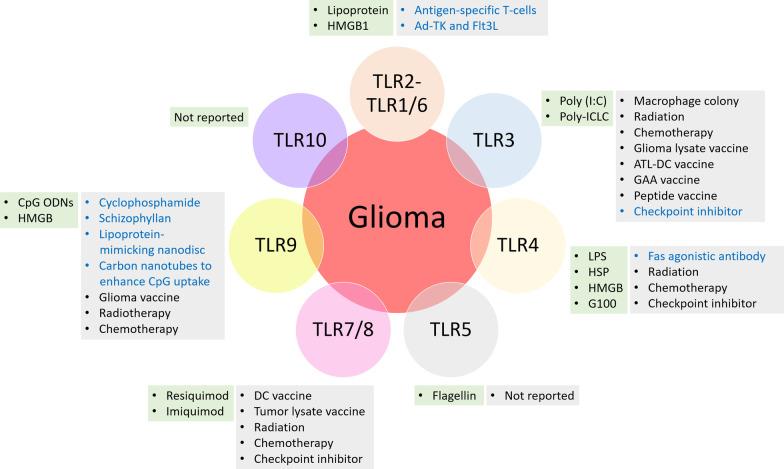
Glioma represents a fast proliferating and highly invasive brain tumor which is resistant to current therapies and invariably recurs. Despite some advancements in anti-glioma therapies, patients' prognosis remains poor. Toll-like receptors (TLRs) act as the first line of defense in the immune system being the detectors of those associated with bacteria, viruses, and danger signals. In the glioma microenvironment, TLRs are expressed on both immune and tumor cells, playing dual roles eliciting antitumoral (innate and adaptive immunity) and protumoral (cell proliferation, migration, invasion, and glioma stem cell maintenance) responses. Up to date, several TLR-targeting therapies have been developed aiming at glioma bulk and stem cells, infiltrating immune cells, the immune checkpoint axis, among others. While some TLR agonists exhibited survival benefit in clinical trials, it attracts more attention when they are involved in combinatorial treatment with radiation, chemotherapy, immune vaccination, and immune checkpoint inhibition in glioma treatment. TLR agonists can be used as immune modulators to enhance the efficacy of other treatment, to avoid dose accumulation, and what brings more interests is that they can potentiate immune checkpoint delayed resistance to PD-1/PD-L1 blockade by upregulating PD-1/PD-L1 overexpression, thus unleash powerful antitumor responses when combined with immune checkpoint inhibitors. Herein, we focus on recent developments and clinical trials exploring TLR-based treatment to provide a picture of the relationship between TLR and glioma and their implications for immunotherapy.
神经胶质瘤是一种快速增殖且高度侵袭性的脑肿瘤,对当前的治疗方法具有耐药性,且总是复发。尽管在抗神经胶质瘤治疗方面取得了一些进展,但患者的预后仍然较差。Toll 样受体 (TLR) 作为免疫系统的第一道防线,是检测与细菌、病毒和危险信号相关物质的传感器。在神经胶质瘤微环境中,TLR 在免疫细胞和肿瘤细胞上均有表达,发挥双重作用,引发抗肿瘤(先天和适应性免疫)和促肿瘤(细胞增殖、迁移、侵袭和神经胶质瘤干细胞维持)反应。迄今为止,已经开发了几种针对神经胶质瘤实质和干细胞、浸润免疫细胞、免疫检查点轴等的 TLR 靶向治疗方法。虽然一些 TLR 激动剂在临床试验中表现出生存获益,但当它们与放疗、化疗、免疫疫苗接种和免疫检查点抑制联合应用于神经胶质瘤治疗时,引起了更多关注。TLR 激动剂可用作免疫调节剂,以增强其他治疗的疗效,避免剂量累积,更有趣的是,它们可以通过上调 PD-1/PD-L1 过表达来增强免疫检查点对 PD-1/PD-L1 阻断的延迟耐药性,从而在与免疫检查点抑制剂联合使用时释放强大的抗肿瘤反应。本文重点介绍了探索 TLR 为基础的治疗方法的最新进展和临床试验,为 TLR 与神经胶质瘤之间的关系及其对免疫治疗的影响提供了一幅图景。


 Zotero 插件