
治疗初发精神分裂症与强迫症患者静息态自发脑活动的比较。
Comparison of resting-state spontaneous brain activity between treatment-naive schizophrenia and obsessive-compulsive disorder.
机构信息
Department of Psychiatry, the Affiliated Wuxi Mental Health Center of Nanjing Medical University, Wuxi, Jiangsu, 214151, People's Republic of China.
School of Mental Health and Psychological Sciences, Anhui Medical University, Hefei, Anhui, 230032, People's Republic of China.
出版信息
BMC Psychiatry. 2021 Nov 3;21(1):544. doi: 10.1186/s12888-021-03554-y.
BACKGROUND
Schizophrenia (SZ) and obsessive-compulsive disorder (OCD) share many demographic characteristics and severity of clinical symptoms, genetic risk factors, pathophysiological underpinnings, and brain structure and function. However, the differences in the spontaneous brain activity patterns between the two diseases remain unclear. Here this study aimed to compare the features of intrinsic brain activity in treatment-naive participants with SZ and OCD and to explore the relationship between spontaneous brain activity and the severity of symptoms.
METHODS
In this study, 22 treatment-naive participants with SZ, 27 treatment-naive participants with OCD, and sixty healthy controls (HC) underwent a resting-state functional magnetic resonance imaging (fMRI) scan. The amplitude of low-frequency fluctuation (ALFF), regional homogeneity (ReHo) and degree of centrality (DC) were performed to examine the intrinsic brain activity of participants. Additionally, the relationships among spontaneous brain activity, the severity of symptoms, and the duration of illness were explored in SZ and OCD groups.
RESULTS
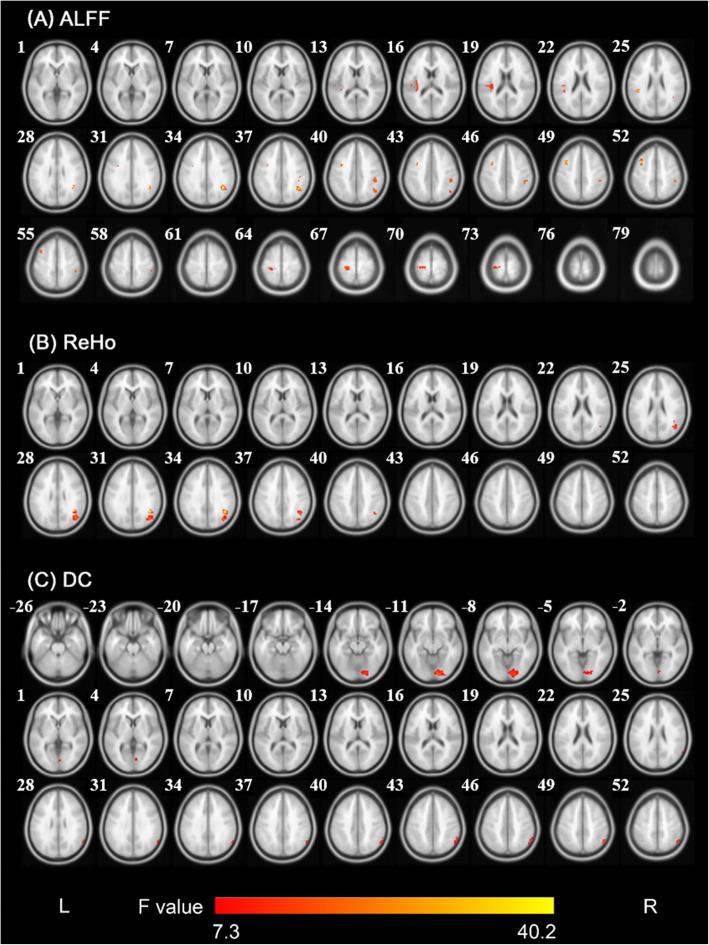
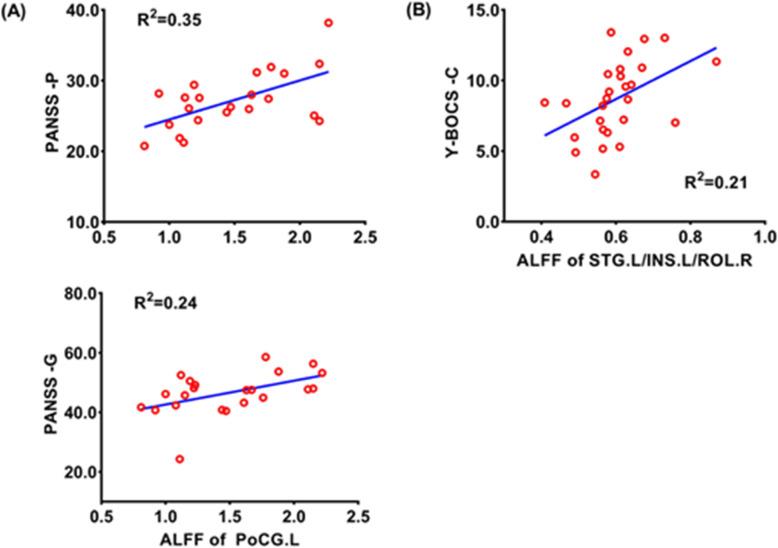
Compared with SZ group and HC group, participants with OCD had significantly higher ALFF in the right angular gyrus and the left middle frontal gyrus/precentral gyrus and significantly lower ALFF in the left superior temporal gyrus/insula/rolandic operculum and the left postcentral gyrus, while there was no significant difference in ALFF between SZ group and HC group. Compared with HC group, lower ALFF in the right supramarginal gyrus/inferior parietal lobule and lower DC in the right lingual gyrus/calcarine fissure and surrounding cortex of the two patient groups, higher ReHo in OCD group and lower ReHo in SZ group in the right angular gyrus/middle occipital gyrus brain region were documented in the present study. DC in SZ group was significantly higher than that in HC group in the right inferior parietal lobule/angular gyrus, while there were no significant DC differences between OCD group and HC group. In addition, ALFF in the left postcentral gyrus were positively correlated with positive subscale score (r = 0.588, P = 0.013) and general psychopathology subscale score (r = 0.488, P = 0.047) respectively on the Positive and Negative Syndrome Scale (PANSS) in SZ group. ALFF in the left superior temporal gyrus/insula/rolandic operculum of participants with OCD were positively correlated with compulsion subscale score (r = 0.463, P = 0.030) on the Yale-Brown Obsessive-Compulsive Scale (Y-BOCS). The longer the illness duration in SZ group, the smaller the ALFF of the left superior temporal gyrus/insula/rolandic operculum (Rho = 0.-492, P = 0.020). The longer the illness duration in OCD group, the higher the ALFF of the right supramarginal gyrus/inferior parietal lobule (Rho = 0.392, P = 0.043) and the left postcentral gyrus (Rho = 0.385, P = 0.048), and the lower the DC of the right inferior parietal lobule/angular gyrus (Rho = - 0.518, P = 0.006).
CONCLUSION
SZ and OCD show some similarities in spontaneous brain activity in parietal and occipital lobes, but exhibit different patterns of spontaneous brain activity in frontal, temporal, parietal, occipital, and insula brain regions, which might imply different underlying neurobiological mechanisms in the two diseases. Compared with OCD, SZ implicates more significant abnormalities in the functional connections among brain regions.
背景
精神分裂症(SZ)和强迫症(OCD)在人口统计学特征和临床症状严重程度、遗传风险因素、病理生理基础以及大脑结构和功能方面有许多相似之处。然而,这两种疾病之间自发性脑活动模式的差异仍不清楚。本研究旨在比较未经治疗的 SZ 和 OCD 患者的大脑内源性活动特征,并探讨自发性脑活动与症状严重程度之间的关系。
方法
本研究纳入 22 例未经治疗的 SZ 患者、27 例未经治疗的 OCD 患者和 60 名健康对照者(HC)进行静息态功能磁共振成像(fMRI)扫描。采用幅度低频波动(ALFF)、局部一致性(ReHo)和中心度(DC)分析来检测参与者的大脑内源性活动。此外,还在 SZ 和 OCD 组中探讨了自发性脑活动与症状严重程度和病程之间的关系。
结果
与 SZ 组和 HC 组相比,OCD 组右侧角回和左侧额中回/额下回的 ALFF 显著升高,左侧颞上回/岛叶/回旋部和左侧中央后回的 ALFF 显著降低,而 SZ 组与 HC 组之间的 ALFF 无显著差异。与 HC 组相比,两组患者的右侧顶下小叶/顶下叶和右侧舌回/楔前叶和周围皮质的 DC 降低,OCD 组右侧角回/中枕叶的 ReHo 升高,SZ 组右侧角回/中枕叶的 ReHo 降低。SZ 组右侧顶下小叶/角回的 DC 明显高于 HC 组,而 OCD 组与 HC 组之间的 DC 无明显差异。此外,SZ 组左侧中央后回的 ALFF 与阳性症状量表(PANSS)的阳性症状分量表评分(r = 0.588,P = 0.013)和一般精神病症状分量表评分(r = 0.488,P = 0.047)呈正相关。OCD 组左侧颞上回/岛叶/回旋部的 ALFF 与耶鲁-布朗强迫症量表(Y-BOCS)的强迫症状分量表评分呈正相关(r = 0.463,P = 0.030)。SZ 组病程越长,左侧颞上回/岛叶/回旋部的 ALFF 越小(Rho = -0.492,P = 0.020)。OCD 组病程越长,右侧顶下小叶/顶下叶的 ALFF 越高(Rho = 0.392,P = 0.043)和左侧中央后回的 ALFF 越高(Rho = 0.385,P = 0.048),右侧顶下小叶/角回的 DC 越低(Rho = -0.518,P = 0.006)。
结论
SZ 和 OCD 在顶叶和枕叶的自发性脑活动中存在一些相似之处,但在前额叶、颞叶、顶叶、枕叶和岛叶的脑区中表现出不同的自发性脑活动模式,这可能意味着这两种疾病存在不同的潜在神经生物学机制。与 OCD 相比,SZ 涉及到大脑区域之间功能连接的更显著异常。


 Zotero 插件