
纳米脂质体伊立替康联合氟尿嘧啶和亚叶酸治疗转移性胰腺导管腺癌二线治疗选择:一项回顾性队列研究。
Nanoliposomal irinotecan plus fluorouracil and folinic acid as a second-line treatment option in patients with metastatic pancreatic ductal adenocarcinoma: a retrospective cohort study.
机构信息
Division of Medical Oncology, Department of Internal Medicine, Cancer Research Institute, College of Medicine, The Catholic University of Korea, Seoul St. Mary's Hospital, 222 Banpo-daero, Secho-gu, Seoul, South Korea.
Division of Medical Oncology, Department of Internal Medicine, The Catholic University of Korea, St. Vincent's Hospital, Suwon, South Korea.
出版信息
BMC Cancer. 2021 Nov 3;21(1):1176. doi: 10.1186/s12885-021-08887-1.
BACKGROUND
According to the NAPOLI-1 trial, nanoliposomal irinotecan (nal-IRI) plus fluorouracil/folinic acid (5-FU/LV) showed improved overall survival compared to fluorouracil alone for patients with metastatic pancreatic cancer who were previously treated with gemcitabine-based therapy. In that trial, Asian patients had frequent dose modification due to haematological toxicity. There has been limited information on the clinical benefits and toxicity of this regimen in real-world settings. In this study, we assessed real-world experience of nal-IRI plus 5-FU/LV in patients with advanced pancreatic cancer after gemcitabine failure.
METHODS
We conducted a single institution, retrospective analysis of response, survival and safety in patients who had been treated with nal-IRI with 5-FU/LV. Patients with metastatic pancreatic ductal adenocarcinoma previously treated with gemcitabine-based therapy received nal-IRI (80 mg/m) with 5-FU/LV every 2 weeks. Kaplan-Meier analysis was performed to obtain median progression free survival and median overall survival. The hazard ratio and 95% confidence interval (CI) were estimated using a stratified Cox regression model. A multivariate Cox proportional hazards regression model was used to identify the effects of clinical factors.
RESULTS
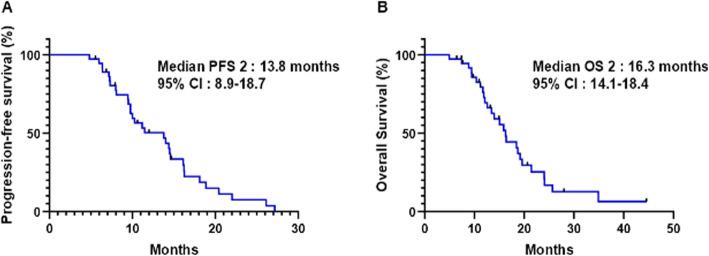
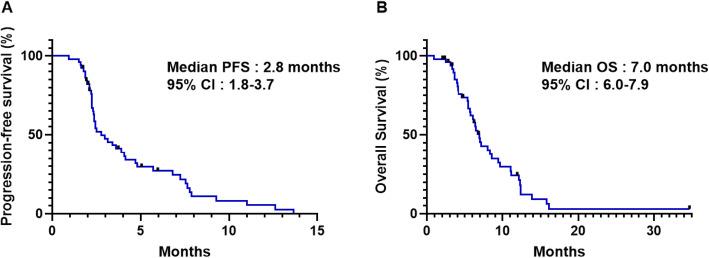
Fifty-one patients received nal-IRI plus 5-FU/LV between January 2015 and December 2020. The median age was 67 years, and males were 58.8%. A total of 40 (78.4%) and 11 (21.6%) patients had received one and two lines of prior chemotherapy before enrollment, respectively. Median progression-free survival was 2.8 months (95% CI 1.8-3.7) and median overall survival was 7.0 months (95% CI 6.0-7.9). Chemotherapy doses were reduced or delayed in 33 (64.7%) patients during the first 6 weeks and median relative dose intensity was 0.87. Thirty-six (70.6%) patients experienced grade 3 or 4 adverse events, most commonly neutropenia (58.8%). Most non-haematologic adverse events were under grade 2. Since the start of first-line chemotherapy, median overall survival was 16.3 months (95% CI 14.1-18.4).
CONCLUSIONS
Nal-IRI plus 5-FU/LV seems to be effective, with manageable toxicities, following gemcitabine-based treatment in patients with metastatic pancreatic ductal adenocarcinoma. Nal-IRI plus 5-FU/LV following gemcitabine with nab-paclitaxel is a feasible sequential treatment option in patients with metastatic pancreatic cancer.
TRIAL REGISTRATION
Retrospectively registered.
背景
根据 NAPOLI-1 试验,对于先前接受过基于吉西他滨的治疗的转移性胰腺导管腺癌患者,与单独使用氟尿嘧啶相比,纳米脂质体伊立替康(nal-IRI)加氟尿嘧啶/亚叶酸(5-FU/LV)显示出总体生存改善。在该试验中,亚洲患者由于血液学毒性而频繁进行剂量调整。在真实环境中,关于该方案的临床获益和毒性的信息有限。在本研究中,我们评估了 nal-IRI 加 5-FU/LV 在吉西他滨治疗失败后的晚期胰腺癌患者中的真实世界经验。
方法
我们对先前接受过基于吉西他滨的治疗的转移性胰腺导管腺癌患者进行了 nal-IRI 加 5-FU/LV 治疗的反应、生存和安全性的单机构回顾性分析。接受过纳洛利替康(80mg/m)加 5-FU/LV 每 2 周治疗的转移性胰腺导管腺癌患者。使用 Kaplan-Meier 分析获得中位无进展生存期和中位总生存期。使用分层 Cox 回归模型估计风险比和 95%置信区间(CI)。使用多变量 Cox 比例风险回归模型确定临床因素的影响。
结果
2015 年 1 月至 2020 年 12 月期间,51 例患者接受 nal-IRI 加 5-FU/LV 治疗。中位年龄为 67 岁,男性占 58.8%。入组前,共有 40(78.4%)和 11(21.6%)例患者分别接受了一线和二线化疗。中位无进展生存期为 2.8 个月(95%CI 1.8-3.7),中位总生存期为 7.0 个月(95%CI 6.0-7.9)。在最初的 6 周内,33(64.7%)例患者的化疗剂量减少或延迟,中位相对剂量强度为 0.87。36(70.6%)例患者发生 3 级或 4 级不良事件,最常见的是中性粒细胞减少(58.8%)。大多数非血液学不良事件为 2 级以下。自一线化疗开始以来,中位总生存期为 16.3 个月(95%CI 14.1-18.4)。
结论
在吉西他滨治疗失败的转移性胰腺导管腺癌患者中,nal-IRI 加 5-FU/LV 似乎是一种有效且毒性可管理的治疗方法。在转移性胰腺癌患者中,吉西他滨联合 nab-紫杉醇后使用 nal-IRI 加 5-FU/LV 是一种可行的序贯治疗选择。
试验注册
回顾性注册。

 Zotero 插件