
遗传癌症风险:在常规就诊前使用遗传聊天机器人。
Hereditary Cancer Risk Using a Genetic Chatbot Before Routine Care Visits.
机构信息
Invitae, San Francisco, California.
出版信息
Obstet Gynecol. 2021 Dec 1;138(6):860-870. doi: 10.1097/AOG.0000000000004596.
OBJECTIVE
To examine user uptake and experience with a clinical chatbot that automates hereditary cancer risk triage by collecting personal and family cancer history in routine women's health care settings.
METHODS
We conducted a multicenter, retrospective observational study of patients who used a web-based chatbot before routine care appointments to assess their risk for hereditary breast and ovarian cancer, Lynch syndrome, and adenomatous polyposis syndromes. Outcome measures included uptake and completion of the risk-assessment and educational section of the chatbot interaction and identification of hereditary cancer risk as evaluated against National Comprehensive Cancer Network criteria.
RESULTS
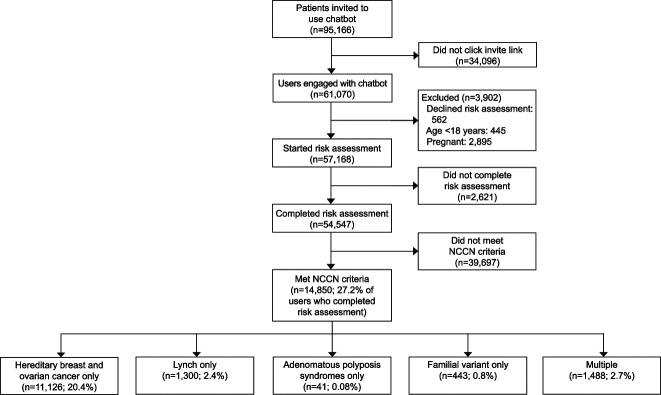
Of the 95,166 patients invited, 61,070 (64.2%) engaged with the clinical chatbot. The vast majority completed the cancer risk assessment (89.4%), and most completed the genetic testing education section (71.4%), indicating high acceptability among those who opted to engage. The mean duration of use was 15.4 minutes (SD 2 hours, 56.2 minutes) when gaps of inactivity longer than 5 minutes were excluded. A personal history of cancer was reported by 19.1% (10,849/56,656) and a family history of cancer was reported by 66.7% (36,469/54,652) of patients who provided the relevant information. One in four patients (14,850/54,547) screened with the chatbot before routine care appointments met National Comprehensive Cancer Network criteria for genetic testing. Among those who were tested, 5.6% (73/1,313) had a disease-causing pathogenic variant.
CONCLUSION
A chatbot digital health tool can help identify patients at high risk for hereditary cancer syndromes before routine care appointments. This scalable intervention can effectively provide cancer risk assessment, engage patients with educational information, and facilitate a path toward preventive genetic testing.
FUNDING SOURCE
Implementation of the chatbot in clinics was funded by industry support from commercial genetic testing laboratories Ambry, Invitae, and Progenity.
目的
研究在常规女性健康护理环境中通过收集个人和家族癌症史来自动分诊遗传性癌症风险的临床聊天机器人的用户接受度和使用体验。
方法
我们对使用基于网络的聊天机器人在常规护理预约前评估其遗传性乳腺癌和卵巢癌、林奇综合征和腺瘤性息肉病综合征风险的患者进行了一项多中心、回顾性观察性研究。主要转归指标包括对聊天机器人交互的风险评估和教育部分的使用和完成情况,以及根据国家综合癌症网络标准评估的遗传性癌症风险的识别。
结果
在邀请的 95166 名患者中,有 61070 名(64.2%)与临床聊天机器人互动。绝大多数患者完成了癌症风险评估(89.4%),大多数患者完成了基因检测教育部分(71.4%),这表明选择参与的患者接受度很高。当排除 5 分钟以上无活动的时间间隔时,平均使用时间为 15.4 分钟(标准差 2 小时 56.2 分钟)。提供相关信息的 56656 名患者中有 19.1%(10849 名)报告了个人癌症史,54652 名患者中有 66.7%(36469 名)报告了家族癌症史。在预约常规护理前使用聊天机器人筛查的患者中,有四分之一(14850/54547)符合国家综合癌症网络基因检测标准。在接受检测的患者中,有 5.6%(73/1313)有致病的致病性变异。
结论
聊天机器人数字健康工具可帮助在常规护理预约前识别遗传性癌症综合征高危患者。这种可扩展的干预措施可以有效地提供癌症风险评估,使患者了解教育信息,并为预防性基因检测提供途径。
资助来源
该聊天机器人在诊所的实施由商业遗传检测实验室安布瑞(Ambry)、英维塔(Invitae)和普罗根蒂(Progenity)的行业支持提供资金。

 Zotero 插件