
环境中的抗生素耐药性。
Antibiotic resistance in the environment.
机构信息
Centre for Antibiotic Resistance Research at University of Gothenburg, Gothenburg, Sweden.
Institute of Biomedicine, Department of Infectious Diseases, Sahlgrenska Academy, University of Gothenburg, Gothenburg, Sweden.
出版信息
Nat Rev Microbiol. 2022 May;20(5):257-269. doi: 10.1038/s41579-021-00649-x. Epub 2021 Nov 4.
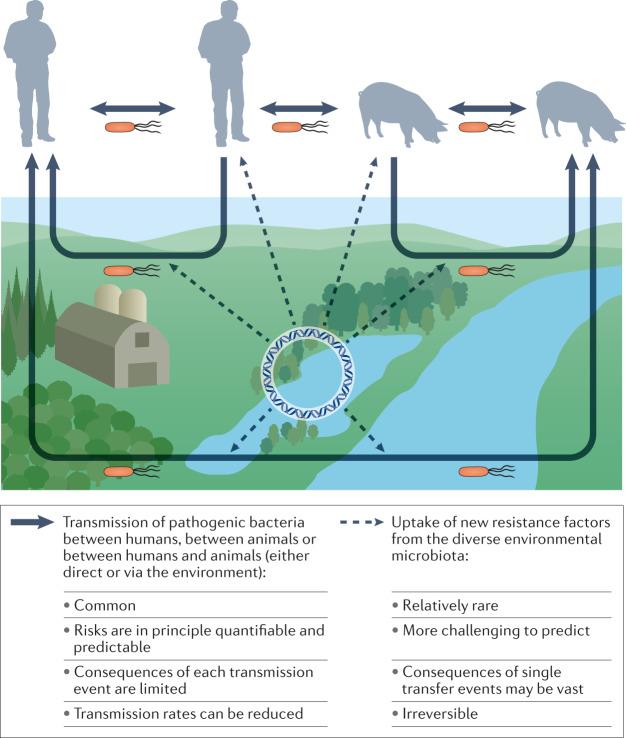
Antibiotic resistance is a global health challenge, involving the transfer of bacteria and genes between humans, animals and the environment. Although multiple barriers restrict the flow of both bacteria and genes, pathogens recurrently acquire new resistance factors from other species, thereby reducing our ability to prevent and treat bacterial infections. Evolutionary events that lead to the emergence of new resistance factors in pathogens are rare and challenging to predict, but may be associated with vast ramifications. Transmission events of already widespread resistant strains are, on the other hand, common, quantifiable and more predictable, but the consequences of each event are limited. Quantifying the pathways and identifying the drivers of and bottlenecks for environmental evolution and transmission of antibiotic resistance are key components to understand and manage the resistance crisis as a whole. In this Review, we present our current understanding of the roles of the environment, including antibiotic pollution, in resistance evolution, in transmission and as a mere reflection of the regional antibiotic resistance situation in the clinic. We provide a perspective on current evidence, describe risk scenarios, discuss methods for surveillance and the assessment of potential drivers, and finally identify some actions to mitigate risks.
抗生素耐药性是一个全球性的健康挑战,涉及细菌和基因在人类、动物和环境之间的转移。尽管有多种障碍限制了细菌和基因的流动,但病原体经常从其他物种获得新的耐药因素,从而降低了我们预防和治疗细菌感染的能力。导致病原体出现新的耐药因素的进化事件很少见且难以预测,但可能会产生广泛的影响。另一方面,已经广泛传播的耐药菌株的传播事件很常见、可量化且更可预测,但每个事件的后果是有限的。量化抗生素耐药性在环境中的进化和传播途径,以及确定驱动因素和瓶颈,是理解和整体管理耐药危机的关键组成部分。在这篇综述中,我们介绍了我们目前对环境(包括抗生素污染)在耐药性进化、传播以及作为临床区域抗生素耐药性情况的反映方面所起作用的理解。我们提供了对现有证据的看法,描述了风险情景,讨论了监测方法和潜在驱动因素的评估,最后确定了一些减轻风险的措施。

 Zotero 插件