
衰老的最佳时机。
The right time for senescence.
机构信息
Instituto de Medicina Molecular - João Lobo Antunes, Faculdade de Medicina da Universidade de Lisboa, Lisbon, Portugal.
CEDOC, NOVA Medical School, Faculdade de Ciências Médicas da Universidade Nova de Lisboa, Lisbon, Portugal.
出版信息
Elife. 2021 Nov 10;10:e72449. doi: 10.7554/eLife.72449.
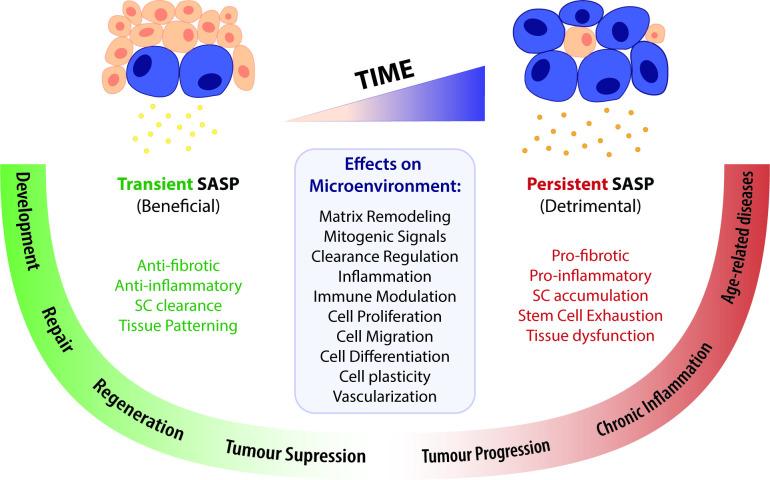
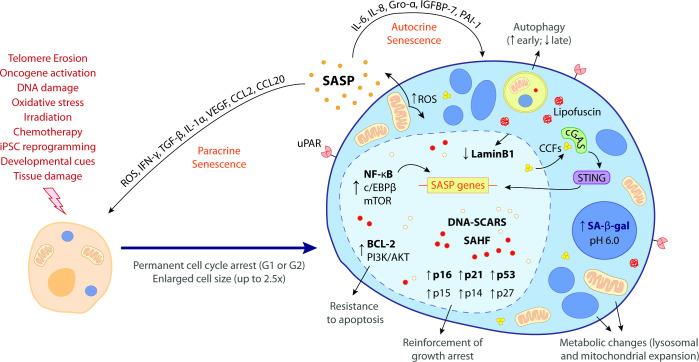
Cellular senescence is a highly complex and programmed cellular state with diverse and, at times, conflicting physiological and pathological roles across the lifespan of an organism. Initially considered a cell culture artifact, senescence evolved from an age-related circumstance to an intricate cellular defense mechanism in response to stress, implicated in a wide spectrum of biological processes like tissue remodelling, injury and cancer. The development of new tools to study senescence in vivo paved the way to uncover its functional roles in various frameworks, which are sometimes hard to reconcile. Here, we review the functional impact of senescent cells on different organismal contexts. We provide updated insights on the role of senescent cells in tissue repair and regeneration, in which they essentially modulate the levels of fibrosis and inflammation, discussing how "time" seems to be the key maestro of their effects. Finally, we overview the current clinical research landscape to target senescent cells and contemplate its repercussions on this fast-evolving field.
细胞衰老(Cellular senescence)是一种高度复杂和程序化的细胞状态,在生物体的整个生命周期中具有多样化的、有时相互矛盾的生理和病理作用。衰老最初被认为是细胞培养的一种假象,它从与年龄相关的情况演变为一种复杂的细胞防御机制,以应对压力,涉及到组织重塑、损伤和癌症等广泛的生物学过程。开发新的工具来在体内研究衰老,为揭示其在各种框架中的功能作用铺平了道路,而这些作用有时很难协调一致。在这里,我们综述了衰老细胞对不同机体环境的功能影响。我们提供了关于衰老细胞在组织修复和再生中作用的最新见解,在这些过程中,衰老细胞主要调节纤维化和炎症的水平,讨论了“时间”似乎是它们作用的关键指挥者。最后,我们概述了目前针对衰老细胞的临床研究现状,并思考其对这个快速发展领域的影响。
 Zotero 插件