
不同患者群体中钠-葡萄糖协同转运蛋白2抑制剂的净效应:大型安慰剂对照随机试验的荟萃分析
Net effects of sodium-glucose co-transporter-2 inhibition in different patient groups: a meta-analysis of large placebo-controlled randomized trials.
作者信息
Staplin Natalie, Roddick Alistair J, Emberson Jonathan, Reith Christina, Riding Alex, Wonnacott Alexa, Kuverji Apexa, Bhandari Sunil, Baigent Colin, Haynes Richard, Herrington William G
机构信息
Medical Research Council Population Health Research Unit at the University of Oxford, Clinical Trial Service Unit and Epidemiological Studies Unit, Nuffield Department of Population Health (NDPH), University of Oxford, Oxford, UK.
Big Data Institute, Li Ka Shing Centre for Health Information and Discovery, University of Oxford, Oxford, UK.
出版信息
EClinicalMedicine. 2021 Oct 26;41:101163. doi: 10.1016/j.eclinm.2021.101163. eCollection 2021 Nov.
BACKGROUND
The net absolute effects of sodium-glucose co-transporter-2 (SGLT-2) inhibitors across different patient groups have not been quantified.
METHODS
We performed a meta-analysis of published large (>500 participants/arm) placebo-controlled SGLT-2 inhibitor trials after systematically searching MEDLINE and Embase databases from inception to 28th August 2021 (PROSPERO 2021 CRD42021240468).
FINDINGS
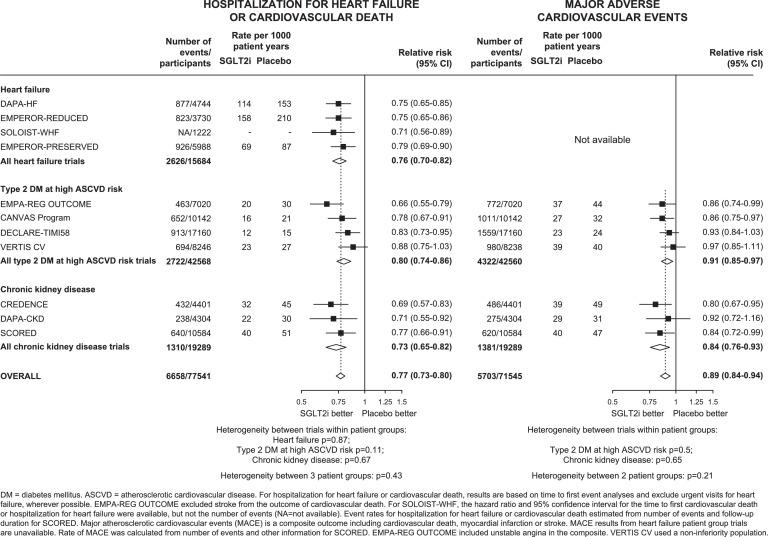
Four heart failure trials (n=15,684 participants), four trials in type 2 diabetes mellitus at high atherosclerotic cardiovascular risk (n=42,568), and three trials in chronic kidney disease (n=19,289) were included. Relative risks (RRs) for all cardiovascular, renal and safety outcomes were broadly similar across these three patient groups, and between people with or without diabetes. Overall, compared to placebo, allocation to SGLT-2 inhibition reduced risk of hospitalization for heart failure or cardiovascular death by 23% (RR=0.77, 95%CI 0.73-0.80; n=6658), cardiovascular death by 14% (0.86, 0.81-0.92; n=3962), major adverse cardiovascular events by 11% (0.89, 0.84-0.94; n=5703), kidney disease progression by 36% (0.64, 0.59-0.70; n=2275), acute kidney injury by 30% (0.70, 0.62-0.79; n=1013 events) and severe hypoglycaemia by 13% (0.87, 0.79-0.97; n=1484). There was no effect of SGLT-2 inhibition on risk of non-cardiovascular death (0.93, 0.86-1.01; n=2226), but a net 12% reduction in all-cause mortality remained evident (0.88, 0.84-0.93; n=6188). However, the risk of ketoacidosis was 2-times higher among those allocated SGLT-2 inhibitors compared to placebo (2.03, 1.41-2.93; n=159; absolute excess in people with diabetes ∼0.3/1000 patient years). A small increased risk of urinary tract infection was evident (1.07, 1.02-1.13; n=5384) alongside a known increased risk of mycotic genital infections. Overall, risk of lower limb amputations was increased by 16% (1.16, 1.02-1.31; n=1074), but this risk was largely driven by a single outlying trial (CANVAS).
INTERPRETATIONS
The relative effects of SGLT-2 inhibition on key safety and efficacy outcomes are consistent across the different studied groups of patient. Consequently, absolute benefits and harms are determined by the absolute baseline risk of particular outcomes, with absolute benefits on mortality and on non-fatal serious cardiac/renal outcomes substantially exceeding the risks of amputation and ketoacidosis in the main patient groups studied to date.
FUNDING
MRC-UK & KRUK.
背景
钠-葡萄糖协同转运蛋白2(SGLT-2)抑制剂在不同患者群体中的净绝对效应尚未得到量化。
方法
我们在系统检索MEDLINE和Embase数据库(从建库至2021年8月28日)后,对已发表的大型(每组>500名参与者)安慰剂对照SGLT-2抑制剂试验进行了荟萃分析(PROSPERO 2021 CRD42021240468)。
结果
纳入了四项心力衰竭试验(n = 15684名参与者)、四项针对动脉粥样硬化性心血管疾病高风险的2型糖尿病试验(n = 42568)以及三项慢性肾脏病试验(n = 19289)。这三组患者以及糖尿病患者和非糖尿病患者之间,所有心血管、肾脏和安全性结局的相对风险(RR)大致相似。总体而言,与安慰剂相比,接受SGLT-2抑制剂治疗可使心力衰竭住院或心血管死亡风险降低23%(RR = 0.77,95%CI 0.73 - 0.80;n = 6658),心血管死亡风险降低14%(0.86,0.81 - 0.92;n = 3962),主要不良心血管事件风险降低11%(0.89,0.84 - 0.94;n = 5703),肾脏疾病进展风险降低36%(0.64,0.59 - 0.70;n = 2275),急性肾损伤风险降低30%(0.70,0.62 - 0.79;n = 1013例事件),严重低血糖风险降低13%(0.87,0.79 - 0.97;n = 1484)。SGLT-2抑制剂对非心血管死亡风险无影响(0.93,0.86 - 1.01;n = 2226),但全因死亡率仍有12%的净降低(0.88,0.84 - 0.93;n = 6188)。然而,与安慰剂相比,接受SGLT-2抑制剂治疗的患者发生酮症酸中毒的风险高出2倍(2.03,1.41 - 2.93;n = 159;糖尿病患者中绝对超额发生率约为0.3/1000患者年)。明显存在轻微增加的尿路感染风险(1.07,1.02 - 1.13;n = 5384)以及已知增加的霉菌性生殖器感染风险。总体而言,下肢截肢风险增加了16%(1.16,1.02 - 1.31;n = 1074),但这种风险在很大程度上是由一项异常试验(CANVAS)驱动的。
解读
SGLT-2抑制剂对关键安全性和有效性结局的相对影响在不同研究的患者群体中是一致的。因此,绝对益处和危害取决于特定结局的绝对基线风险,在迄今为止研究的主要患者群体中,在死亡率和非致命性严重心脏/肾脏结局方面的绝对益处大大超过截肢和酮症酸中毒风险。
资助
英国医学研究理事会和英国癌症研究中心。




 Zotero 插件