
奖赏缺乏综合征(RDS):所有成瘾行为的一种细胞结构共同神经生物学特征。
Reward Deficiency Syndrome (RDS): A Cytoarchitectural Common Neurobiological Trait of All Addictions.
作者信息
Blum Kenneth, Bowirrat Abdalla, Braverman Eric R, Baron David, Cadet Jean Lud, Kazmi Shan, Elman Igor, Thanos Panyotis K, Badgaiyan Rajendra D, Downs William B, Bagchi Debasis, Llanos-Gomez Luis, Gold Mark S
机构信息
Division of Addiction Research & Education, Center for Psychiatry, Medicine, & Primary Care (Office of the Provost), Western University Health Sciences, Pomona, CA 91766, USA.
Institute of Psychology, Eotvos Loránd University, 1053 Budapest, Hungary.
出版信息
Int J Environ Res Public Health. 2021 Nov 2;18(21):11529. doi: 10.3390/ijerph182111529.
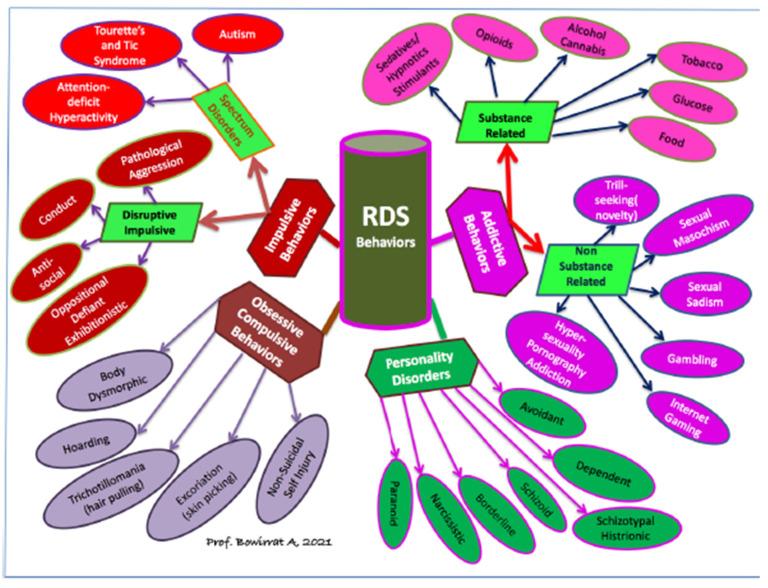
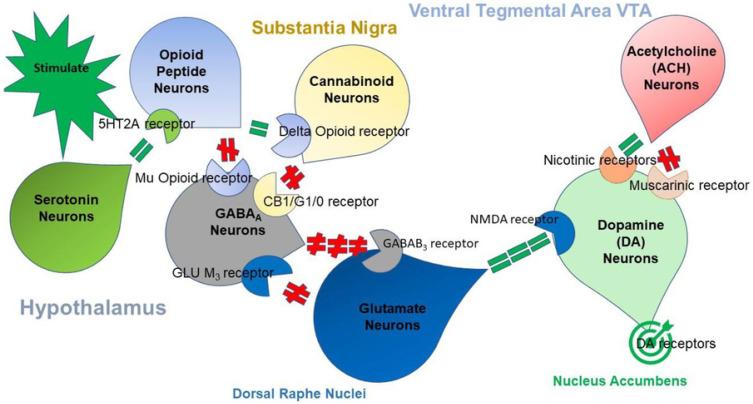
Alcohol and other substance use disorders share comorbidity with other RDS disorders, i.e., a reduction in dopamine signaling within the reward pathway. RDS is a term that connects addictive, obsessive, compulsive, and impulsive behavioral disorders. An estimated 2 million individuals in the United States have opioid use disorder related to prescription opioids. It is estimated that the overall cost of the illegal and legally prescribed opioid crisis exceeds one trillion dollars. Opioid Replacement Therapy is the most common treatment for addictions and other RDS disorders. Even after repeated relapses, patients are repeatedly prescribed the same opioid replacement treatments. A recent JAMA report indicates that non-opioid treatments fare better than chronic opioid treatments. Research demonstrates that over 50 percent of all suicides are related to alcohol or other drug use. In addition to effective fellowship programs and spirituality acceptance, nutrigenomic therapies (e.g., KB220Z) optimize gene expression, rebalance neurotransmitters, and restore neurotransmitter functional connectivity. KB220Z was shown to increase functional connectivity across specific brain regions involved in dopaminergic function. KB220/Z significantly reduces RDS behavioral disorders and relapse in human DUI offenders. Taking a Genetic Addiction Risk Severity (GARS) test combined with a the KB220Z semi-customized nutrigenomic supplement effectively restores dopamine homeostasis (WC 199).
酒精和其他物质使用障碍与其他成瘾相关疾病共病,即奖赏通路内多巴胺信号传导减少。成瘾相关疾病(RDS)是一个涵盖成瘾、强迫、冲动行为障碍的术语。据估计,美国有200万人患有与处方阿片类药物相关的阿片类药物使用障碍。据估计,非法和合法处方阿片类药物危机的总成本超过一万亿美元。阿片类药物替代疗法是治疗成瘾和其他成瘾相关疾病最常用的方法。即使在多次复发后,患者仍会反复接受相同的阿片类药物替代治疗。最近《美国医学会杂志》的一份报告表明,非阿片类药物治疗比慢性阿片类药物治疗效果更好。研究表明,超过50%的自杀事件与酒精或其他药物使用有关。除了有效的互助项目和对精神层面的接纳外,营养基因组疗法(如KB220Z)可优化基因表达、重新平衡神经递质并恢复神经递质功能连接。研究显示,KB220Z可增强参与多巴胺能功能的特定脑区的功能连接。KB220/Z可显著减少成瘾相关疾病的行为障碍以及人类酒驾罪犯的复发率。进行遗传成瘾风险严重程度(GARS)测试并结合KB220Z半定制营养基因组补充剂可有效恢复多巴胺稳态(WC 199)。

 Zotero 插件