
关注神经母细胞瘤中连接微小RNA、转录因子和靶基因的调控网络。
A Focus on Regulatory Networks Linking MicroRNAs, Transcription Factors and Target Genes in Neuroblastoma.
作者信息
Perri Patrizia, Ponzoni Mirco, Corrias Maria Valeria, Ceccherini Isabella, Candiani Simona, Bachetti Tiziana
机构信息
Laboratory of Experimental Therapies in Oncology, IRCCS Istituto Giannina Gaslini, 16147 Genoa, Italy.
Laboratory of Genetics and Genomics of Rare Diseases, IRCCS Istituto Giannina Gaslini, 16147 Genoa, Italy.
出版信息
Cancers (Basel). 2021 Nov 3;13(21):5528. doi: 10.3390/cancers13215528.
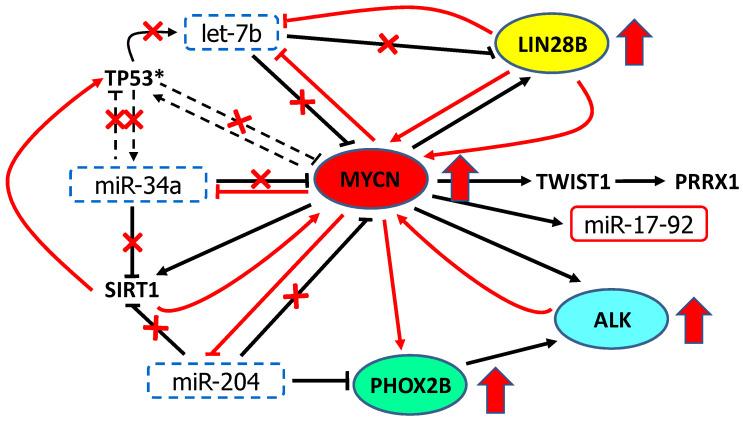
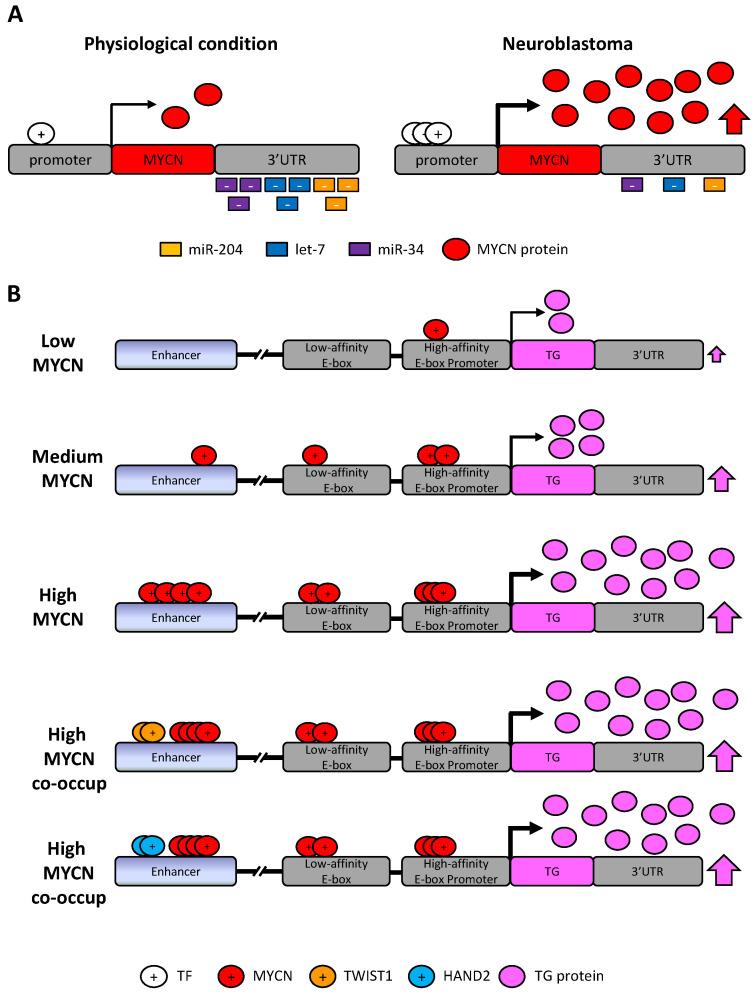
Neuroblastoma (NB) is a tumor of the peripheral sympathetic nervous system that substantially contributes to childhood cancer mortality. NB originates from neural crest cells (NCCs) undergoing a defective sympathetic neuronal differentiation and although the starting events leading to the development of NB remain to be fully elucidated, the master role of genetic alterations in key oncogenes has been ascertained: (1) amplification and/or over-expression of , which is strongly associated with tumor progression and invasion; (2) activating mutations, amplification and/or over-expression of , which is involved in tumor initiation, angiogenesis and invasion; (3) amplification and/or over-expression of , promoting proliferation and suppression of neuroblast differentiation; (4) mutations and/or over-expression of , which is involved in the regulation of NB differentiation, stemness maintenance, migration and metastasis. Moreover, altered microRNA (miRNA) expression takes part in generating pathogenetic networks, in which the regulatory loops among transcription factors, miRNAs and target genes lead to complex and aberrant oncogene expression that underlies the development of a tumor. In this review, we have focused on the circuitry linking the oncogenic transcription factors MYCN and PHOX2B with their transcriptional targets ALK and LIN28B and the tumor suppressor microRNAs let-7, miR-34 and miR-204, which should act as down-regulators of their expression. We have also looked at the physiologic role of these genetic and epigenetic determinants in NC development, as well as in terminal differentiation, with their pathogenic dysregulation leading to NB oncogenesis.
神经母细胞瘤(NB)是一种起源于外周交感神经系统的肿瘤,对儿童癌症死亡率有重大影响。NB起源于经历了有缺陷的交感神经元分化的神经嵴细胞(NCCs),尽管导致NB发生发展的起始事件仍有待充分阐明,但关键癌基因中遗传改变的主要作用已得到确定:(1) 的扩增和/或过表达,这与肿瘤进展和侵袭密切相关;(2) 的激活突变、扩增和/或过表达,其参与肿瘤起始、血管生成和侵袭;(3) 的扩增和/或过表达,促进增殖并抑制神经母细胞分化;(4) 的突变和/或过表达,其参与NB分化、干性维持、迁移和转移的调控。此外,微小RNA(miRNA)表达的改变参与了致病网络的形成,其中转录因子、miRNA和靶基因之间的调控环导致复杂且异常的癌基因表达,这是肿瘤发生发展的基础。在本综述中,我们重点关注了致癌转录因子MYCN和PHOX2B与其转录靶点ALK和LIN28B以及肿瘤抑制性微小RNA let-7、miR-34和miR-204之间的联系,这些微小RNA应作为它们表达的下调因子。我们还研究了这些遗传和表观遗传决定因素在神经嵴发育以及终末分化中的生理作用,它们的致病性失调导致了NB的发生。



 Zotero 插件