
饮用咖啡和茶与发生中风、痴呆和中风后痴呆风险的关系:英国生物库中的一项队列研究。
Consumption of coffee and tea and risk of developing stroke, dementia, and poststroke dementia: A cohort study in the UK Biobank.
机构信息
School of Public Health, Tianjin Medical University, Tianjin, China.
Department of Biostatistics, Yale School of Public Health, Yale University, New Haven, Connecticut, United States of America.
出版信息
PLoS Med. 2021 Nov 16;18(11):e1003830. doi: 10.1371/journal.pmed.1003830. eCollection 2021 Nov.
BACKGROUND
Previous studies have revealed the involvement of coffee and tea in the development of stroke and dementia. However, little is known about the association between the combination of coffee and tea and the risk of stroke, dementia, and poststroke dementia. Therefore, we aimed to investigate the associations of coffee and tea separately and in combination with the risk of developing stroke and dementia.
METHODS AND FINDINGS
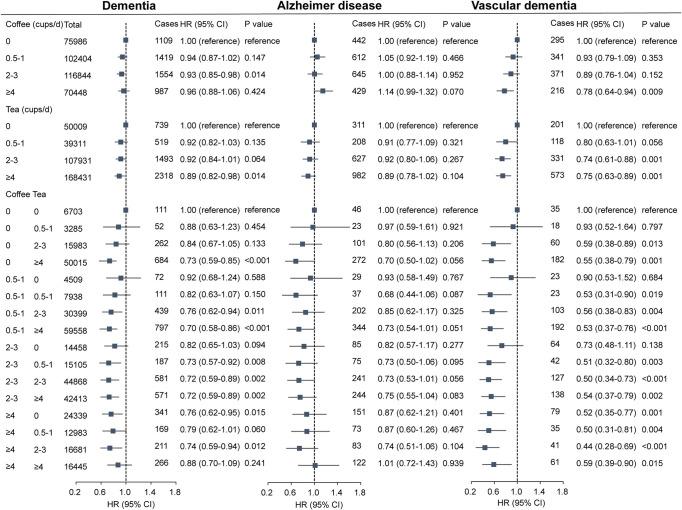
This prospective cohort study included 365,682 participants (50 to 74 years old) from the UK Biobank. Participants joined the study from 2006 to 2010 and were followed up until 2020. We used Cox proportional hazards models to estimate the associations between coffee/tea consumption and incident stroke and dementia, adjusting for sex, age, ethnicity, qualification, income, body mass index (BMI), physical activity, alcohol status, smoking status, diet pattern, consumption of sugar-sweetened beverages, high-density lipoprotein (HDL), low-density lipoprotein (LDL), history of cancer, history of diabetes, history of cardiovascular arterial disease (CAD), and hypertension. Coffee and tea consumption was assessed at baseline. During a median follow-up of 11.4 years for new onset disease, 5,079 participants developed dementia, and 10,053 participants developed stroke. The associations of coffee and tea with stroke and dementia were nonlinear (P for nonlinear <0.01), and coffee intake of 2 to 3 cups/d or tea intake of 3 to 5 cups/d or their combination intake of 4 to 6 cups/d were linked with the lowest hazard ratio (HR) of incident stroke and dementia. Compared with those who did not drink tea and coffee, drinking 2 to 3 cups of coffee and 2 to 3 cups of tea per day was associated with a 32% (HR 0.68, 95% CI, 0.59 to 0.79; P < 0.001) lower risk of stroke and a 28% (HR, 0.72, 95% CI, 0.59 to 0.89; P = 0.002) lower risk of dementia. Moreover, the combination of coffee and tea consumption was associated with lower risk of ischemic stroke and vascular dementia. Additionally, the combination of tea and coffee was associated with a lower risk of poststroke dementia, with the lowest risk of incident poststroke dementia at a daily consumption level of 3 to 6 cups of coffee and tea (HR, 0.52, 95% CI, 0.32 to 0.83; P = 0.007). The main limitations were that coffee and tea intake was self-reported at baseline and may not reflect long-term consumption patterns, unmeasured confounders in observational studies may result in biased effect estimates, and UK Biobank participants are not representative of the whole United Kingdom population.
CONCLUSIONS
We found that drinking coffee and tea separately or in combination were associated with lower risk of stroke and dementia. Intake of coffee alone or in combination with tea was associated with lower risk of poststroke dementia.
背景
先前的研究表明,咖啡和茶的摄入与中风和痴呆的发生有关。然而,关于咖啡和茶的组合与中风、痴呆和中风后痴呆风险之间的关系,我们知之甚少。因此,我们旨在调查咖啡和茶分别以及组合使用与发生中风和痴呆风险之间的关系。
方法和发现
这项前瞻性队列研究纳入了来自英国生物银行的 365682 名参与者(50 至 74 岁)。参与者于 2006 年至 2010 年参加了该研究,并随访至 2020 年。我们使用 Cox 比例风险模型来估计咖啡/茶消费与新发中风和痴呆之间的关联,调整了性别、年龄、种族、学历、收入、体重指数(BMI)、身体活动、酒精状况、吸烟状况、饮食模式、含糖饮料消费、高密度脂蛋白(HDL)、低密度脂蛋白(LDL)、癌症史、糖尿病史、心血管动脉疾病(CAD)史和高血压史。咖啡和茶的摄入量在基线时进行评估。在中位随访 11.4 年期间,有 5079 名参与者出现痴呆,10053 名参与者出现中风。咖啡和茶与中风和痴呆的关联是非线性的(P<0.01),每天摄入 2 至 3 杯咖啡或 3 至 5 杯茶或两者组合摄入 4 至 6 杯与最低的中风和痴呆风险比(HR)相关。与不喝茶和咖啡的人相比,每天饮用 2 至 3 杯咖啡和 2 至 3 杯茶与中风风险降低 32%(HR 0.68,95%CI,0.59 至 0.79;P<0.001)和痴呆风险降低 28%(HR,0.72,95%CI,0.59 至 0.89;P=0.002)相关。此外,咖啡和茶的组合摄入与缺血性中风和血管性痴呆的风险降低有关。此外,茶和咖啡的组合摄入与中风后痴呆的风险降低有关,每天饮用 3 至 6 杯咖啡和茶的组合与最低的中风后痴呆风险相关(HR,0.52,95%CI,0.32 至 0.83;P=0.007)。主要局限性在于,咖啡和茶的摄入量在基线时是自我报告的,可能无法反映长期的消费模式,观察性研究中未测量的混杂因素可能导致有偏估计,并且英国生物银行的参与者不能代表整个英国人口。
结论
我们发现,单独或组合饮用咖啡和茶与中风和痴呆风险降低有关。单独饮用咖啡或与茶组合饮用与中风后痴呆风险降低有关。


 Zotero 插件