
不同软杀螨剂对蜜蜂体外寄生螨(蜱螨目:瓦螨科)的防治效果
Effectiveness of Different Soft Acaricides against Honey Bee Ectoparasitic Mite (Acari: Varroidae).
作者信息
Qadir Ziyad Abdul, Idrees Atif, Mahmood Rashid, Sarwar Ghulam, Bakar Muhammad Abu, Ahmad Saboor, Raza Muhammad Mohsin, Li Jun
机构信息
Honeybee Research Institute, National Agricultural Research Centre, Park Road, Islamabad 45500, Pakistan.
Department of Entomology and Wildlife Ecology, University of Delaware, Newark, DE 19716, USA.
出版信息
Insects. 2021 Nov 17;12(11):1032. doi: 10.3390/insects12111032.
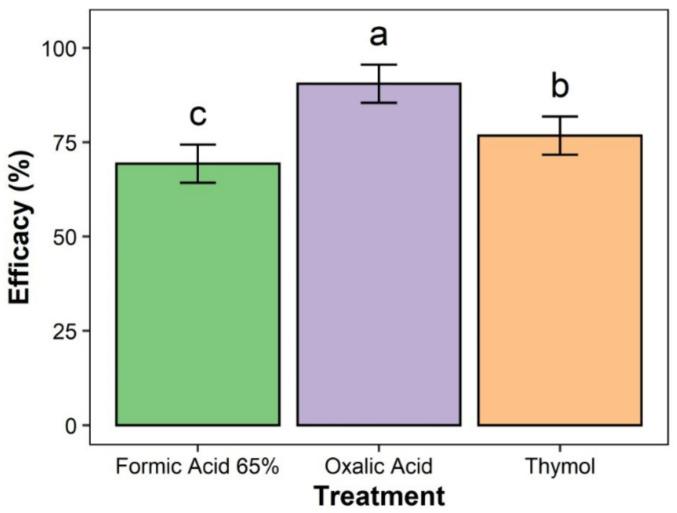
Honey bees () are essential for their products-honey, royal jelly, pollen, propolis and beeswax. They are also indispensable because they support ecosystems with their pollination services. However, the production and functions of honey bees are hindered by the arthropod pest , which attacks bees through its feeding activities. Efforts to control varroa mites have been made through the development of various synthetic pesticide groups, but have had limited success because the mites developed resistance and some of these pesticides are harmful to bees. Branded pesticides are rarely used in Pakistan, as beekeepers utilize acaricides from unknown sources. There is a need to create awareness of available naturally occurring acaricides that may serve as an alternative to synthetic acaricides. Although some naturally occurring compounds are considered toxic to the environment, the soft acaricides oxalic acid, thymol, and formic acid 65% are usually safe for honey bee colonies and beekeepers, when handled appropriately. The current study investigated the effectiveness of formic acid (10, 15, and 20 mL/hive), oxalic acid (4.2, 3.2, and 2.1%/hive), and thymol (6, 4, and 2 g/hive) in controlling mite infestation. The results indicated that all treatments significantly reduced the mite population ( < 0.05). The average efficacies of oxalic acid at 3.2% (94.84% ± 0.34) and 4.2% (92.68% ± 0.37) were significantly higher than those of the other treatments. The lowest efficacy was recorded in formic acid 65% at 10 mL (54.13%). Overall, the results indicated that soft acaricides-such as oxalic acid at 3.2% and 4.2% concentrations-are very effective at controlling varroa mites and can be used in broodless conditions without side effects.
蜜蜂( )因其产品——蜂蜜、蜂王浆、花粉、蜂胶和蜂蜡而至关重要。它们也不可或缺,因为它们通过授粉服务来支持生态系统。然而,蜜蜂的生产和功能受到节肢动物害虫 的阻碍,这种害虫通过取食活动攻击蜜蜂。人们通过开发各种合成农药组来控制瓦螨,但成效有限,因为螨虫产生了抗性,而且其中一些农药对蜜蜂有害。在巴基斯坦,品牌农药很少使用,因为养蜂人使用来源不明的杀螨剂。有必要提高人们对可用的天然杀螨剂的认识,这些杀螨剂可以作为合成杀螨剂的替代品。尽管一些天然化合物被认为对环境有毒,但当适当处理时,软杀螨剂草酸、百里香酚和65%的甲酸通常对蜂群和养蜂人是安全的。本研究调查了甲酸(10、15和20毫升/蜂箱)、草酸(4.2%、3.2%和2.1%/蜂箱)和百里香酚(6、4和2克/蜂箱)控制螨虫感染的有效性。结果表明,所有处理均显著降低了螨虫数量( < 0.05)。3.2%(94.84%±0.34)和4.2%(92.68%±0.37)的草酸平均防治效果显著高于其他处理。最低防治效果记录在10毫升的65%甲酸中(54.13%)。总体而言,结果表明,软杀螨剂——如浓度为3.2%和4.2%的草酸——在控制瓦螨方面非常有效,并且可以在无幼虫的条件下使用而无副作用。


 Zotero 插件