
scCODA 是一种用于分析单细胞组成数据的贝叶斯模型。
scCODA is a Bayesian model for compositional single-cell data analysis.
机构信息
Institute of Computational Biology, Helmholtz Zentrum München, German Research Center for Environmental Health, Neuherberg, Germany.
Department of Statistics, Ludwig-Maximilians-Universität München, München, Germany.
出版信息
Nat Commun. 2021 Nov 25;12(1):6876. doi: 10.1038/s41467-021-27150-6.
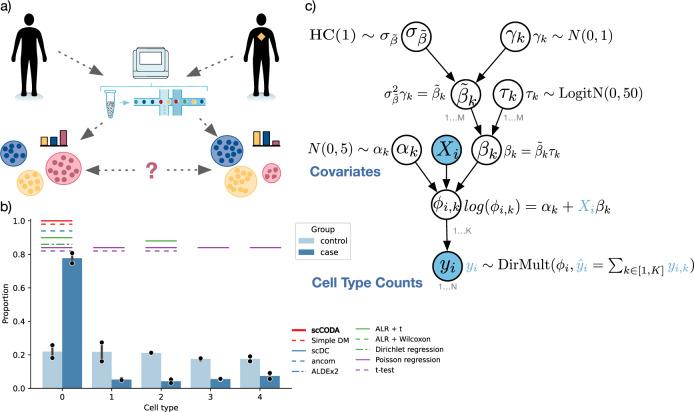
Compositional changes of cell types are main drivers of biological processes. Their detection through single-cell experiments is difficult due to the compositionality of the data and low sample sizes. We introduce scCODA ( https://github.com/theislab/scCODA ), a Bayesian model addressing these issues enabling the study of complex cell type effects in disease, and other stimuli. scCODA demonstrated excellent detection performance, while reliably controlling for false discoveries, and identified experimentally verified cell type changes that were missed in original analyses.
细胞类型的组成变化是生物过程的主要驱动因素。由于数据的组成性和低样本量,通过单细胞实验进行检测具有一定难度。我们引入了 scCODA(https://github.com/theislab/scCODA),这是一个贝叶斯模型,可以解决这些问题,从而能够研究疾病和其他刺激因素中的复杂细胞类型效应。scCODA 表现出出色的检测性能,同时可靠地控制了假发现,并且鉴定了在原始分析中遗漏的经过实验验证的细胞类型变化。


 Zotero 插件