
调控 FLT3-ITD 定位和靶向不同下游信号通路作为克服 FLT3 抑制剂耐药性的潜在策略。
Modulation of FLT3-ITD Localization and Targeting of Distinct Downstream Signaling Pathways as Potential Strategies to Overcome FLT3-Inhibitor Resistance.
机构信息
Klinik für Innere Medizin II, Abteilung Hämatologie und Onkologie, Universitätsklinikum Jena, 07747 Jena, Germany.
Department for Proteomic Analysis, The Francis Crick Institute, London NW1 1AT, UK.
出版信息
Cells. 2021 Nov 3;10(11):2992. doi: 10.3390/cells10112992.
OBJECTIVES
Internal tandem duplications (ITDs) of the Fms-like tyrosine kinase 3 (FLT3) represent the most frequent molecular aberrations in acute myeloid leukemia (AML) and are associated with an inferior prognosis. The pattern of downstream activation by this constitutively activated receptor tyrosine kinase is influenced by the localization of FLT3-ITD depending on its glycosylation status. Different pharmacological approaches can affect FLT3-ITD-driven oncogenic pathways by the modulation of FLT3-ITD localization.
AIMS
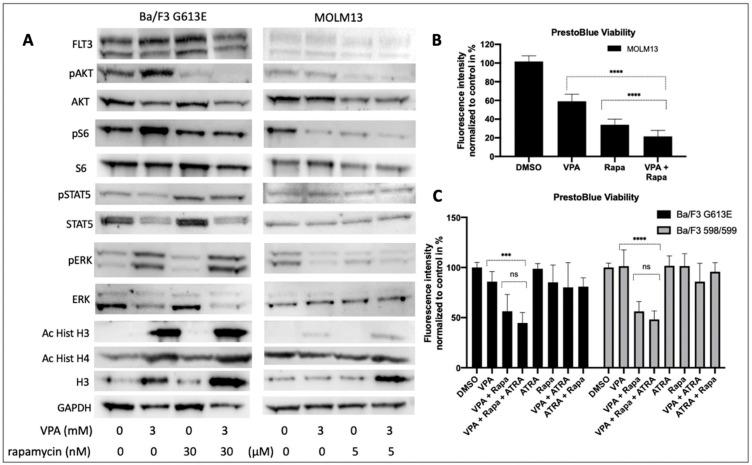
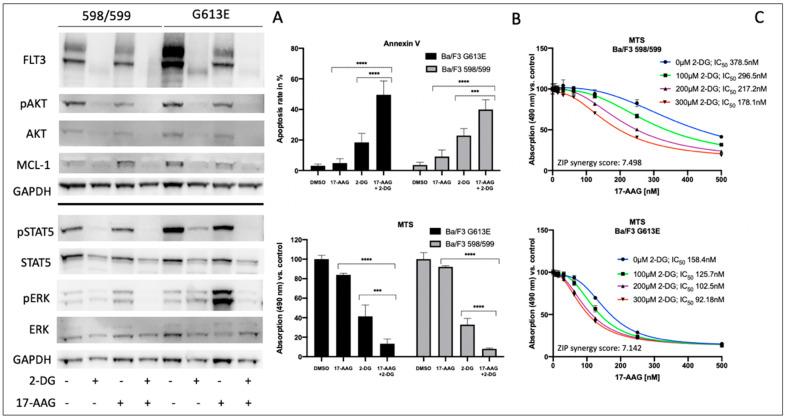
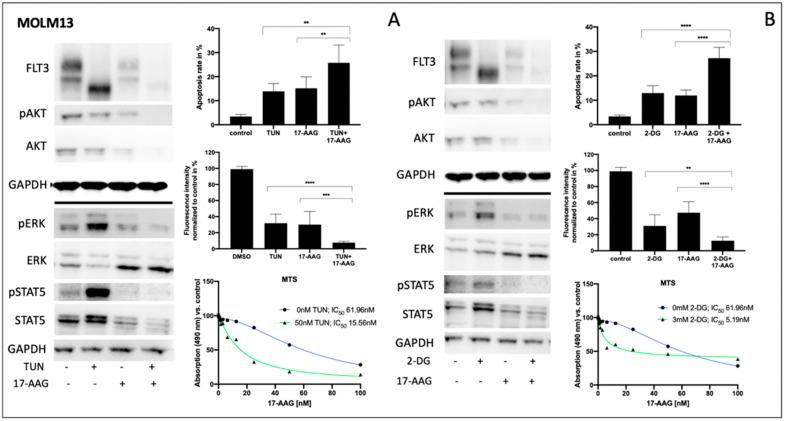
The objective of this study was to investigate the effects of N-glycosylation inhibitors (tunicamycin or 2-deoxy-D-glucose) or the histone deacetylase inhibitor valproic acid (VPA) on FLT3-ITD localization and downstream activity. We sought to determine the potential differences between the distinct FLT3-ITD variants, particularly concerning their susceptibility towards combined treatment by addressing either N-glycosylation and the heat shock protein 90 (HSP90) by 17-AAG, or by targeting the PI3K/AKT/mTOR pathway by rapamycin after treatment with VPA.
METHODS
Murine Ba/F3 leukemia cell lines were stably transfected with distinct FLT3-ITD variants resulting in IL3-independent growth. These Ba/F3 FLT3-ITD cell lines or FLT3-ITD-expressing human MOLM13 cells were exposed to tunicamycin, 2-deoxy-D-glucose or VPA, and 17-AAG or rapamycin, and characterized in terms of downstream signaling by immunoblotting. FLT3 surface expression, apoptosis, and metabolic activity were analyzed by flow cytometry or an MTS assay. Proteome analysis by liquid chromatography-tandem mass spectrometry was performed to assess differential protein expression.
RESULTS
The susceptibility of FLT3-ITD-expressing cells to 17-AAG after pre-treatment with tunicamycin or 2-deoxy-D-glucose was demonstrated. Importantly, in Ba/F3 cells that were stably expressing distinct FLT3-ITD variants that were located either in the juxtamembrane domain (JMD) or in the tyrosine kinase 1 domain (TKD1), response to the sequential treatments with tunicamycin and 17-AAG varied between individual FLT3-ITD motifs without dependence on the localization of the ITD. In all of the FLT3-ITD cell lines that were investigated, incubation with tunicamycin was accompanied by intracellular retention of FLT3-ITD due to the inhibition of glycosylation. In contrast, treatment of Ba/F3-FLT3-ITD cells with VPA was associated with a significant increase of FLT3-ITD surface expression depending on FLT3 protein synthesis. The allocation of FLT3 to different cellular compartments that was induced by tunicamycin, 2-deoxy-D-glucose, or VPA resulted in the activation of distinct downstream signaling pathways. Whole proteome analyses of Ba/F3 FLT3-ITD cells revealed up-regulation of the relevant chaperone proteins (e.g., calreticulin, calnexin, HSP90beta1) that are directly involved in the stabilization of FLT3-ITD or in its retention in the ER compartment.
CONCLUSION
The allocation of FLT3-ITD to different cellular compartments and targeting distinct downstream signaling pathways by combined treatment with N-glycosylation and HSP90 inhibitors or VPA and rapamycin might represent new therapeutic strategies to overcome resistance towards tyrosine kinase inhibitors in FLT3-ITD-positive AML. The treatment approaches addressing N-glycosylation of FLT3-ITD appear to depend on patient-specific FLT3-ITD sequences, potentially affecting the efficacy of such pharmacological strategies.
目的
内部串联重复(ITD)的 Fms 样酪氨酸激酶 3(FLT3)是急性髓系白血病(AML)最常见的分子异常之一,与预后不良相关。这种组成性激活的受体酪氨酸激酶的下游激活模式受 FLT3-ITD 的定位影响,这取决于其糖基化状态。不同的药理学方法可以通过调节 FLT3-ITD 的定位来影响 FLT3-ITD 驱动的致癌途径。
目的
本研究旨在研究 N-糖基化抑制剂(衣霉素或 2-脱氧-D-葡萄糖)或组蛋白去乙酰化酶抑制剂丙戊酸(VPA)对 FLT3-ITD 定位和下游活性的影响。我们试图确定不同 FLT3-ITD 变体之间的潜在差异,特别是关于它们对联合治疗的敏感性,通过用 17-AAG 靶向 N-糖基化和热休克蛋白 90(HSP90),或在用 VPA 治疗后通过雷帕霉素靶向 PI3K/AKT/mTOR 途径。
方法
用不同的 FLT3-ITD 变体稳定转染小鼠 Ba/F3 白血病细胞系,导致 IL3 非依赖性生长。这些 Ba/F3 FLT3-ITD 细胞系或表达 FLT3-ITD 的人 MOLM13 细胞系暴露于衣霉素、2-脱氧-D-葡萄糖或 VPA、17-AAG 或雷帕霉素,并通过免疫印迹分析下游信号转导。通过流式细胞术或 MTS 测定法分析 FLT3 表面表达、细胞凋亡和代谢活性。通过液相色谱-串联质谱法进行蛋白质组分析以评估差异蛋白表达。
结果
证明了在用衣霉素或 2-脱氧-D-葡萄糖预处理后,表达 FLT3-ITD 的细胞对 17-AAG 的敏感性。重要的是,在稳定表达位于跨膜域(JMD)或酪氨酸激酶 1 域(TKD1)的不同 FLT3-ITD 变体的 Ba/F3 细胞中,用衣霉素和 17-AAG 序贯治疗的反应在个体 FLT3-ITD 基序之间有所不同,而与 ITD 的定位无关。在所研究的所有 FLT3-ITD 细胞系中,用衣霉素孵育伴随着由于糖基化抑制而导致的 FLT3-ITD 细胞内滞留。相比之下,用 VPA 处理 Ba/F3-FLT3-ITD 细胞与 FLT3 蛋白合成有关的 FLT3-ITD 表面表达显著增加。衣霉素、2-脱氧-D-葡萄糖或 VPA 引起的 FLT3 分配到不同的细胞区室导致不同的下游信号通路激活。对 Ba/F3 FLT3-ITD 细胞的全蛋白质组分析显示,相关伴侣蛋白(例如钙网蛋白、钙连蛋白、HSP90β1)的上调,这些蛋白直接参与 FLT3-ITD 的稳定或其在 ER 区室中的滞留。
结论
通过用 N-糖基化和 HSP90 抑制剂或 VPA 和雷帕霉素联合治疗将 FLT3-ITD 分配到不同的细胞区室并靶向不同的下游信号通路,可能代表克服 FLT3-ITD 阳性 AML 对酪氨酸激酶抑制剂耐药性的新治疗策略。针对 FLT3-ITD 的 N-糖基化的治疗方法似乎取决于患者特异性的 FLT3-ITD 序列,可能会影响这些药理学策略的疗效。



 Zotero 插件