
载脂蛋白 E ɛ4 与代谢综合征特征的老年餐后炎症相关。
APOE ɛ4 Is Associated with Postprandial Inflammation in Older Adults with Metabolic Syndrome Traits.
机构信息
Nutritional Physiology, Department of Nutrition and Food Science, University of Bonn, 53115 Bonn, Germany.
Institute of Clinical Chemistry and Clinical Pharmacology, University Hospital Bonn, 53127 Bonn, Germany.
出版信息
Nutrients. 2021 Nov 2;13(11):3924. doi: 10.3390/nu13113924.
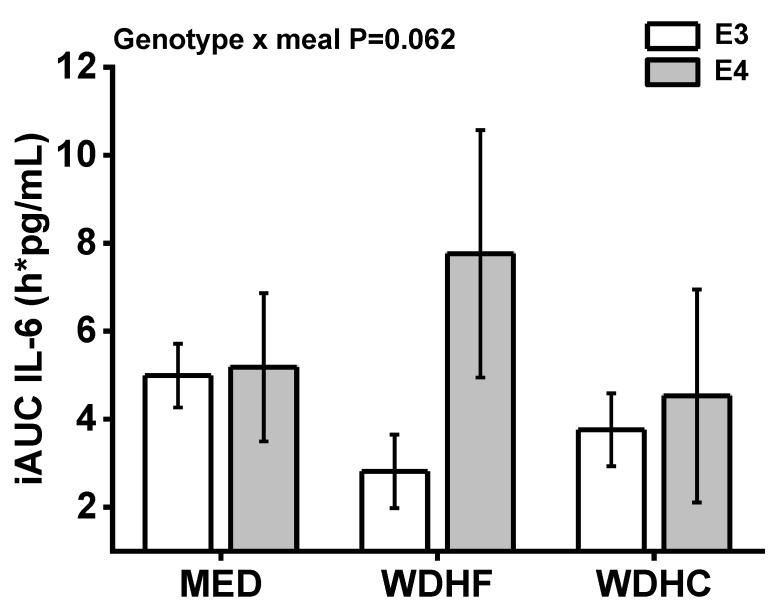
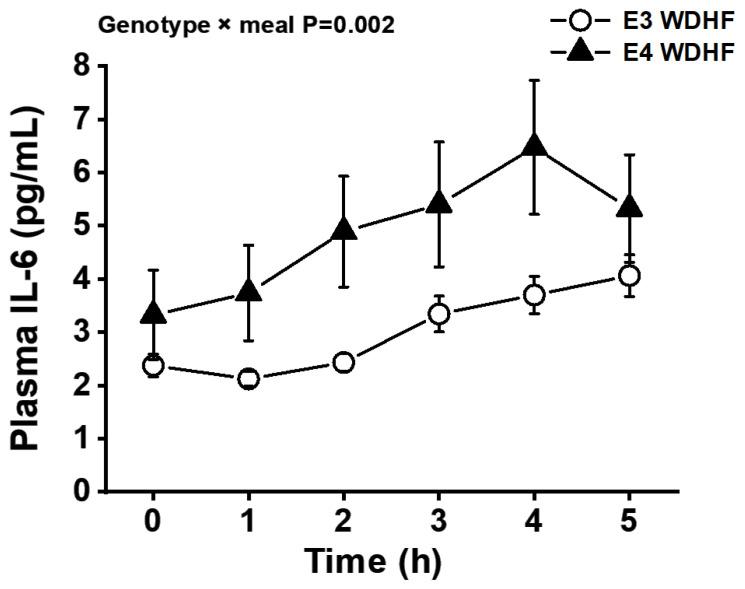
The apolipoprotein E () polymorphism impacts blood lipids and biomarkers of oxidation and inflammation, contributing to an isoform-dependent disease risk. We investigated the effect of the genotype on postprandial metabolism after consumption of three different isoenergetic (4200 kJ) meals in older adults with a CVD risk phenotype. In a randomized crossover study, participants with metabolic syndrome traits ( E3, n = 39; E4, n = 10; mean age, 70 ± 5 years; BMI 31.3 ± 3.0 kg/m) consumed a Western-like diet high-fat (WDHF), Western-like diet high-carbohydrate (WDHC), or Mediterranean-like diet (MED) meal. Parameters of lipid and glucose metabolism, inflammatory, and oxidative parameters were analyzed in blood samples collected at fasting and 1-5 h postprandially. Data were analyzed by linear mixed models. The magnitude of the IL-6 increase after the WDHF meal was significantly higher in E4 than in E3 carriers (iAUC: E4 = 7.76 vs. E3 = 2.81 pg/mL × h). The time to detect the IL-6 increase was shorter in the E4 group. All meals produced postprandial glycemia, insulinemia, and lipidemia, without differences between the E3 and the E4 groups. IL-1β and oxidized LDL levels did not change postprandially. In conclusion, APOE E4 carriers display increased postprandial inflammation, indicated by higher postprandial IL-6 increase, when compared to non-carriers.
载脂蛋白 E () 多态性影响血脂和氧化及炎症生物标志物,导致依赖于异构体的疾病风险增加。我们研究了基因型对具有 CVD 风险表型的老年人摄入三种不同等热量(4200kJ)餐食后的餐后代谢的影响。在一项随机交叉研究中,具有代谢综合征特征的参与者(E3,n=39;E4,n=10;平均年龄 70±5 岁;BMI 31.3±3.0kg/m)摄入高脂肪(WDHF)、高碳水化合物(WDHC)或地中海饮食(MED)餐。在空腹和餐后 1-5 小时采集血样,分析脂质和葡萄糖代谢、炎症和氧化参数。数据通过线性混合模型进行分析。与 E3 携带者相比,E4 携带者在 WDHF 餐后的 IL-6 增加幅度明显更高(iAUC:E4=7.76 vs. E3=2.81pg/mL×h)。E4 组检测到 IL-6 增加的时间更短。所有餐食都引起餐后血糖、胰岛素血症和血脂血症,E3 和 E4 组之间没有差异。餐后 IL-1β 和氧化 LDL 水平没有变化。总之,与非携带者相比,APOE E4 携带者显示出更高的餐后炎症,表现为餐后 IL-6 增加更多。

 Zotero 插件