
用于外周动脉疾病风险与冠状动脉疾病比较的代谢生物标志物发现:5 个前瞻性队列中 31657 个人的脂蛋白和代谢物特征分析。
Metabolic Biomarker Discovery for Risk of Peripheral Artery Disease Compared With Coronary Artery Disease: Lipoprotein and Metabolite Profiling of 31 657 Individuals From 5 Prospective Cohorts.
机构信息
Nightingale Health Plc Helsinki Finland.
Medical Research Council Population Health Research Unit University of Oxford United Kingdom.
出版信息
J Am Heart Assoc. 2021 Dec 7;10(23):e021995. doi: 10.1161/JAHA.121.021995. Epub 2021 Nov 30.
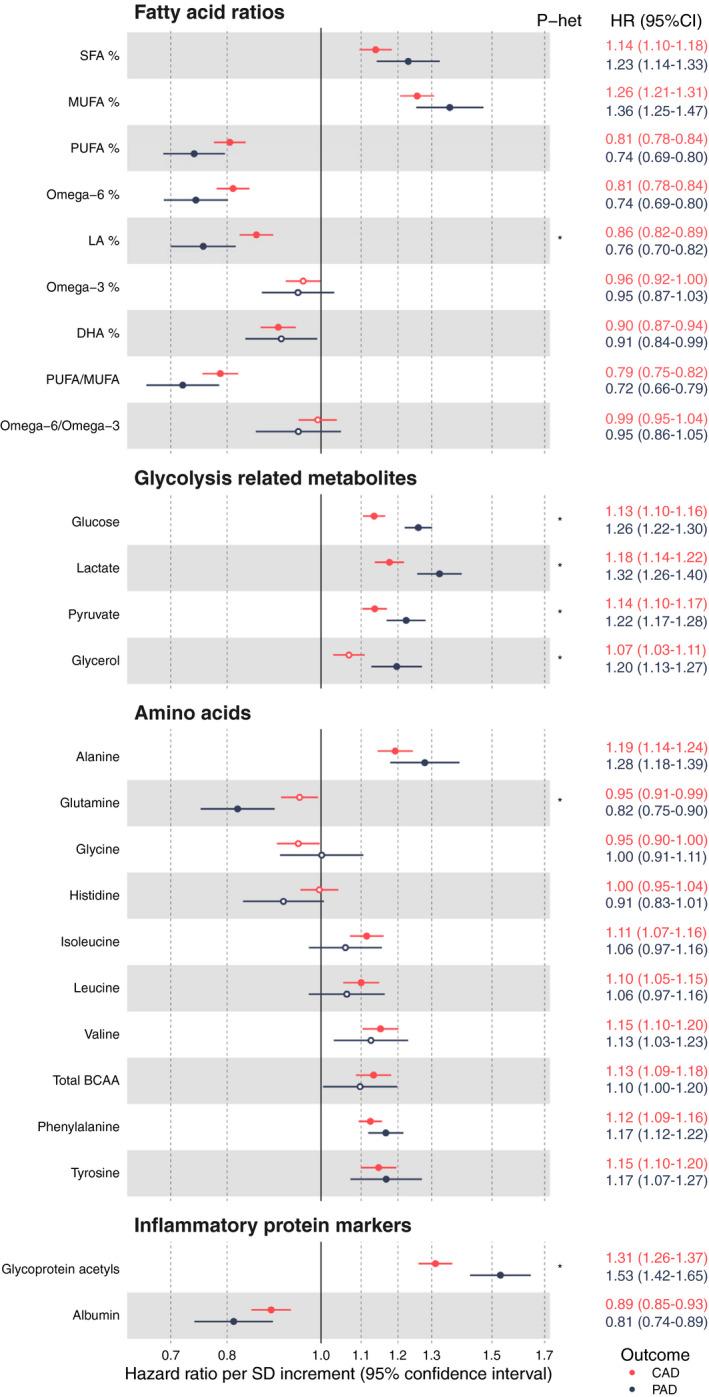
Background Peripheral artery disease (PAD) and coronary artery disease (CAD) represent atherosclerosis in different vascular beds. We used detailed metabolic biomarker profiling to identify common and discordant biomarkers and clarify pathophysiological differences for these vascular diseases. Methods and Results We used 5 prospective cohorts from Finnish population (FINRISK 1997, 2002, 2007, and 2012, and Health 2000; n=31 657; median follow-up time of 14 years) to estimate associations between >200 metabolic biomarkers and incident PAD and CAD. Metabolic biomarkers were measured with nuclear magnetic resonance, and disease events were obtained from nationwide hospital records. During the follow-up, 498 incident PAD and 2073 incident CAD events occurred. In age- and sex-adjusted Cox models, apolipoproteins and cholesterol measures were robustly associated with incident CAD (eg, hazard ratio [HR] per SD for higher apolipoprotein B/A-1 ratio, 1.30; 95% CI, 1.25-1.36), but not with incident PAD (HR per SD for higher apolipoprotein B/A-1 ratio, 1.04; 95% CI, 0.95-1.14; <0.001). In contrast, triglyceride levels in low-density lipoprotein and high-density lipoprotein were associated with both end points (>0.05). Lower proportion of polyunsaturated fatty acids relative to total fatty acids, and higher concentrations of monounsaturated fatty acids, glycolysis-related metabolites, and inflammatory protein markers were strongly associated with incident PAD, and many of these associations were stronger for PAD than for CAD (<0.001). Most differences in metabolic profiles for PAD and CAD remained when adjusting for traditional risk factors. Conclusions The metabolic biomarker profile for future PAD risk is distinct from that of CAD. This may represent pathophysiological differences.
背景
外周动脉疾病(PAD)和冠状动脉疾病(CAD)代表不同血管床的动脉粥样硬化。我们使用详细的代谢生物标志物谱分析来确定这些血管疾病的共同和不同的生物标志物,并阐明其病理生理差异。
方法和结果
我们使用来自芬兰人群的 5 个前瞻性队列(FINRISK 1997、2002、2007 和 2012 年以及 Health 2000;n=31657;中位随访时间为 14 年)来估计>200 种代谢生物标志物与 PAD 和 CAD 事件的相关性。代谢生物标志物使用核磁共振进行测量,疾病事件从全国性医院记录中获得。在随访期间,发生了 498 例 PAD 事件和 2073 例 CAD 事件。在年龄和性别调整的 Cox 模型中,载脂蛋白和胆固醇测量与 CAD 事件显著相关(例如,较高的载脂蛋白 B/A-1 比值的每标准差的危险比,1.30;95%CI,1.25-1.36),但与 PAD 事件无关(较高的载脂蛋白 B/A-1 比值的每标准差的危险比,1.04;95%CI,0.95-1.14;<0.001)。相比之下,载脂蛋白 B 浓度和高密度脂蛋白中甘油三酯与这两个终点均相关(>0.05)。多不饱和脂肪酸与总脂肪酸的比例较低,单不饱和脂肪酸、糖酵解相关代谢物和炎症蛋白标志物的浓度较高与 PAD 事件密切相关,其中许多与 PAD 的相关性强于 CAD(<0.001)。当调整传统危险因素时,PAD 和 CAD 的代谢特征差异仍然存在。
结论
未来 PAD 风险的代谢生物标志物谱与 CAD 不同。这可能代表了病理生理差异。


 Zotero 插件