
考察游戏化在抑郁症心理健康应用程序中的有效性:系统评价与荟萃分析。
Examining the Effectiveness of Gamification in Mental Health Apps for Depression: Systematic Review and Meta-analysis.
作者信息
Six Stephanie G, Byrne Kaileigh A, Tibbett Thomas P, Pericot-Valverde Irene
机构信息
Department of Psychology, Clemson University, Clemson, SC, United States.
SAP National Security Services, Inc, Newtown Square, PA, United States.
出版信息
JMIR Ment Health. 2021 Nov 29;8(11):e32199. doi: 10.2196/32199.
BACKGROUND
Previous research showed that computerized cognitive behavioral therapy can effectively reduce depressive symptoms. Some mental health apps incorporate gamification into their app design, yet it is unclear whether features differ in their effectiveness to reduce depressive symptoms over and above mental health apps without gamification.
OBJECTIVE
The aim of this study was to determine whether mental health apps with gamification elements differ in their effectiveness to reduce depressive symptoms when compared to those that lack these elements.
METHODS
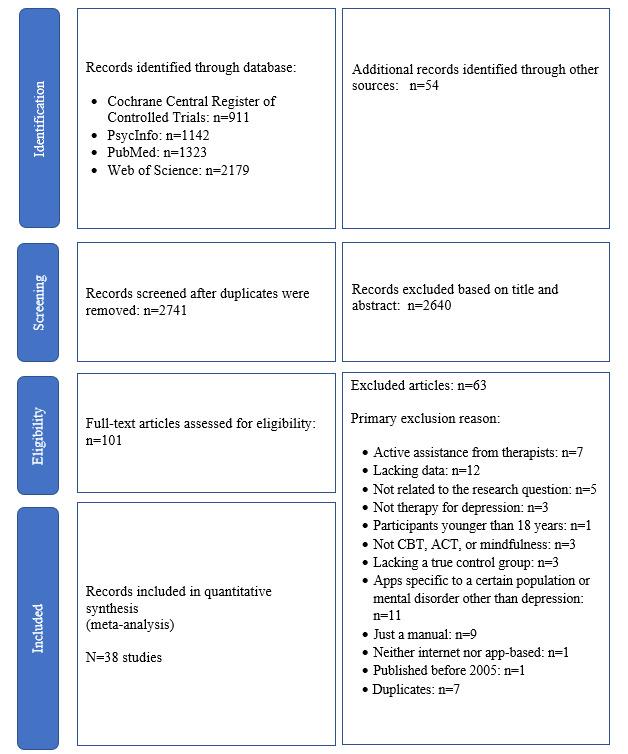
A meta-analysis of studies that examined the effect of app-based therapy, including cognitive behavioral therapy, acceptance and commitment therapy, and mindfulness, on depressive symptoms was performed. A total of 5597 articles were identified via five databases. After screening, 38 studies (n=8110 participants) remained for data extraction. From these studies, 50 total comparisons between postintervention mental health app intervention groups and control groups were included in the meta-analysis.
RESULTS
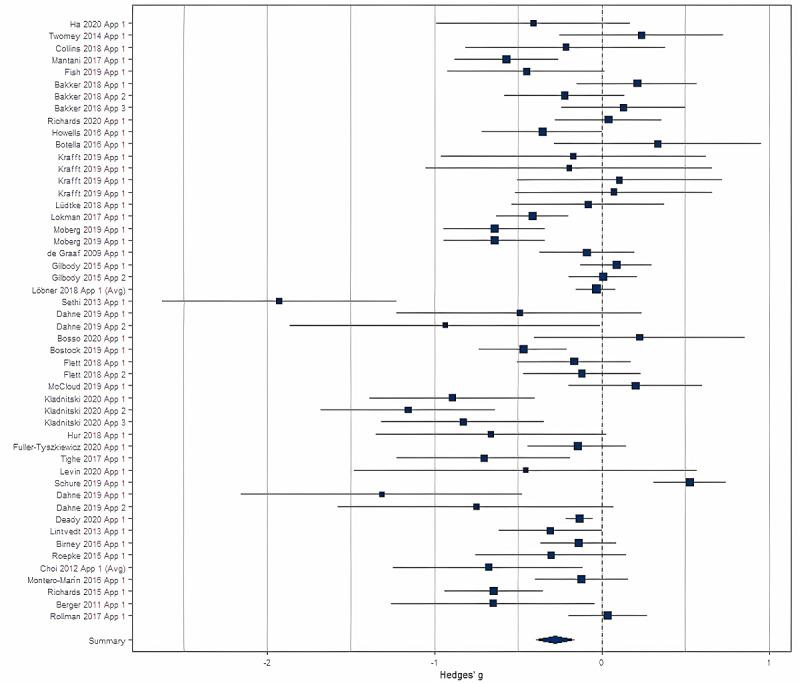
A random effects model was performed to examine the effect of mental health apps on depressive symptoms compared to controls. The number of gamification elements within the apps was included as a moderator. Results indicated a small to moderate effect size across all mental health apps in which the mental health app intervention effectively reduced depressive symptoms compared to controls (Hedges g=-0.27, 95% CI -0.36 to -0.17; P<.001). The gamification moderator was not a significant predictor of depressive symptoms (β=-0.03, SE=0.03; P=.38), demonstrating no significant difference in effectiveness between mental health apps with and without gamification features. A separate meta-regression also did not show an effect of gamification elements on intervention adherence (β=-1.93, SE=2.28; P=.40).
CONCLUSIONS
The results show that both mental health apps with and without gamification elements were effective in reducing depressive symptoms. There was no significant difference in the effectiveness of mental health apps with gamification elements on depressive symptoms or adherence. This research has important clinical implications for understanding how gamification elements influence the effectiveness of mental health apps on depressive symptoms.
背景
先前的研究表明,计算机化认知行为疗法可有效减轻抑郁症状。一些心理健康应用程序在其应用设计中融入了游戏化元素,但尚不清楚这些功能在减轻抑郁症状方面的效果是否优于没有游戏化的心理健康应用程序。
目的
本研究的目的是确定与缺乏这些元素的心理健康应用程序相比,具有游戏化元素的心理健康应用程序在减轻抑郁症状方面的效果是否不同。
方法
对研究基于应用程序的疗法(包括认知行为疗法、接受与承诺疗法和正念疗法)对抑郁症状影响的研究进行荟萃分析。通过五个数据库共识别出5597篇文章。筛选后,保留38项研究(n = 8110名参与者)进行数据提取。在这些研究中,荟萃分析纳入了干预后心理健康应用程序干预组与对照组之间的50次总体比较。
结果
采用随机效应模型来检验心理健康应用程序与对照组相比对抑郁症状的影响。应用程序中的游戏化元素数量作为一个调节变量。结果表明,与对照组相比,所有心理健康应用程序在减轻抑郁症状方面均有小到中等程度的效应量(Hedges g = -0.27,95%CI -0.36至-0.17;P <.001)。游戏化调节变量不是抑郁症状的显著预测因子(β = -0.03,SE = 0.03;P =.38),表明有无游戏化功能的心理健康应用程序在效果上无显著差异。一项单独的元回归也未显示游戏化元素对干预依从性有影响(β = -1.93,SE = 2.28;P =.40)。
结论
结果表明,有无游戏化元素的心理健康应用程序在减轻抑郁症状方面均有效。有游戏化元素的心理健康应用程序在抑郁症状或依从性方面的效果无显著差异。这项研究对于理解游戏化元素如何影响心理健康应用程序对抑郁症状的效果具有重要的临床意义。

 Zotero 插件