
从乳腺癌筛查到转移性疾病的循环肿瘤 DNA 分析。
Circulating Tumor DNA Profiling From Breast Cancer Screening Through to Metastatic Disease.
机构信息
Leicester Cancer Research Centre, University of Leicester, Leicester, United Kingdom.
Department of Surgery and Cancer, Imperial College London, Hammersmith Hospital Campus, London, United Kingdom.
出版信息
JCO Precis Oncol. 2021 Nov 24;5. doi: 10.1200/PO.20.00522. eCollection 2021.
PURPOSE
We investigated the utility of the Oncomine Breast cfDNA Assay for detecting circulating tumor DNA (ctDNA) in women from a breast screening population, including healthy women with no abnormality detected by mammogram, and women on follow-up through to advanced breast cancer.
MATERIALS AND METHODS
Blood samples were taken from 373 women (127 healthy controls recruited through breast screening, 28 ductal carcinoma in situ, 60 primary breast cancers, 47 primary breast cancer on follow-up, and 111 metastatic breast cancers [MBC]) to recover plasma and germline DNA for analysis with the Oncomine Breast cfDNA Assay on the Ion S5 platform.
RESULTS
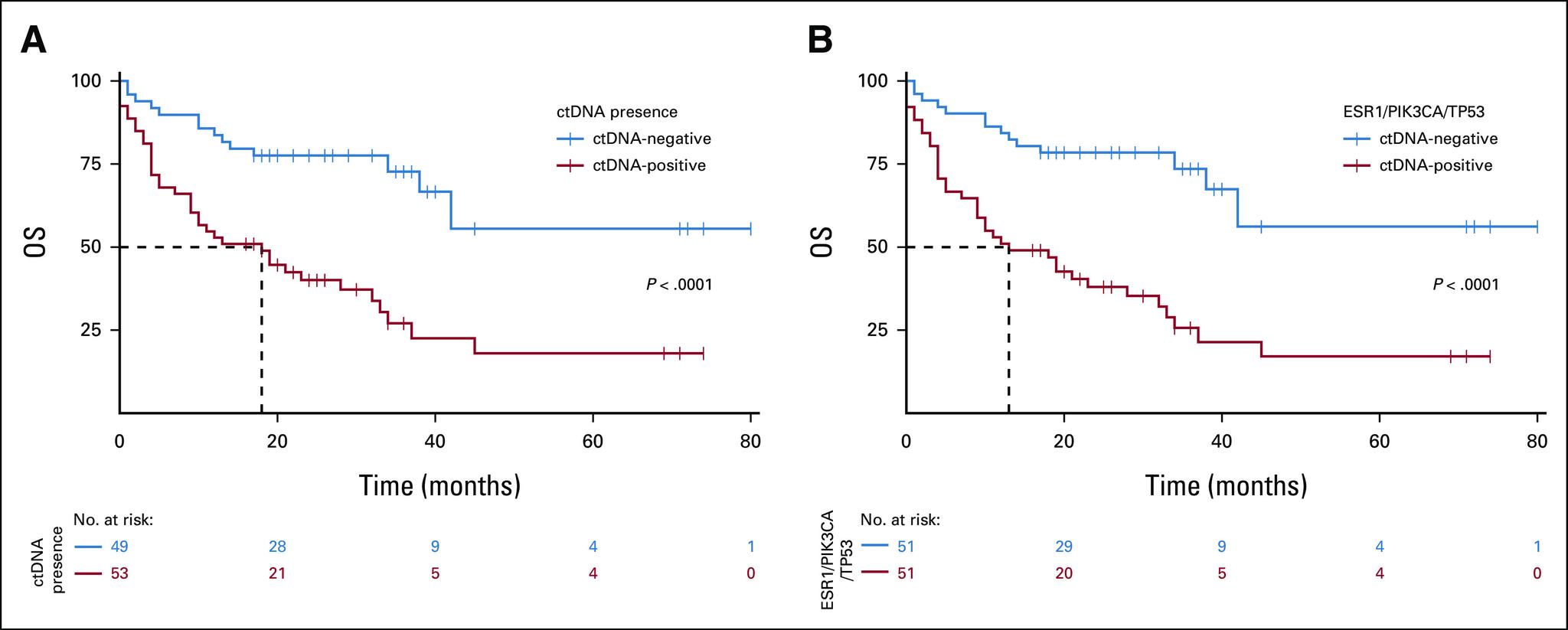
One hundred sixteen of 373 plasma samples had one or more somatic variants detected across eight of the 10 genes and were called ctDNA-positive; MBC had the highest proportion of ctDNA-positive samples (61; 55%) and healthy controls the lowest (20; 15.7%). , , and mutations account for 93% of all variants detected and predict poor overall survival in MBC (hazard ratio = 3.461; 95% CI, 1.866 to 6.42; = .001). Patients with MBC had higher plasma cell-free DNA levels, higher variant allele frequencies, and more polyclonal variants, notably in than in all other groups. Only 15 individuals had evidence of potential clonal hematopoiesis of indeterminate potential mutations.
CONCLUSION
We were able detect ctDNA across the breast cancer spectrum, notably in MBC where variants in , , and predicted poor overall survival. The assay could be used to monitor emergence of resistance mutations such as in that herald resistance to aromatase inhibitors to tailor adjuvant therapies. However, we suggest caution is needed when interpreting results from a single plasma sample as variants were also detected in a small proportion of HCs.
目的
我们研究了 Oncomine Breast cfDNA 检测在乳腺筛查人群中检测循环肿瘤 DNA(ctDNA)的效用,包括通过乳房 X 光检查未发现异常的健康女性以及随访至晚期乳腺癌的女性。
材料和方法
从 373 名女性(127 名健康对照者通过乳房筛查招募,28 名导管原位癌,60 名原发性乳腺癌,47 名原发性乳腺癌随访,111 名转移性乳腺癌 [MBC])采集血样,用于分析 Ion S5 平台上的 Oncomine Breast cfDNA 检测。
结果
373 个血浆样本中有 116 个样本在 10 个基因中的 8 个中检测到一个或多个体细胞变异,被称为 ctDNA 阳性;MBC 的 ctDNA 阳性样本比例最高(61;55%),健康对照组最低(20;15.7%)。、、和 突变占所有检测到的变异的 93%,并预测 MBC 的总体生存不良(危险比=3.461;95%CI,1.866 至 6.42;P=0.001)。MBC 患者的血浆无细胞游离 DNA 水平较高,变异等位基因频率较高,多克隆变异较多,尤其是在 中。只有 15 名患者存在潜在的克隆性造血不确定潜能突变的证据。
结论
我们能够在乳腺癌谱中检测到 ctDNA,特别是在 MBC 中,、、和 中的变异预测总体生存不良。该检测可用于监测潜在的耐药突变,如 中的突变,这些突变预示着对芳香酶抑制剂的耐药性,以调整辅助治疗。然而,我们建议在解释单个血浆样本的结果时要谨慎,因为在一小部分 HCs 中也检测到了变异。


 Zotero 插件