
热带城市非正规住区的长期热应激
Chronic heat stress in tropical urban informal settlements.
作者信息
Ramsay Emma E, Fleming Genie M, Faber Peter A, Barker S Fiona, Sweeney Rohan, Taruc Ruzka R, Chown Steven L, Duffy Grant A
机构信息
School of Biological Sciences, Monash University, Clayton, VIC 3800, Australia.
School of Public Health and Preventive Medicine, Monash University, Clayton, VIC 3004, Australia.
出版信息
iScience. 2021 Nov 10;24(11):103248. doi: 10.1016/j.isci.2021.103248. eCollection 2021 Nov 19.
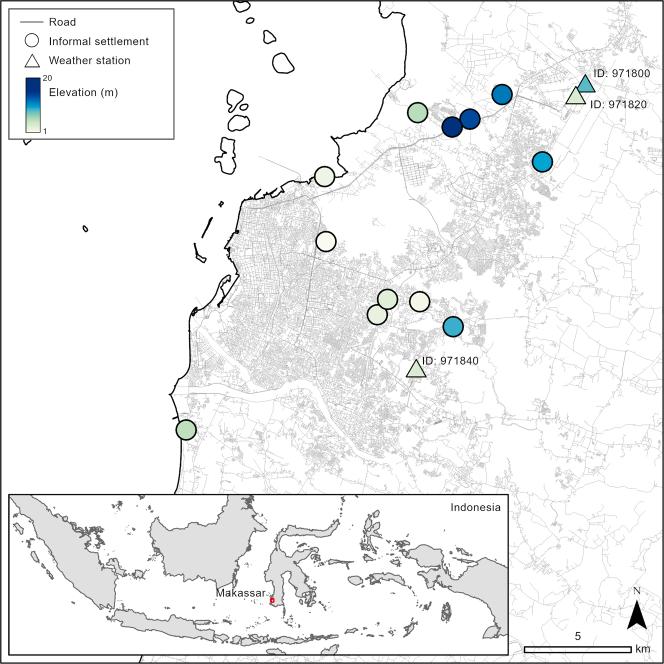
The health and economic impacts of extreme heat on humans are especially pronounced in populations without the means to adapt. We deployed a sensor network across 12 informal settlements in Makassar, Indonesia to measure the thermal environment that people experience inside and outside their homes. We calculated two metrics to assess the magnitude and frequency of heat stress conditions, wet bulb temperature and wet bulb globe temperature, and compared our data to that collected by weather stations. We found that informal settlement residents experience chronic heat stress conditions, which are underestimated by weather stations. Wet bulb temperatures approached the uppermost limits of human survivability, and wet bulb globe temperatures regularly exceeded recommended physical activity thresholds, both in houses and outdoors. Under a warming climate, a growing number of people living informally will face potentially severe impacts from heat stress that have likely been previously overlooked or underestimated.
极端高温对人类健康和经济的影响在缺乏适应能力的人群中尤为显著。我们在印度尼西亚望加锡的12个非正式住区部署了一个传感器网络,以测量人们在家内外所经历的热环境。我们计算了两个指标来评估热应激状况的强度和频率,即湿球温度和湿球黑球温度,并将我们的数据与气象站收集的数据进行了比较。我们发现,非正式住区居民经历着慢性热应激状况,而气象站对此估计不足。湿球温度接近人类生存能力的上限,无论是在室内还是室外,湿球黑球温度经常超过推荐的身体活动阈值。在气候变暖的情况下,越来越多的非正规居住人群将面临热应激带来的潜在严重影响,而这些影响可能此前一直被忽视或低估。




 Zotero 插件