
双重抑制 TGF-β 和 PD-L1:一种新的癌症治疗方法。
Dual inhibition of TGF-β and PD-L1: a novel approach to cancer treatment.
机构信息
Genitourinary Malignancies Branch, Center for Cancer Research, National Cancer Institute, Bethesda, MD, USA.
Laboratory of Tumor Immunology and Biology, Center for Cancer Research, National Cancer Institute, Bethesda, MD, USA.
出版信息
Mol Oncol. 2022 Jun;16(11):2117-2134. doi: 10.1002/1878-0261.13146. Epub 2022 Jan 4.
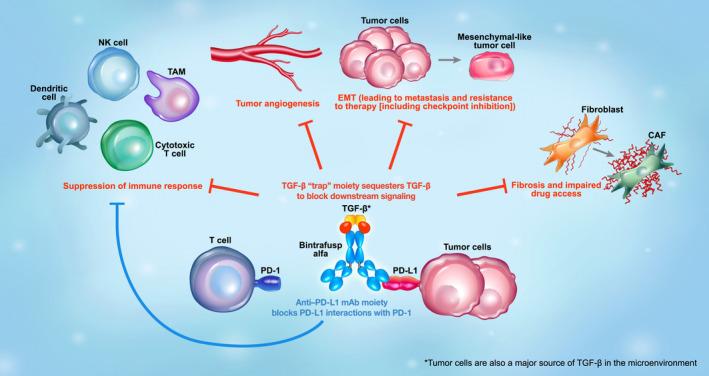
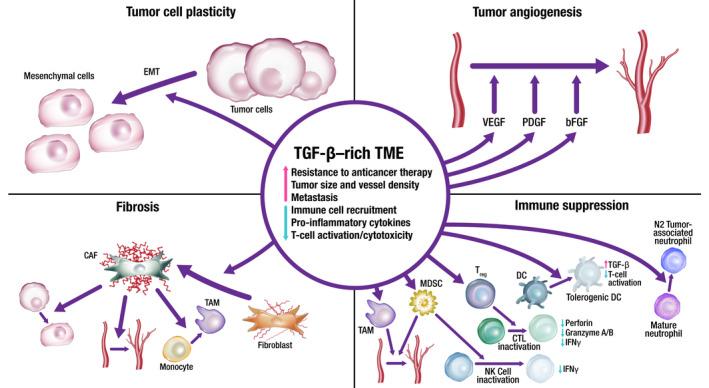
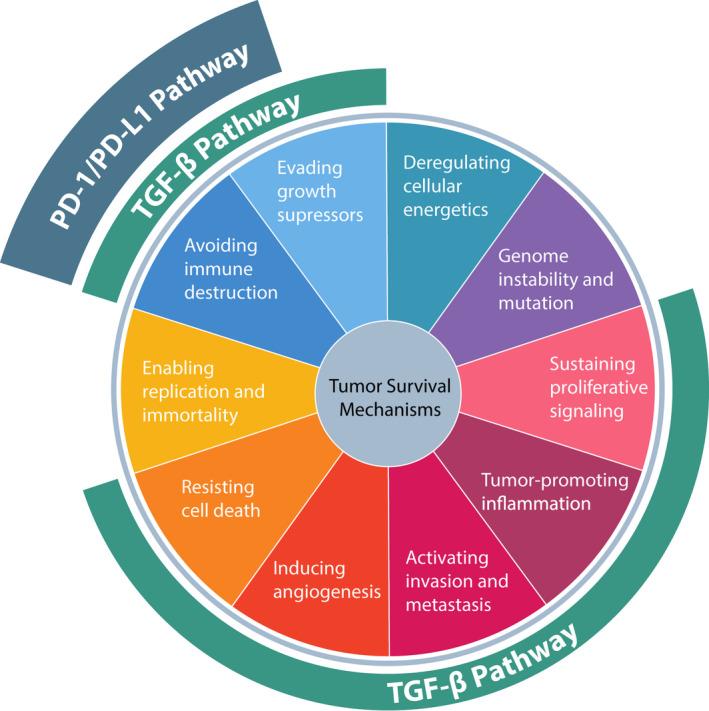
Transforming growth factor-β (TGF-β) and programmed death ligand 1 (PD-L1) initiate signaling pathways with complementary, nonredundant immunosuppressive functions in the tumor microenvironment (TME). In the TME, dysregulated TGF-β signaling suppresses antitumor immunity and promotes cancer fibrosis, epithelial-to-mesenchymal transition, and angiogenesis. Meanwhile, PD-L1 expression inactivates cytotoxic T cells and restricts immunosurveillance in the TME. Anti-PD-L1 therapies have been approved for the treatment of various cancers, but TGF-β signaling in the TME is associated with resistance to these therapies. In this review, we discuss the importance of the TGF-β and PD-L1 pathways in cancer, as well as clinical strategies using combination therapies that block these pathways separately or approaches with dual-targeting agents (bispecific and bifunctional immunotherapies) that may block them simultaneously. Currently, the furthest developed dual-targeting agent is bintrafusp alfa. This drug is a first-in-class bifunctional fusion protein that consists of the extracellular domain of the TGF-βRII receptor (a TGF-β 'trap') fused to a human immunoglobulin G1 (IgG1) monoclonal antibody blocking PD-L1. Given the immunosuppressive effects of the TGF-β and PD-L1 pathways within the TME, colocalized and simultaneous inhibition of these pathways may potentially improve clinical activity and reduce toxicity.
转化生长因子-β(TGF-β)和程序性死亡配体 1(PD-L1)在肿瘤微环境(TME)中启动具有互补、非冗余免疫抑制功能的信号通路。在 TME 中,失调的 TGF-β 信号抑制抗肿瘤免疫并促进癌症纤维化、上皮间质转化和血管生成。同时,PD-L1 的表达使细胞毒性 T 细胞失活,并限制 TME 中的免疫监视。抗 PD-L1 疗法已被批准用于治疗各种癌症,但 TME 中的 TGF-β 信号与这些疗法的耐药性有关。在这篇综述中,我们讨论了 TGF-β 和 PD-L1 通路在癌症中的重要性,以及分别阻断这些通路的联合治疗策略,以及可能同时阻断它们的双靶向药物(双特异性和双功能免疫疗法)的临床策略。目前,开发最深入的双靶向药物是 bintrafusp alfa。该药物是一种首创的双功能融合蛋白,由 TGF-βRII 受体的细胞外结构域(TGF-β“陷阱”)与阻断 PD-L1 的人免疫球蛋白 G1(IgG1)单克隆抗体融合而成。鉴于 TGF-β 和 PD-L1 通路在 TME 中的免疫抑制作用,这些通路的局部和同时抑制可能潜在地提高临床疗效并降低毒性。
 Zotero 插件