
抗程序性细胞死亡蛋白1单克隆抗体免疫疗法治疗合并感染的肺癌的安全性和有效性
The safety and efficacy of immunotherapy with anti-programmed cell death 1 monoclonal antibody for lung cancer complicated with infection.
作者信息
Shi Jinpeng, Li Jiayu, Wang Qi, Cheng Xiaomin, Du He, Han Ruoshuang, Li Xuefei, Zhao Chao, Gao Guanghui, He Yayi, Chen Xiaoxia, Su Chunxia, Ren Shengxiang, Wu Fengying, Zhang Zhemin, Zhou Caicun
机构信息
Department of Medical Oncology, Shanghai Pulmonary Hospital & Thoracic Cancer Institute, School of Medicine, Tongji University, Shanghai, China.
Department of Pulmonary & Critical Care Medicine, Shanghai Pulmonary Hospital, School of Medicine, Tongji University, Shanghai, China.
出版信息
Transl Lung Cancer Res. 2021 Oct;10(10):3929-3942. doi: 10.21037/tlcr-21-524.
BACKGROUND
Anti-programmed cell death 1 (PD-1)/programmed cell death-ligand 1 (PD-L1) immunotherapy has boosted the prognosis in advanced lung cancer. Meanwhile, accumulating cases showed the correlation between tuberculosis (TB) reactivation and anti-PD-1/PD-L1 immunotherapy. However, the safety and efficacy of anti-PD-1/PD-L1 immunotherapy for lung cancer complicated with TB infection could only be learned from real-world data.
METHODS
We retrospectively analyzed 562 patients with advanced lung cancer who received anti-PD-1/PD-L1 immunotherapy at Shanghai Pulmonary Hospital from 2015 to 2019, including 13 patients with TB infection. Besides, relevant literature reviews were performed online to analyze the safety and efficacy of immunotherapy and to explore the appropriate treatment strategies in this specific population.
RESULTS
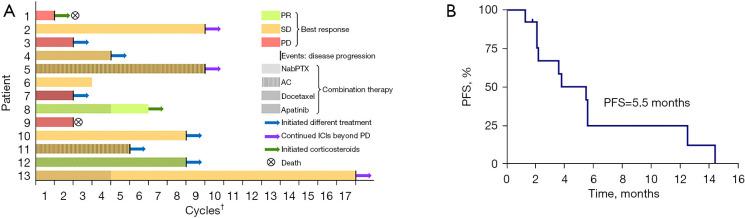
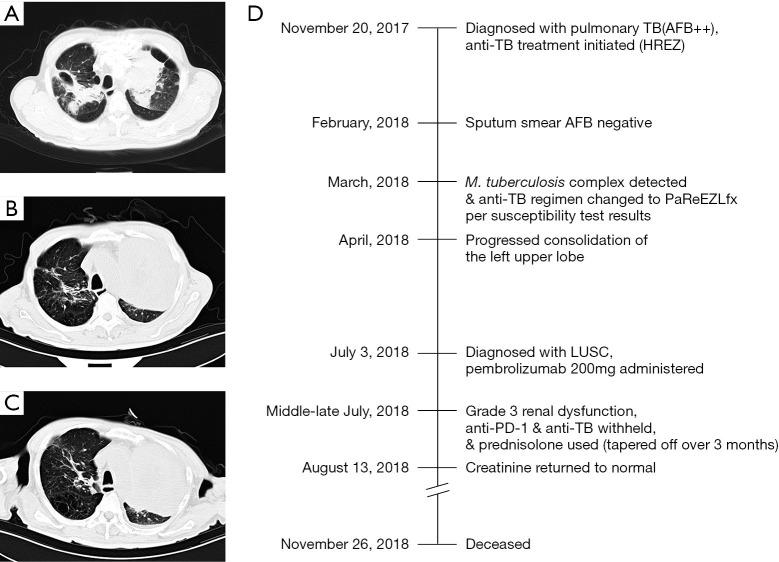
In our cohort, the initiation of anti-PD-1/PD-L1 immunotherapy was from June 2015 to December 2019. Among them, 13 patients had TB infection prior to immunotherapy including 11 latent TB and 2 active TB, and all of them were treated with anti-PD-1 immunotherapy. Patients with active TB infection were treated with concurrent anti-TB and anti-PD-1 treatments, and the remaining received either mono-immunotherapy or combined immunotherapy. Neither reactivation of latent TB nor progression of active TB was monitored in our cohort during immunotherapy. Severe immune-related adverse events (irAEs) were diagnosed in two patients. Treatment strategies such as discontinuation of immunotherapy and administration of corticosteroids were provided timely, and one with latent TB infection got gradually improved, but the other one with active TB died quickly. The median progression-free survival (PFS) was 5.5 months for tumor immunotherapy in our cohort. However, the PFS of immunotherapy was merely 2.1 and 2.2 months in lung cancer patients with active TB infection.
CONCLUSIONS
Immunotherapy is relatively safe for lung cancer patients complicated with previously treated latent TB, and the efficacy of immunotherapy in this specified population is not inferior to that in lung cancer patients without TB infection. TB screening before anti-PD-1/PD-L1 immunotherapy is strongly recommended, and irAEs should be monitored more cautiously in lung cancer patients with active TB infection.
背景
抗程序性细胞死亡蛋白1(PD-1)/程序性细胞死亡配体1(PD-L1)免疫疗法改善了晚期肺癌的预后。同时,越来越多的病例显示结核病(TB)复发与抗PD-1/PD-L1免疫疗法之间存在关联。然而,抗PD-1/PD-L1免疫疗法用于合并TB感染的肺癌患者的安全性和疗效只能从真实世界数据中得知。
方法
我们回顾性分析了2015年至2019年在上海肺科医院接受抗PD-1/PD-L1免疫疗法的562例晚期肺癌患者,其中包括13例合并TB感染的患者。此外,进行了在线相关文献综述,以分析免疫疗法的安全性和疗效,并探索该特定人群的合适治疗策略。
结果
在我们的队列中,抗PD-1/PD-L1免疫疗法始于2015年6月至2019年12月。其中,13例患者在免疫疗法前合并TB感染,包括11例潜伏性TB和2例活动性TB,所有患者均接受抗PD-1免疫疗法。活动性TB感染患者接受抗TB和抗PD-1联合治疗,其余患者接受单免疫疗法或联合免疫疗法。在我们的队列中,免疫疗法期间未监测到潜伏性TB复发或活动性TB进展。两名患者被诊断出严重的免疫相关不良事件(irAE)。及时提供了诸如停止免疫疗法和给予皮质类固醇等治疗策略,1例潜伏性TB感染患者逐渐好转,但另1例活动性TB患者很快死亡。我们队列中肿瘤免疫疗法的中位无进展生存期(PFS)为5.5个月。然而,活动性TB感染的肺癌患者免疫疗法的PFS仅为2.1个月和2.2个月。
结论
免疫疗法对于合并既往治疗过的潜伏性TB感染肺癌患者相对安全,且该特定人群中免疫疗法的疗效不低于未合并TB感染的肺癌患者。强烈建议在抗PD-1/PD-L1免疫疗法前进行TB筛查,对于活动性TB感染的肺癌患者应更谨慎地监测irAE。


 Zotero 插件