
在撒哈拉以南非洲地区,用吡喹酮进行预防化疗对学龄儿童血吸虫病的影响:时空建模研究。
Effect of preventive chemotherapy with praziquantel on schistosomiasis among school-aged children in sub-Saharan Africa: a spatiotemporal modelling study.
机构信息
Department of Epidemiology and Public Health, Swiss Tropical and Public Health Institute, Basel, Switzerland; University of Basel, Basel, Switzerland.
Department of Control of Neglected Tropical Diseases, WHO, Geneva, Switzerland.
出版信息
Lancet Infect Dis. 2022 Jan;22(1):136-149. doi: 10.1016/S1473-3099(21)00090-6. Epub 2021 Dec 2.
BACKGROUND
Over the past 20 years, schistosomiasis control has been scaled up. Preventive chemotherapy with praziquantel is the main intervention. We aimed to assess the effect of preventive chemotherapy on schistosomiasis prevalence in sub-Saharan Africa, comparing 2000-10 with 2011-14 and 2015-19.
METHODS
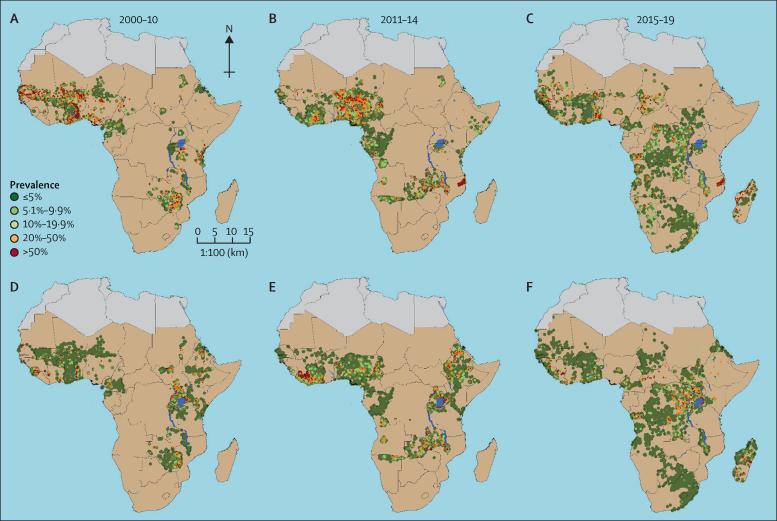
In this spatiotemporal modelling study, we analysed survey data from school-aged children (aged 5-14 years) in 44 countries across sub-Saharan Africa. The data were extracted from the Global Neglected Tropical Diseases database and augmented by 2018 and 2019 survey data obtained from disease control programmes. Bayesian geostatistical models were fitted to Schistosoma haematobium and Schistosoma mansoni survey data. The models included data on climatic predictors obtained from satellites and other open-source environmental databases and socioeconomic predictors obtained from various household surveys. Temporal changes in Schistosoma species prevalence were estimated by a categorical variable with values corresponding to the three time periods (2000-10, 2011-14, and 2015-19) during which preventive chemotherapy interventions were scaled up.
FINDINGS
We identified 781 references with relevant geolocated schistosomiasis survey data for 2000-19. There were 19 166 unique survey locations for S haematobium and 23 861 for S mansoni, of which 77% (14 757 locations for S haematobium and 18 372 locations for S mansoni) corresponded to 2011-19. Schistosomiasis prevalence among school-aged children in sub-Saharan Africa decreased from 23·0% (95% Bayesian credible interval 22·1-24·1) in 2000-10 to 9·6% (9·1-10·2) in 2015-19, an overall reduction of 58·3%. The reduction of S haematobium was 67·9% (64·6-71·1) and that of S mansoni 53·6% (45·2-58·3) when comparing 2000-10 with 2015-19.
INTERPRETATION
Our model-based estimates suggest that schistosomiasis prevalence in sub-Saharan Africa has decreased considerably, most likely explained by the scale-up of preventive chemotherapy. There is a need to consolidate gains in the control of schistosomiasis by means of preventive chemotherapy, coupled with other interventions to interrupt disease transmission.
FUNDING
European Research Council and WHO.
背景
在过去的 20 年中,血吸虫病控制工作得到了大力推进。以吡喹酮为基础的预防性化疗是主要干预措施。我们旨在评估预防性化疗对撒哈拉以南非洲血吸虫病流行率的影响,比较 2000-10 年、2011-14 年和 2015-19 年的数据。
方法
在这项时空建模研究中,我们分析了来自撒哈拉以南非洲 44 个国家的学龄儿童(5-14 岁)的调查数据。这些数据从全球被忽视的热带病数据库中提取,并通过 2018 年和 2019 年从疾病控制规划中获得的调查数据进行补充。贝叶斯地质统计学模型适用于血吸虫和曼氏血吸虫的调查数据。这些模型包括从卫星和其他开源环境数据库获得的气候预测因子数据,以及从各种家庭调查中获得的社会经济预测因子数据。通过具有对应于三个时期(2000-10 年、2011-14 年和 2015-19 年)的类别变量来估计血吸虫物种流行率的时间变化,在此期间预防性化疗干预措施得到了大力推广。
结果
我们确定了 781 篇与 2000-19 年具有相关地理位置的血吸虫病调查数据相关的参考文献。有 19166 个独特的血吸虫感染调查地点和 23861 个曼氏血吸虫感染调查地点,其中 77%(血吸虫感染调查地点 14757 个,曼氏血吸虫感染调查地点 18372 个)对应于 2011-19 年。撒哈拉以南非洲地区学龄儿童的血吸虫病流行率从 2000-10 年的 23.0%(95%贝叶斯可信区间 22.1-24.1)下降到 2015-19 年的 9.6%(9.1-10.2),总体下降了 58.3%。血吸虫感染的下降率为 67.9%(64.6-71.1),曼氏血吸虫感染的下降率为 53.6%(45.2-58.3),与 2000-10 年相比。
解释
我们基于模型的估计表明,撒哈拉以南非洲的血吸虫病流行率已经大幅下降,这很可能是由于预防性化疗的大力推广。需要通过预防性化疗以及其他中断疾病传播的干预措施来巩固血吸虫病控制方面的成果。
资金
欧洲研究理事会和世界卫生组织。

 Zotero 插件