
SARS-CoV-2 刺突蛋白能否不依赖 RGD 序列结合整合素?
Can the SARS-CoV-2 Spike Protein Bind Integrins Independent of the RGD Sequence?
机构信息
Department of Biochemistry, Sanger Building, University of Cambridge, Cambridge, United Kingdom.
Department of Biochemistry, Hopkins Building, University of Cambridge, Cambridge, United Kingdom.
出版信息
Front Cell Infect Microbiol. 2021 Nov 18;11:765300. doi: 10.3389/fcimb.2021.765300. eCollection 2021.
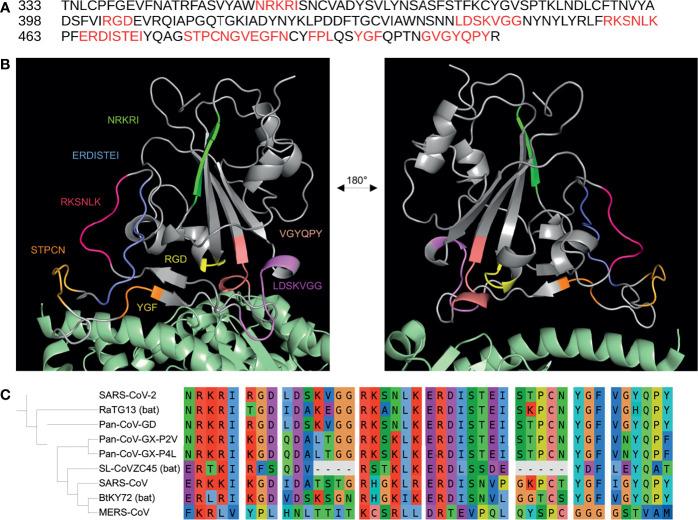
The RGD motif in the Severe Acute Syndrome Coronavirus 2 (SARS-CoV-2) spike protein has been predicted to bind RGD-recognizing integrins. Recent studies have shown that the spike protein does, indeed, interact with αβ and αβ integrins, both of which bind to RGD-containing ligands. However, computational studies have suggested that binding between the spike RGD motif and integrins is not favourable, even when unfolding occurs after conformational changes induced by binding to the canonical host entry receptor, angiotensin-converting enzyme 2 (ACE2). Furthermore, non-RGD-binding integrins, such as α, have been suggested to interact with the SARS-CoV-2 spike protein. Other viral pathogens, such as rotaviruses, have been recorded to bind integrins in an RGD-independent manner to initiate host cell entry. Thus, in order to consider the potential for the SARS-CoV-2 spike protein to bind integrins independent of the RGD sequence, we investigate several factors related to the involvement of integrins in SARS-CoV-2 infection. First, we review changes in integrin expression during SARS-CoV-2 infection to identify which integrins might be of interest. Then, all known non-RGD integrin-binding motifs are collected and mapped to the spike protein receptor-binding domain and analyzed for their 3D availability. Several integrin-binding motifs are shown to exhibit high sequence similarity with solvent accessible regions of the spike receptor-binding domain. Comparisons of these motifs with other betacoronavirus spike proteins, such as SARS-CoV and RaTG13, reveal that some have recently evolved while others are more conserved throughout phylogenetically similar betacoronaviruses. Interestingly, all of the potential integrin-binding motifs, including the RGD sequence, are conserved in one of the known pangolin coronavirus strains. Of note, the most recently recorded mutations in the spike protein receptor-binding domain were found outside of the putative integrin-binding sequences, although several mutations formed inside and close to one motif, in particular, may potentially enhance binding. These data suggest that the SARS-CoV-2 spike protein may interact with integrins independent of the RGD sequence and may help further explain how SARS-CoV-2 and other viruses can evolve to bind to integrins.
严重急性呼吸系统综合征冠状病毒 2(SARS-CoV-2)刺突蛋白中的 RGD 基序已被预测与识别 RGD 的整合素结合。最近的研究表明,刺突蛋白确实与结合 RGD 配体的αβ和αβ整合素相互作用。然而,计算研究表明,即使在结合到典型的宿主进入受体血管紧张素转换酶 2(ACE2)后发生构象变化导致的解折叠之后,刺突 RGD 基序与整合素之间的结合也不是有利的。此外,已提出非 RGD 结合的整合素,如α,与 SARS-CoV-2 刺突蛋白相互作用。其他病毒病原体,如轮状病毒,已被记录为以不依赖于 RGD 的方式结合整合素以启动宿主细胞进入。因此,为了考虑 SARS-CoV-2 刺突蛋白与整合素结合的潜力而不依赖于 RGD 序列,我们研究了与整合素参与 SARS-CoV-2 感染相关的几个因素。首先,我们综述了 SARS-CoV-2 感染过程中整合素表达的变化,以确定哪些整合素可能是值得关注的。然后,收集并映射到刺突蛋白受体结合域所有已知的非 RGD 整合素结合基序,并对其 3D 可用性进行分析。显示几个整合素结合基序与刺突受体结合域的溶剂可及区域具有高度序列相似性。将这些基序与其他β冠状病毒刺突蛋白(如 SARS-CoV 和 RaTG13)进行比较,揭示出一些在进化上相似的β冠状病毒中最近进化,而另一些则更为保守。有趣的是,所有潜在的整合素结合基序,包括 RGD 序列,都在已知的穿山甲冠状病毒株之一中保守。值得注意的是,在刺突蛋白受体结合域中发现的最近记录的突变位于假定的整合素结合序列之外,尽管有几个突变形成于一个基序内部和附近,特别是,可能潜在地增强结合。这些数据表明,SARS-CoV-2 刺突蛋白可能与整合素相互作用而不依赖于 RGD 序列,并可能有助于进一步解释 SARS-CoV-2 和其他病毒如何进化以与整合素结合。
 Zotero 插件