
[F]氟代阿尔伐斯汀环丙基非肽类 FAPI-04 正电子发射断层扫描/计算机断层扫描(PET/CT)摄取在转移灶的 PET/CT 成像上可能有助于鉴别不同病理类型的肺癌。
[F]AlF-NOTA-FAPI-04 PET/CT uptake in metastatic lesions on PET/CT imaging might distinguish different pathological types of lung cancer.
机构信息
Cheeloo College of Medicine, Shandong University, Jinan, China.
Department of Radiology, Shandong Cancer Hospital and Institute, Shandong First Medical University, Shandong Academy of Medical Sciences, Jinan, 250117, Shandong, China.
出版信息
Eur J Nucl Med Mol Imaging. 2022 Apr;49(5):1671-1681. doi: 10.1007/s00259-021-05638-z. Epub 2021 Dec 6.
PURPOSE
Heterogeneity is found in the tumor microenvironment among different pathological types of tumors. Radionuclide-labeled fibroblast-activation-protein inhibitor (FAPI), as an important tracer for non-invasive imaging of the tumor microenvironment, can be used to evaluate the expression of FAP in cancer-associated fibroblasts, macrophages, and tumor cells. Our aim was to explore the ability of [F]AlF-NOTA-FAPI-04 positron emission tomography (PET)/computed tomography (CT) to distinguish different types of lung cancer by evaluating the uptake of this tracer in primary and metastatic lesions.
METHODS
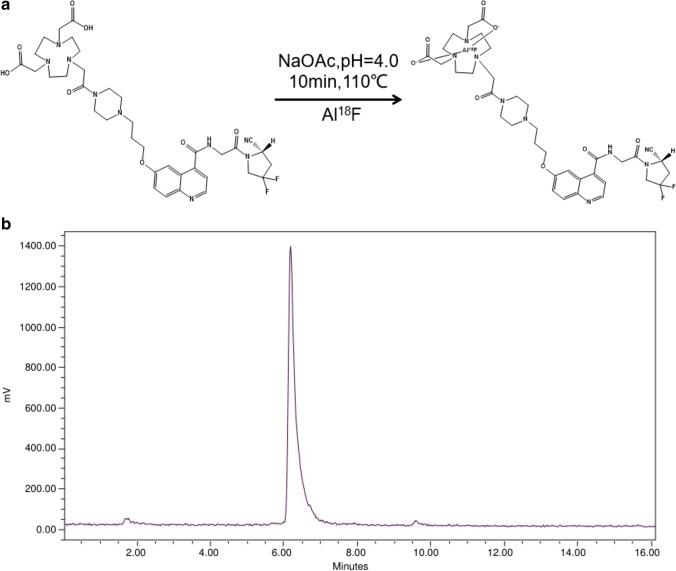
We prospectively enrolled 61 patients with histopathologically proven primary lung cancer with metastases. PET/CT scanning was performed before any antitumor therapy and 1 h after injection of 235.10 ± 3.89 MBq of [F]AlF-NOTA-FAPI-04. Maximum standard uptake values (SUV) were calculated for comparison among primary and metastatic lesions. Immunohistochemical staining for FAP was performed on tumor specimens.
RESULTS
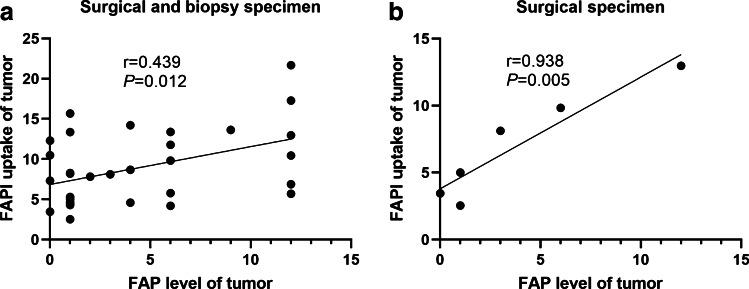
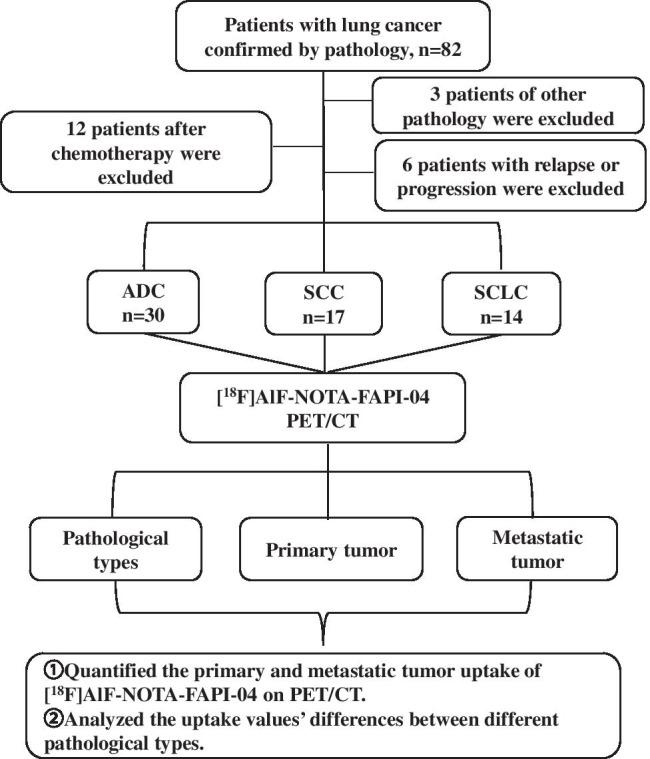
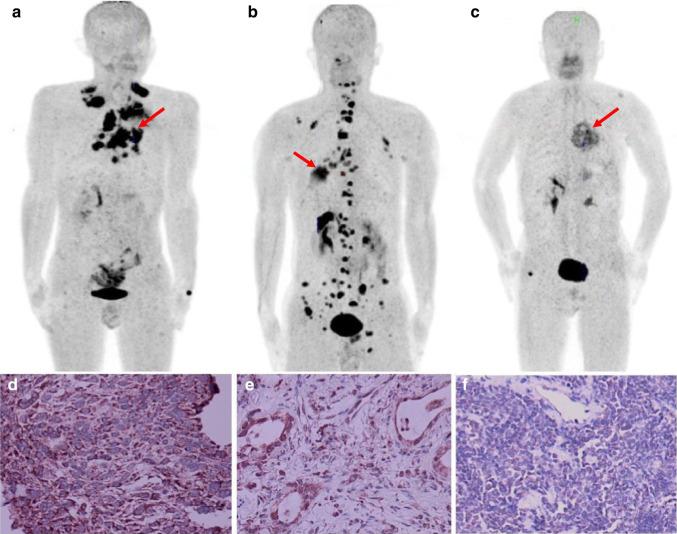
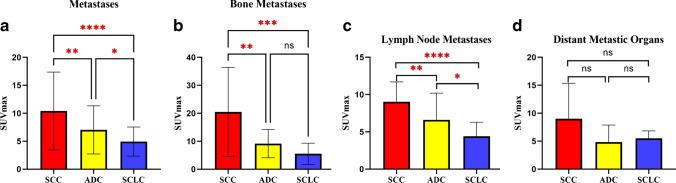
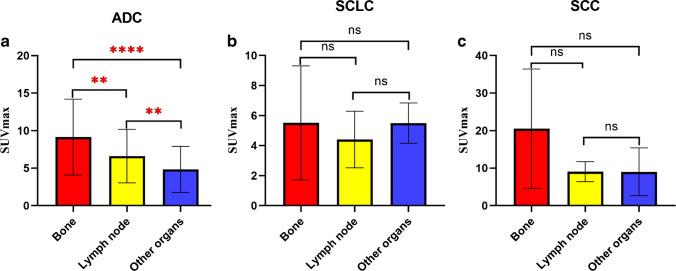
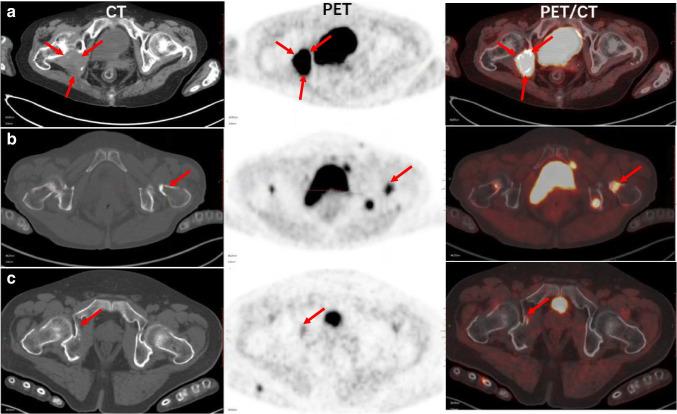
Sixty-one patients with adenocarcinoma (ADC, n = 30), squamous cell carcinoma (SCC, n = 17), and small cell lung cancer (SCLC, n = 14) were enrolled in this study, and 61 primary tumors and 199 metastases were evaluated. No difference in [F]AlF-NOTA-FAPI-04 uptake was observed among primary ADC, SCC, and SCLC tumors (P = 0.198). Additionally, no difference in uptake was found between primary and metastatic lesions of lung cancer with the same pathological type (P > 0.05). However, uptake did differ among metastases of differing pathological types (P < 0.001). The SUV of metastatic lymph nodes was highest for SCC, followed by ADC and then SCLC (P < 0.001). The SUV of bone metastases also was highest for SCC, followed by ADC and SCLC (P < 0.05), but no difference was observed between ADC and SCLC. The SUV of metastases in other organs was higher in SCC cases than in ADC cases but did not differ between SCC and SCLC or ADC and SCLC. Bone metastases exhibited higher uptake than those of lymph nodes and other organs in SCC and ADC (P < 0.05) but not in SCLC. Positive correlations were found between FAPI uptake and FAP expression in surgical plus biopsy specimens (r = 0.439, P = 0.012) and surgical specimens (r = 0.938, P = 0.005).
CONCLUSION
[F]AlF-NOTA-FAPI-04 PET/CT imaging revealed differences in FAP expression in metastases of lung cancer, with the highest expression specifically in bone metastases, and thus, may be valuable for distinguishing different pathological types of lung cancer.
目的
不同病理类型的肿瘤之间存在肿瘤微环境的异质性。放射性核素标记的成纤维细胞激活蛋白抑制剂(FAPI)作为肿瘤微环境非侵入性成像的重要示踪剂,可用于评估癌症相关成纤维细胞、巨噬细胞和肿瘤细胞中 FAP 的表达。我们的目的是通过评估原发性和转移性病变中该示踪剂的摄取,探讨[F]AlF-NOTA-FAPI-04 正电子发射断层扫描(PET)/计算机断层扫描(CT)区分不同类型肺癌的能力。
方法
我们前瞻性纳入了 61 例经组织病理学证实的原发性肺癌伴转移患者。在任何抗肿瘤治疗前和注射[F]AlF-NOTA-FAPI-04 235.10±3.89MBq 1 小时后进行 PET/CT 扫描。比较原发性和转移性病变的最大标准摄取值(SUV)。对肿瘤标本进行 FAP 免疫组织化学染色。
结果
本研究纳入了 61 例腺癌(ADC,n=30)、鳞状细胞癌(SCC,n=17)和小细胞肺癌(SCLC,n=14)患者,共评估了 61 个原发性肿瘤和 199 个转移灶。ADC、SCC 和 SCLC 原发性肿瘤之间[F]AlF-NOTA-FAPI-04 摄取无差异(P=0.198)。此外,同一病理类型的肺癌原发性和转移性病变之间摄取无差异(P>0.05)。然而,不同病理类型的转移灶之间摄取有差异(P<0.001)。SCC 患者的转移性淋巴结 SUV 最高,其次是 ADC 和 SCLC(P<0.001)。SCC 患者的骨转移 SUV 也最高,其次是 ADC 和 SCLC(P<0.05),但 ADC 和 SCLC 之间无差异。SCC 患者其他器官转移的 SUV 高于 ADC 患者,但 SCC 与 SCLC 或 ADC 与 SCLC 之间无差异。SCC 患者的骨转移摄取高于淋巴结和其他器官转移(P<0.05),但 SCLC 患者无差异。手术加活检标本(r=0.439,P=0.012)和手术标本(r=0.938,P=0.005)中 FAPI 摄取与 FAP 表达呈正相关。
结论
[F]AlF-NOTA-FAPI-04 PET/CT 成像显示肺癌转移中 FAP 表达存在差异,在骨转移中表达最高,因此可能对区分不同类型的肺癌有价值。

 Zotero 插件