
2019年青少年和青年癌症的全球负担:全球疾病负担研究2019的系统分析
The global burden of adolescent and young adult cancer in 2019: a systematic analysis for the Global Burden of Disease Study 2019.
出版信息
Lancet Oncol. 2022 Jan;23(1):27-52. doi: 10.1016/S1470-2045(21)00581-7. Epub 2021 Dec 3.
BACKGROUND
In estimating the global burden of cancer, adolescents and young adults with cancer are often overlooked, despite being a distinct subgroup with unique epidemiology, clinical care needs, and societal impact. Comprehensive estimates of the global cancer burden in adolescents and young adults (aged 15-39 years) are lacking. To address this gap, we analysed results from the Global Burden of Diseases, Injuries, and Risk Factors Study (GBD) 2019, with a focus on the outcome of disability-adjusted life-years (DALYs), to inform global cancer control measures in adolescents and young adults.
METHODS
Using the GBD 2019 methodology, international mortality data were collected from vital registration systems, verbal autopsies, and population-based cancer registry inputs modelled with mortality-to-incidence ratios (MIRs). Incidence was computed with mortality estimates and corresponding MIRs. Prevalence estimates were calculated using modelled survival and multiplied by disability weights to obtain years lived with disability (YLDs). Years of life lost (YLLs) were calculated as age-specific cancer deaths multiplied by the standard life expectancy at the age of death. The main outcome was DALYs (the sum of YLLs and YLDs). Estimates were presented globally and by Socio-demographic Index (SDI) quintiles (countries ranked and divided into five equal SDI groups), and all estimates were presented with corresponding 95% uncertainty intervals (UIs). For this analysis, we used the age range of 15-39 years to define adolescents and young adults.
FINDINGS
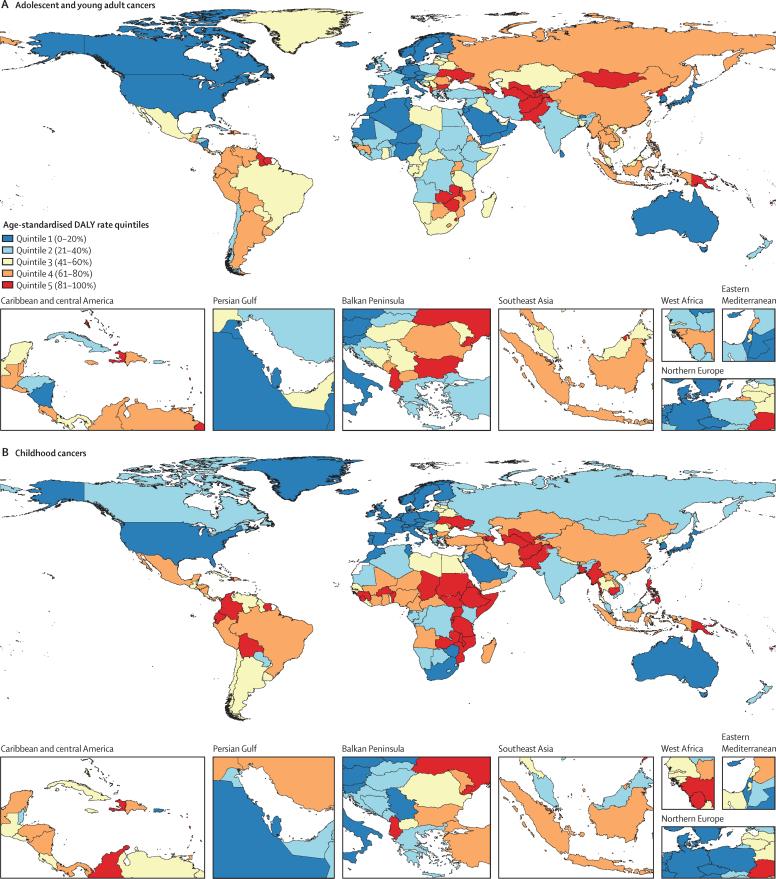
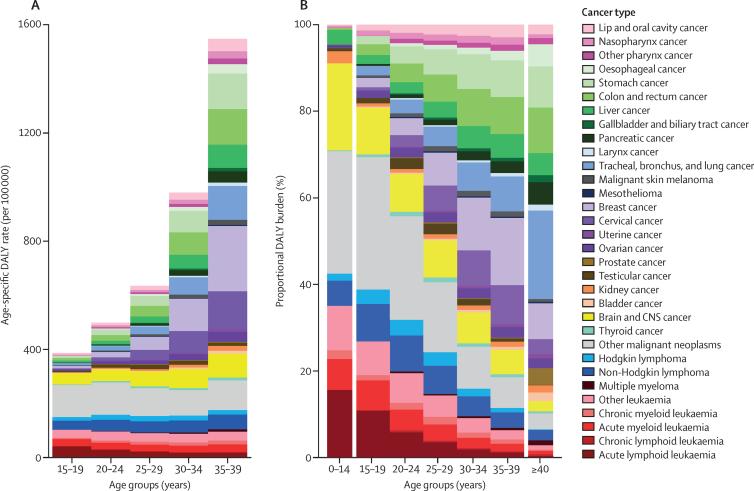
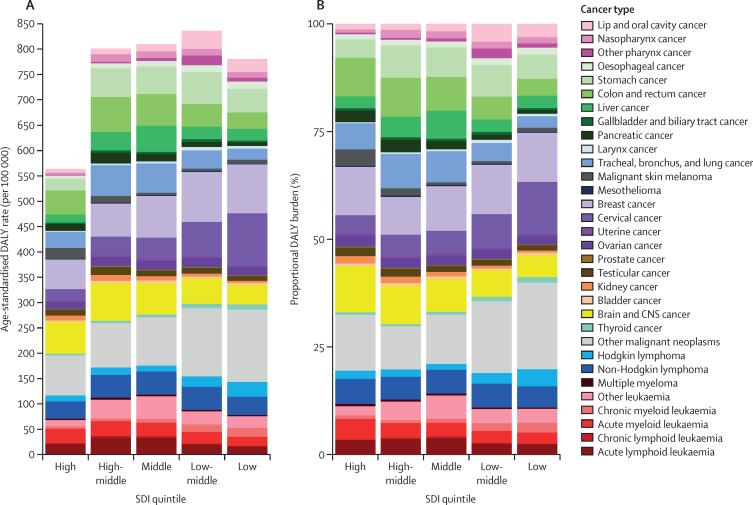
There were 1·19 million (95% UI 1·11-1·28) incident cancer cases and 396 000 (370 000-425 000) deaths due to cancer among people aged 15-39 years worldwide in 2019. The highest age-standardised incidence rates occurred in high SDI (59·6 [54·5-65·7] per 100 000 person-years) and high-middle SDI countries (53·2 [48·8-57·9] per 100 000 person-years), while the highest age-standardised mortality rates were in low-middle SDI (14·2 [12·9-15·6] per 100 000 person-years) and middle SDI (13·6 [12·6-14·8] per 100 000 person-years) countries. In 2019, adolescent and young adult cancers contributed 23·5 million (21·9-25·2) DALYs to the global burden of disease, of which 2·7% (1·9-3·6) came from YLDs and 97·3% (96·4-98·1) from YLLs. Cancer was the fourth leading cause of death and tenth leading cause of DALYs in adolescents and young adults globally.
INTERPRETATION
Adolescent and young adult cancers contributed substantially to the overall adolescent and young adult disease burden globally in 2019. These results provide new insights into the distribution and magnitude of the adolescent and young adult cancer burden around the world. With notable differences observed across SDI settings, these estimates can inform global and country-level cancer control efforts.
FUNDING
Bill & Melinda Gates Foundation, American Lebanese Syrian Associated Charities, St Baldrick's Foundation, and the National Cancer Institute.
背景
在估算全球癌症负担时,患癌青少年和青年常常被忽视,尽管他们是一个独特的亚组,有着独特的流行病学特征、临床护理需求及社会影响。目前缺乏对全球青少年和青年(15 - 39岁)癌症负担的全面估算。为填补这一空白,我们分析了《2019年全球疾病、伤害及风险因素负担研究》(GBD)的结果,重点关注伤残调整生命年(DALYs)这一指标,以为全球青少年和青年的癌症控制措施提供参考。
方法
采用GBD 2019的方法,从人口动态登记系统、死因推断及基于人群的癌症登记数据(通过死亡率与发病率之比建模)中收集国际死亡率数据。发病率通过死亡率估算值及相应的死亡率与发病率之比来计算。患病率估算值通过建模生存情况计算得出,并乘以伤残权重以获得伤残生存年数(YLDs)。寿命损失年数(YLLs)通过特定年龄的癌症死亡人数乘以死亡年龄的标准预期寿命来计算。主要结果是DALYs(YLLs与YLDs之和)。估算值在全球范围内以及按社会人口指数(SDI)五分位数(将各国排序并分为五个相等的SDI组)呈现,所有估算值均带有相应的95%不确定性区间(UIs)。在本分析中,我们使用15 - 39岁的年龄范围来定义青少年和青年。
结果
2019年,全球15 - 39岁人群中,有119万例(95% UI 111 - 128万)新发癌症病例,39.6万例(37万 - 42.5万)癌症死亡病例。年龄标准化发病率最高的是高SDI国家(每10万人年59.6例[54.5 - 65.7例])和高中等SDI国家(每10万人年53.2例[48.8 -
57.9例]),而年龄标准化死亡率最高的是低中等SDI国家(每10万人年14.2例[12.9 - 15.6例])和中等SDI国家(每10万人年13.6例[12.6 - 14.8例])。2019年,青少年和青年癌症导致全球疾病负担达2350万(2190 - 2520)DALYs,其中2.7%(1.9% - 3.6%)来自YLDs,97.3%(96.4% - 98.1%)来自YLLs。癌症是全球青少年和青年中第四大主要死因及第十大主要DALYs病因。
解读
2019年,青少年和青年癌症在全球青少年和青年总体疾病负担中占很大比例。这些结果为全球青少年和青年癌症负担的分布及规模提供了新的见解。鉴于在不同SDI环境下观察到显著差异,这些估算可为全球和国家层面的癌症控制工作提供参考。
资金来源
比尔及梅琳达·盖茨基金会、美国黎巴嫩叙利亚联合慈善机构、圣巴德里克基金会及美国国立癌症研究所。


 Zotero 插件