
浙江省头花千金藤(防己科)完整叶绿体基因组:分子结构、比较基因组分析、突变热点和系统发育关系的见解。
Complete chloroplast genome of Stephania tetrandra (Menispermaceae) from Zhejiang Province: insights into molecular structures, comparative genome analysis, mutational hotspots and phylogenetic relationships.
机构信息
School of Pharmaceutical Sciences, Zhejiang Chinese Medical University, 548 Binwen Road, Hangzhou, Zhejiang Province, People's Republic of China.
The Administration Bureau of Zhejiang Jiulongshan National Nature Reserve, Suichang, Zhejiang Province, People's Republic of China.
出版信息
BMC Genomics. 2021 Dec 6;22(1):880. doi: 10.1186/s12864-021-08193-x.
BACKGROUND
The Stephania tetrandra S. Moore (S. tetrandra) is a medicinal plant belonging to the family Menispermaceae that has high medicinal value and is well worth doing further exploration. The wild resources of S. tetrandra were widely distributed in tropical and subtropical regions of China, generating potential genetic diversity and unique population structures. The geographical origin of S. tetrandra is an important factor influencing its quality and price in the market. In addition, the species relationship within Stephania genus still remains uncertain due to high morphological similarity and low support values of molecular analysis approach. The complete chloroplast (cp) genome data has become a promising strategy to determine geographical origin and understand species evolution for closely related plant species. Herein, we sequenced the complete cp genome of S. tetrandra from Zhejiang Province and conducted a comparative analysis within Stephania plants to reveal the structural variations, informative markers and phylogenetic relationship of Stephania species.
RESULTS
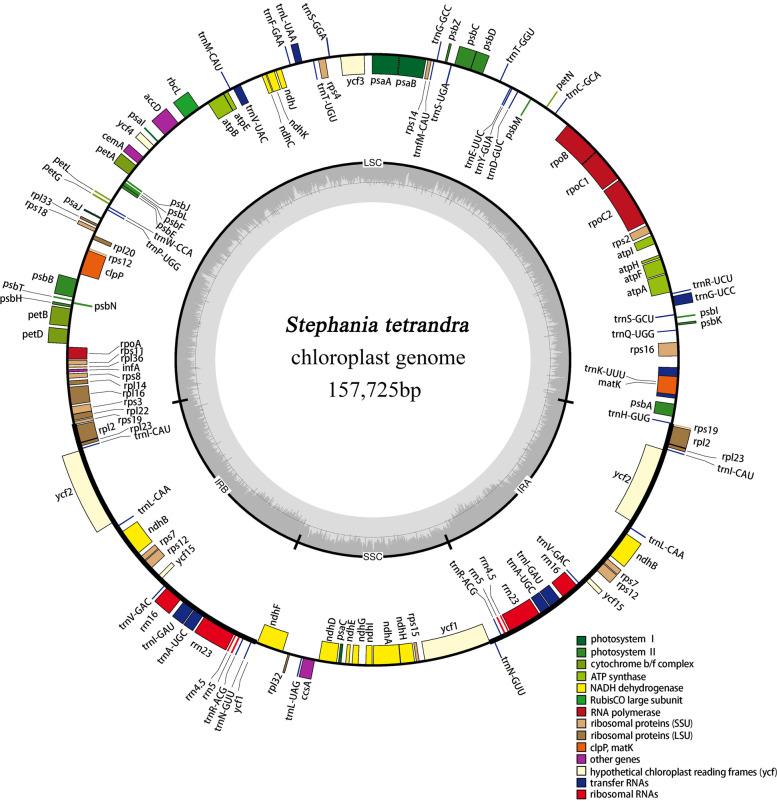
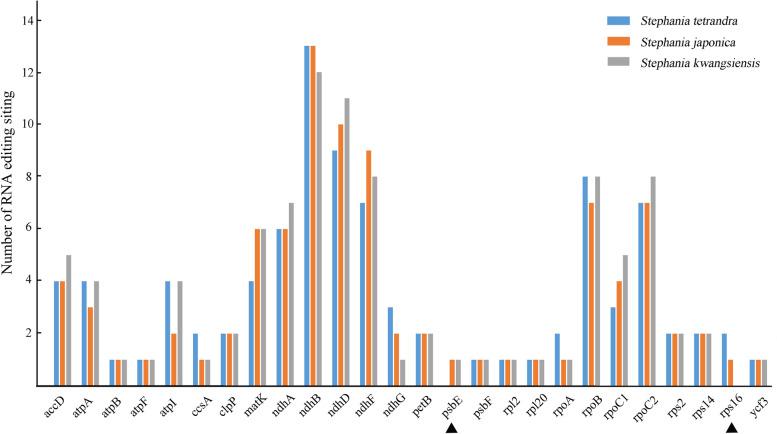
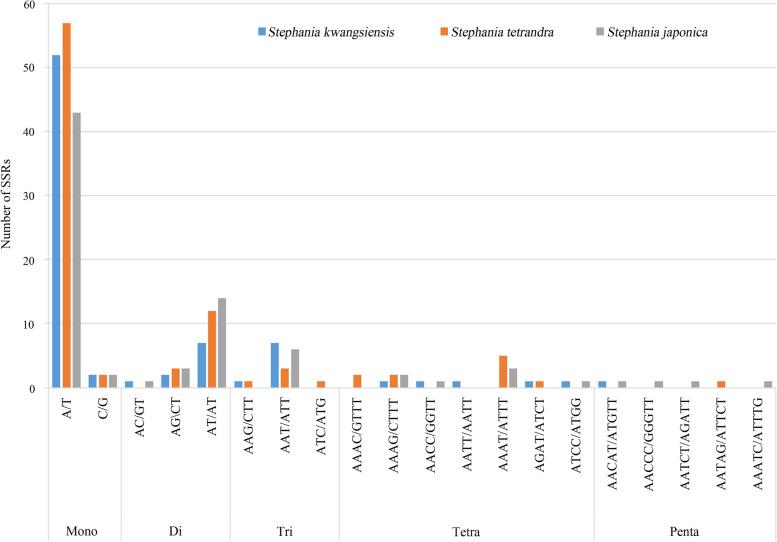
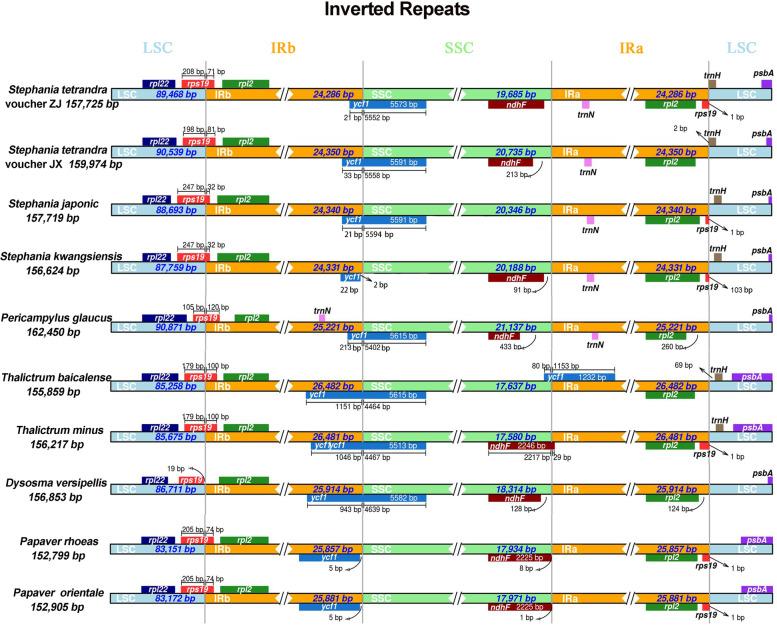
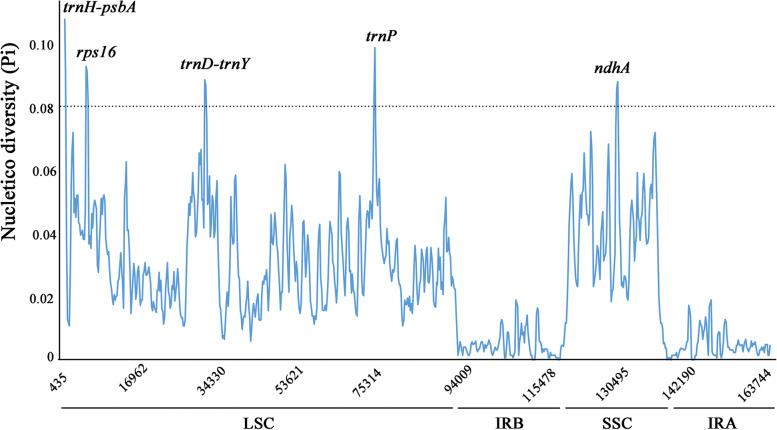
The cp genome of S. tetrandra voucher ZJ was 157,725 bp, consisting of a large single copy region (89,468 bp), a small single copy region (19,685 bp) and a pair of inverted repeat regions (24,286 bp each). A total of 134 genes were identified in the cp genome of S. tetrandra, including 87 protein-coding genes, 8 rRNA genes, 37 tRNA genes and 2 pseudogene copies (ycf1 and rps19). The gene order and GC content were highly consistent in the Stephania species according to the comparative analysis results, with the highest RSCU value in arginine (1.79) and lowest RSCU value in serine of S. tetrandra, respectively. A total of 90 SSRs have been identified in the cp genome of S. tetrandra, where repeats that consisting of A or T bases were much higher than that of G or C bases. In addition, 92 potential RNA editing sites were identified in 25 protein-coding genes, with the most predicted RNA editing sites in ndhB gene. The variations on length and expansion extent to the junction of ycf1 gene were observed between S. tetrandra vouchers from different regions, indicating potential markers for further geographical origin discrimination. Moreover, the values of transition to transversion ratio (Ts/Tv) in the Stephania species were significantly higher than 1 using Pericampylus glaucus as reference. Comparative analysis of the Stephania cp genomes revealed 5 highly variable regions, including 3 intergenic regions (trnH-psbA, trnD-trnY, trnP) and two protein coding genes (rps16 and ndhA). The identified mutational hotspots of Stephania plants exhibited multiple SNP sites and Gaps, as well as different Ka/Ks ratio values. In addition, five pairs of specific primers targeting the divergence regions were accordingly designed, which could be utilized as potential molecular markers for species identification, population genetic and phylogenetic analysis in Stephania species. Phylogenetic tree analysis based on the conserved chloroplast protein coding genes indicated a sister relationship between S. tetrandra and the monophyletic group of S. japonica and S. kwangsiensis with high support values, suggesting a close genetic relationship within Stephania plants. However, two S. tetrandra vouches from different regions failed to cluster into one clade, confirming the occurrences of genetic diversities and requiring further investigation for geographical tracing strategy.
CONCLUSIONS
Overall, we provided comprehensive and detailed information on the complete chloroplast genome and identified nucleotide diversity hotspots of Stephania species. The obtained genetic resource of S. tetrandra from Zhejiang Province would facilitate future studies in DNA barcode, species discrimination, the intraspecific and interspecific variability and the phylogenetic relationships of Stephania plants.
背景
Stephania tetrandra S. Moore(S. tetrandra)是防己科的一种药用植物,具有很高的药用价值,非常值得进一步探索。S. tetrandra 的野生资源广泛分布于中国的热带和亚热带地区,具有潜在的遗传多样性和独特的种群结构。S. tetrandra 的地理起源是影响其在市场上质量和价格的一个重要因素。此外,由于形态相似性高和分子分析方法支持值低,Stephania 属内的种间关系仍然不确定。完整的叶绿体(cp)基因组数据已成为确定地理起源和了解近缘植物种进化的有前途的策略。本研究对来自浙江的 S. tetrandra 进行了完整 cp 基因组测序,并对 Stephania 植物进行了比较分析,以揭示 Stephania 种的结构变异、信息标记和系统发育关系。
结果
S. tetrandra 凭证 ZJ 的 cp 基因组为 157725 bp,由一个大的单拷贝区(89468 bp)、一个小的单拷贝区(19685 bp)和一对反向重复区(各 24286 bp)组成。在 S. tetrandra 的 cp 基因组中鉴定出 134 个基因,包括 87 个蛋白质编码基因、8 个 rRNA 基因、37 个 tRNA 基因和 2 个假基因拷贝(ycf1 和 rps19)。根据比较分析结果,Stephania 种的基因排列和 GC 含量高度一致,Arg (1.79)的 RSCU 值最高,Ser 的 RSCU 值最低。在 S. tetrandra 的 cp 基因组中鉴定出 90 个 SSRs,其中由 A 或 T 碱基组成的重复序列明显高于由 G 或 C 碱基组成的重复序列。此外,在 25 个蛋白质编码基因中鉴定出 92 个潜在的 RNA 编辑位点,其中 ndhB 基因预测的 RNA 编辑位点最多。来自不同地区的 S. tetrandra 凭证在 ycf1 基因的长度和扩展程度上存在差异,表明存在潜在的地理起源标记。此外,Stephania 种的转换/颠换比(Ts/Tv)值显著高于以 Pericampylus glaucus 为参照的比值。Stephania cp 基因组的比较分析揭示了 5 个高度可变区域,包括 3 个内含子区域(trnH-psbA、trnD-trnY、trnP)和两个蛋白质编码基因(rps16 和 ndhA)。Stephania 植物的突变热点表现出多个 SNP 位点和缺口,以及不同的 Ka/Ks 比值。此外,还设计了 5 对针对分歧区域的特异性引物,可作为 Stephania 种物种鉴定、群体遗传和系统发育分析的潜在分子标记。基于保守的叶绿体蛋白质编码基因的系统发育树分析表明,S. tetrandra 与单系的 S. japonica 和 S. kwangsiensis 具有姊妹关系,支持值很高,表明 Stephania 植物之间存在密切的遗传关系。然而,来自不同地区的两个 S. tetrandra 凭证未能聚类为一个分支,证实了遗传多样性的存在,需要进一步调查以确定地理起源策略。
结论
总之,本研究提供了 Stephania 种完整叶绿体基因组的综合详细信息,并确定了 Stephania 种核苷酸多样性热点。来自浙江的 S. tetrandra 遗传资源将有助于未来的 DNA 条码、物种鉴别、种内和种间变异以及 Stephania 植物系统发育关系的研究。


 Zotero 插件