
新冠康复男性的精液参数:一项系统评价和荟萃分析。
Semen parameters in men recovered from COVID-19: a systematic review and meta-analysis.
作者信息
Tiwari Sagar, Kc Niranjan, Thapa Sajan, Ghimire Anuja, Bijukchhe Sanjeev, Sah Guru Sharan, Isnuwardana Ronny
机构信息
Department of Medicine, Bharatpur Central Hospital, Chitwan, Nepal.
Emergency Unit, Sumeru City Hospital, Kathmandu, Nepal.
出版信息
Middle East Fertil Soc J. 2021;26(1):44. doi: 10.1186/s43043-021-00089-w. Epub 2021 Dec 2.
BACKGROUND
The novel beta-coronavirus disease (COVID-19) has infected millions of people globally with high risk among males than females. However, the effect of COVID-19 andrology is still a subject of dispute. We planned to analyze the overall consequences of COVID-19 on semen parameters and male sex hormones.
MAIN TEXT
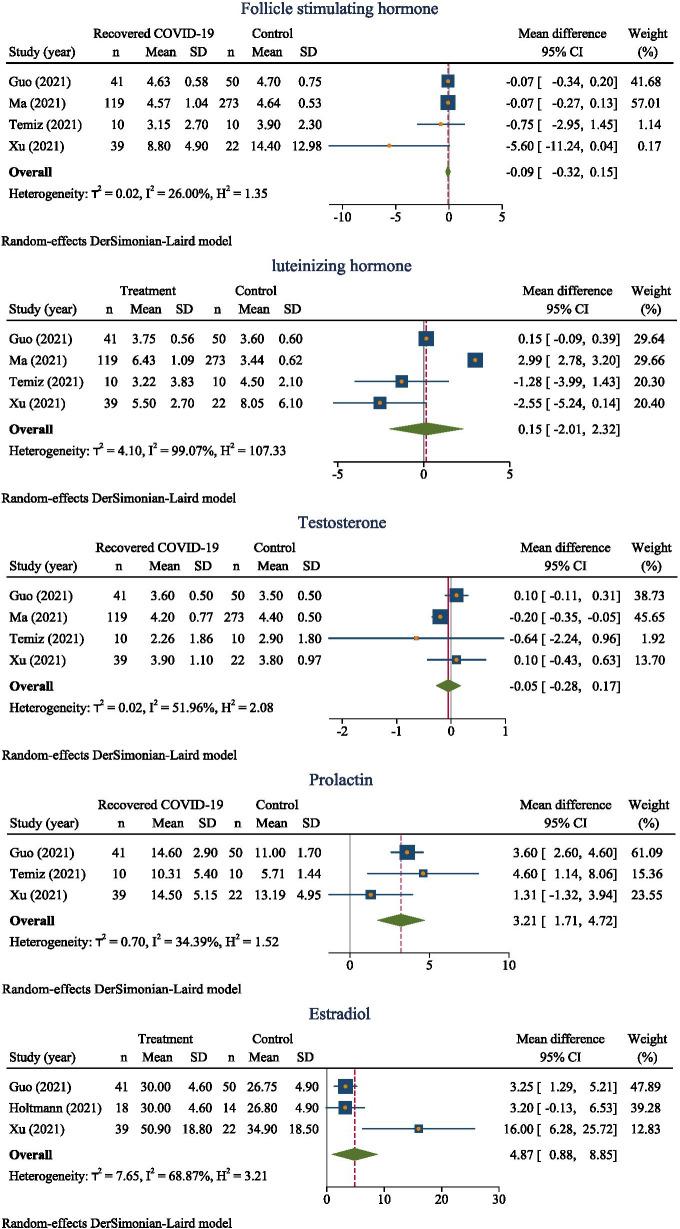
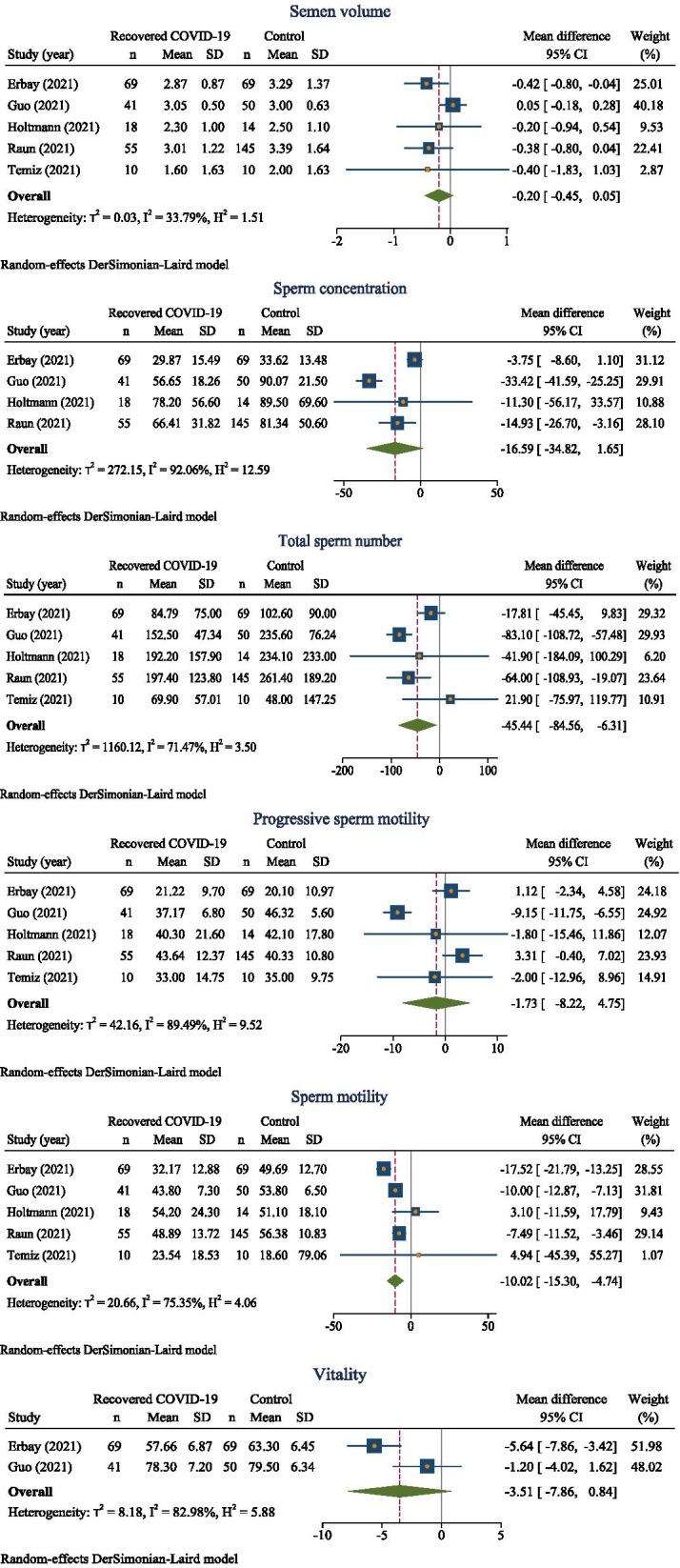
Systematic search was performed on MEDLINE and Scopus database until 11 June 2021. We included observational studies, which reported mean ± standard deviation of the semen parameters and serum sex hormones of those reproductive-aged males recovered from COVID-19 and controls who did not suffered from COVID-19. We used Random-effect model to pool the studies, as heterogeneity was present. The test and evaluated heterogeneity. All articles were assessed with their quality and publication bias.We assessed 966 articles for eligibility and found seven eligible studies. These 7 studies included 934 participants with mean age 37.34 ± 10.5 years. Random-effect model meta-analysis showed that men who recovered from COVID-19 had semen parameters less than those who had not suffered from COVID-19. The overall mean difference (MD) [95% confidence interval (CI)] in semen volume, sperm concentration, sperm number, and progressive sperm motility was - 0.20 (- 0.45, 0.05) ml, - 16.59 (- 34.82, 1.65) millions/ml, - 45.44 (- 84.56, - 6.31) millions per ejaculate, - 1.73 (- 8.20, 4.75) percentage respectively. Considering sex hormones, luteinizing hormone and prolactin levels were higher among those recovered with a significant MD (95% CI) of 3.47 (1.59, 5.35)U l and 3.21 (1.71, 4.72)ng ml respectively.
CONCLUSION
We found that COVID-19 affects both semen parameters and sexual hormones. However, the mechanism for testicular involvement remains doubtful.
TRIAL REGISTRATION
PROSPERO CRD42021259445.
SUPPLEMENTARY INFORMATION
The online version contains supplementary material available at 10.1186/s43043-021-00089-w.
背景
新型β冠状病毒疾病(COVID-19)已在全球感染了数百万人,男性感染风险高于女性。然而,COVID-19对男性生殖系统的影响仍存在争议。我们计划分析COVID-19对精液参数和男性性激素的总体影响。
正文
截至2021年6月11日,我们在MEDLINE和Scopus数据库中进行了系统检索。我们纳入了观察性研究,这些研究报告了从COVID-19中康复的生殖年龄男性以及未感染COVID-19的对照组的精液参数和血清性激素的均值±标准差。由于存在异质性,我们使用随机效应模型对研究进行汇总。通过I²检验和τ²评估异质性。所有文章均评估其质量和发表偏倚。我们评估了966篇文章的 eligibility,发现7项符合条件的研究。这7项研究包括934名参与者,平均年龄为37.34±10.5岁。随机效应模型荟萃分析显示,从COVID-19中康复的男性精液参数低于未感染COVID-19的男性。精液体积、精子浓度、精子数量和精子前向运动能力的总体平均差异(MD)[95%置信区间(CI)]分别为-0.20(-0.45,0.05)ml、-16.59(-34.82,1.65)百万/ml、-45.44(-84.56,-6.31)百万/射精、-1.73(-8.20,4.75)%。考虑性激素,促黄体生成素和催乳素水平在康复者中较高,显著MD(95%CI)分别为3.47(1.59,5.35)U/l和3.21(1.71,4.72)ng/ml。
结论
我们发现COVID-19会影响精液参数和性激素。然而,睾丸受累的机制仍值得怀疑。
试验注册
PROSPERO CRD42021259445。
补充信息
在线版本包含可在10.1186/s43043-021-00089-w获取的补充材料。

 Zotero 插件