
一例患者病例展示了贝那利珠单抗在难治性严重嗜酸性粒细胞性哮喘中的疗效,该哮喘对奥马珠单抗和美泊利珠单抗治疗无效。
A patient case demonstrating the efficacy of benralizumab in uncontrolled severe eosinophilic asthma refractory to omalizumab and mepolizumab treatment.
作者信息
Davison John, Doe Simon
机构信息
Newcastle Severe Asthma Service, Newcastle upon Tyne Hospitals NHS Foundation Trust, United Kingdom.
出版信息
Respir Med Case Rep. 2021 Nov 17;34:101557. doi: 10.1016/j.rmcr.2021.101557. eCollection 2021.
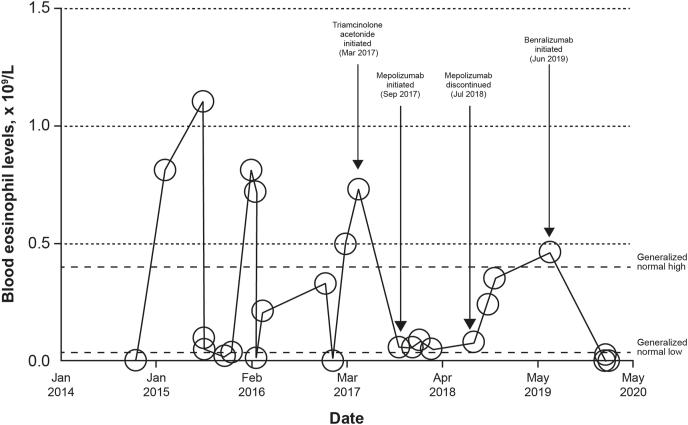
Severe eosinophilic asthma is associated with a heavy burden and impact on daily living in patients experiencing uncontrolled symptoms, exacerbations, and treatment side effects. This case study reports a 49-year-old woman who presented to the severe asthma center with uncontrolled severe asthma despite multiple maintenance medications and omalizumab treatment. On presentation, the patient had experienced two to three hospitalizations per year, frequent asthma exacerbations requiring courses of oral corticosteroids, and symptoms that impacted her quality of life. Omalizumab was previously discontinued, and bronchial thermoplasty was also unsuccessful. The patient stabilized on injectable steroids and commenced mepolizumab once available on prescription. Owing to continued exacerbations and an inability to reduce steroid treatment without exacerbating, mepolizumab was discontinued and the patient commenced benralizumab (30 mg subcutaneously every 4 weeks for the first three doses, every 8 weeks thereafter) under the sole care of the severe asthma center. Benralizumab treatment resulted in a reduction in steroid treatment, zero asthma exacerbations, improved asthma control and lung function, and a marked improvement in activity levels that allowed the patient to participate in a long-distance running event. Additionally, 7 months following the initiation of benralizumab treatment, her blood eosinophils were completely depleted. These findings support the use of benralizumab in patients with refractory uncontrolled severe eosinophilic asthma despite previous biologic treatment with omalizumab and mepolizumab, as improvements in clinical and patient outcomes, including quality of life, can be achieved in difficult-to-treat cases.
重度嗜酸性粒细胞性哮喘给症状未得到控制、病情加重以及出现治疗副作用的患者带来沉重负担并影响其日常生活。本病例研究报告了一名49岁女性,尽管使用了多种维持药物和奥马珠单抗治疗,但仍因重度哮喘未得到控制而前往重度哮喘中心就诊。初诊时,该患者每年住院两到三次,频繁的哮喘发作需要口服糖皮质激素治疗,症状影响了她的生活质量。奥马珠单抗此前已停用,支气管热成形术也未成功。患者使用注射用类固醇后病情稳定,一旦有处方便开始使用美泊利珠单抗。由于持续发作且无法在不加重病情的情况下减少类固醇治疗,美泊利珠单抗停药,患者在重度哮喘中心的单独护理下开始使用贝那利珠单抗(前三剂每4周皮下注射30毫克,此后每8周注射一次)。贝那利珠单抗治疗使类固醇治疗减少,哮喘发作次数降为零,哮喘控制和肺功能得到改善,活动水平显著提高,患者能够参加长跑活动。此外,在开始使用贝那利珠单抗治疗7个月后,她的血液嗜酸性粒细胞完全消失。这些发现支持在尽管先前使用奥马珠单抗和美泊利珠单抗进行生物治疗但仍难治性未控制的重度嗜酸性粒细胞性哮喘患者中使用贝那利珠单抗,因为在难治性病例中可以实现包括生活质量在内的临床和患者结局的改善。
 Zotero 插件