
杯状细胞增生在 Cftr 基因敲除的肠道中不是上皮细胞自主的。
Goblet cell hyperplasia is not epithelial-autonomous in the Cftr knockout intestine.
机构信息
Dalton Cardiovascular Research Center, University of Missouri, Columbia, Missouri.
Department of Pathobiology, University of Missouri, Columbia, Missouri.
出版信息
Am J Physiol Gastrointest Liver Physiol. 2022 Feb 1;322(2):G282-G293. doi: 10.1152/ajpgi.00290.2021. Epub 2021 Dec 8.
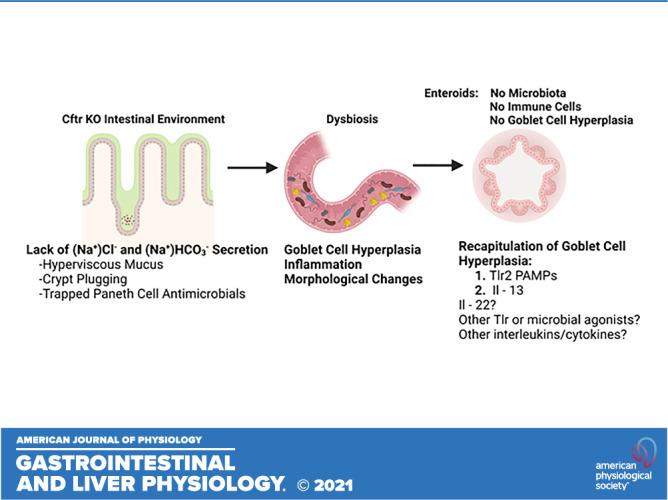
Goblet cell hyperplasia is an important manifestation of cystic fibrosis (CF) disease in epithelial-lined organs. Explants of CF airway epithelium show normalization of goblet cell numbers; therefore, we hypothesized that small intestinal enteroids from Cftr knockout (KO) mice would not exhibit goblet cell hyperplasia. Toll-like receptors 2 and 4 (Tlr2 and Tlr4) were investigated as markers of inflammation and influence on goblet cell differentiation. Ex vivo studies found goblet cell hyperplasia in Cftr KO jejunum compared with wild-type (WT) mice. IL-13, SAM pointed domain-containing ETS transcription factor (Spdef), Tlr2, and Tlr4 protein expression were increased in Cftr KO intestine relative to WT. In contrast, WT and Cftr KO enteroids did not exhibit differences in basal or IL-13-stimulated goblet cell numbers, or differences in expression of Tlr2, Tlr4, and Spdef. Ileal goblet cell numbers in Cftr KO/Tlr4 KO and Cftr KO/Tlr2 KO mice were not different from Cftr KO mice, but enumeration was confounded by altered mucosal morphology. Treatment with Tlr4 agonist LPS did not affect goblet cell numbers in WT or Cftr KO enteroids, whereas the Tlr2 agonist Pam3Csk4 stimulated goblet cell hyperplasia in both genotypes. Pam3Csk4 stimulation of goblet cell numbers was associated with suppression of Notch1 and Neurog3 expression and upregulated determinants of goblet cell differentiation. We conclude that goblet cell hyperplasia and inflammation of the Cftr KO small intestine are not exhibited by enteroids, indicating that this manifestation of CF intestinal disease is not epithelial-automatous but secondary to the altered CF intestinal environment. Studies of small intestinal organoids from cystic fibrosis (CF) mice show that goblet cell hyperplasia and increased Toll-like receptor 2/4 expression are not primary manifestations of the CF intestine. Intestinal goblet cell hyperplasia in the CF mice was not strongly altered by genetic ablation of Tlr2 and Tlr 4, but could be induced in both wild-type and CF intestinal organoids by a Tlr2-dependent suppression of Notch signaling.
杯状细胞增生是囊性纤维化(CF)上皮衬里器官疾病的重要表现。CF 气道上皮的外植体显示杯状细胞数量正常化;因此,我们假设 Cftr 敲除(KO)小鼠的小肠肠类器官不会表现出杯状细胞增生。我们研究了 Toll 样受体 2 和 4(TLR2 和 TLR4)作为炎症标志物及其对杯状细胞分化的影响。离体研究发现,与野生型(WT)相比,Cftr KO 空肠中的杯状细胞增生。与 WT 相比,Cftr KO 肠中的白细胞介素 13(IL-13)、含有 SAM 结构域的 ETS 转录因子(Spdef)、TLR2 和 TLR4 蛋白表达增加。相比之下,WT 和 Cftr KO 肠类器官在基础或 IL-13 刺激的杯状细胞数量上没有差异,TLR2、TLR4 和 Spdef 的表达也没有差异。Cftr KO/Tlr4 KO 和 Cftr KO/Tlr2 KO 小鼠的回肠杯状细胞数量与 Cftr KO 小鼠没有不同,但由于粘膜形态改变,计数受到干扰。TLR4 激动剂 LPS 处理对 WT 或 Cftr KO 肠类器官的杯状细胞数量没有影响,而 TLR2 激动剂 Pam3Csk4 刺激两种基因型的杯状细胞增生。Pam3Csk4 刺激杯状细胞数量与 Notch1 和 Neurog3 表达的抑制以及杯状细胞分化决定因素的上调有关。我们得出结论,肠类器官没有表现出 Cftr KO 小肠的杯状细胞增生和炎症,这表明 CF 肠病的这种表现不是上皮自主的,而是继发于改变的 CF 肠环境。来自囊性纤维化(CF)小鼠的小肠类器官研究表明,杯状细胞增生和 Toll 样受体 2/4 表达增加不是 CF 肠的主要表现。CF 小鼠的肠道杯状细胞增生并没有因 TLR2 和 TLR4 的基因缺失而强烈改变,但在 WT 和 CF 肠类器官中,TLR2 依赖性 Notch 信号抑制均可诱导杯状细胞增生。
 Zotero 插件